The DA plays an important part in the salary structure and benefits of an employee, as it helps mitigate or decrease the harsh impact of rising inflation and cost-of-living expenses faced by a person.
Additionally, compensating an individual and balancing the cost of living with current economic conditions improves a person’s financial well-being and mental health.
With this guide, we will learn the meaning of DA, how it differs from base or normal pay, and how to calculate it using the current dearness allowance rate, providing a clear idea of the benefits it delivers to employees who manage their finances on their own.
What is the Meaning of Dearness Allowance (DA)?
The term “Dearness” in Dearness Allowances refers to the rising cost of living and increased inflation, which basically means paying high expenses for essential and basic services like hospitals, electricity, water and more.
Dearness Allowance acts as an additional compensation insurance for employees and retired pensioners so as to counterbalance the rising costs of living by adjusting pay based on the Consumer Price Index (CPI).
As DA is based on the cost of living, the benefits provided may vary depending on various factors such as :
- Consumer Price Index (CPI) – This is a crucial economic indicator that measures the average change over time in prices paid by consumers for essential services or goods.
- Inflation Rate – It is directly proportional to higher DA percentages, so as to offset the high inflation rate, there becomes an increased need to swell the DA percentage just to maintain a balance.
- Basic Salary – DA is calculated as a percentage of an employee or retired personnel’s base salary, which simply means that higher pay leads to a higher absolute amount of Dearness allowance.
- Location – An individual’s location of residence type affects DA as rates differ by urban and rural regions.
Importance of Dearness Allowance
Dearness allowance plays an important role, as it is crucial as a salary component for pensioners, government employees and public sector workers.
It acts as a protective covering, shielding people in need from high and inflated costs and expensive living conditions and gives them more financial stability.
Eligibility and Rules of Dearness Allowance
To qualify for the benefits of a dearness allowance, a person must come under the eligibility criteria set by the government, as mentioned below:
- Employment Status – Active, Permanent or Temporary Staff are eligible.
- Employment Type – Full Time Govt. employee (Central or State), PSU Employee and Pensioners.
- Excluded Employees – Employees who have a fixed pay scale according to their employment contract are excluded and not eligible for DA.
There are also several rules set by the government to compensate government employees with the use of dearness allowance. The following are:
- Revision – The government changes the rates of DA twice a year, depending on changes in the consumer price index.
- Taxes – The DA is to be declared as a part of the total salary and is fully taxable by law.
- Legal Viewpoint – The Supreme Court of India has asserted that DA is a legal right and not a benefit that is voluntary.
What Are the Types of Dearness Allowance?
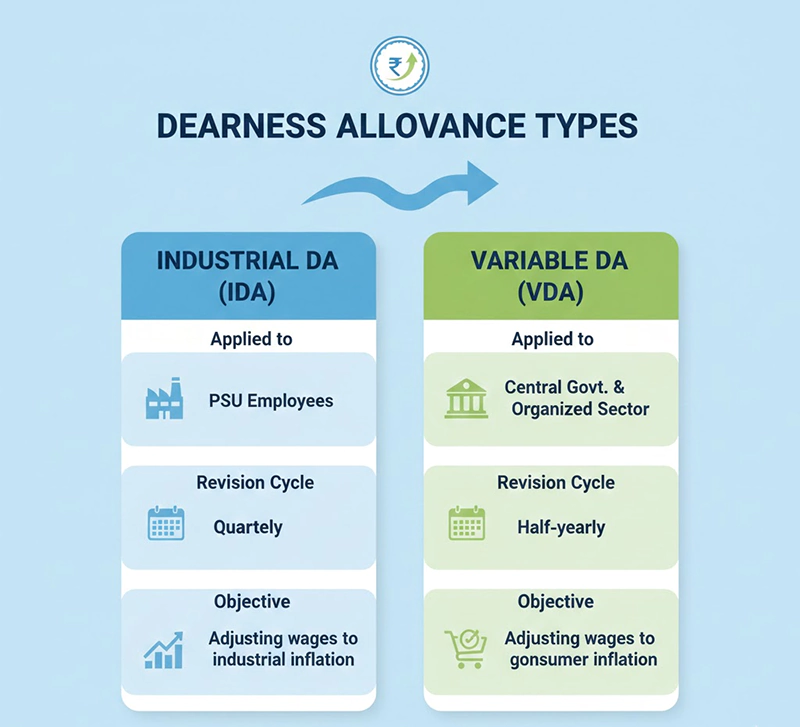
The Dearness Allowance (DA) is classified into two major types :
- Variable Dearness Allowance (VDA) – It is basically an allowance offered to employees of the central government. As the name suggests, its value doesn’t stay fixed permanently and is scheduled to change every 6 months due to the presence of factors like CPI, Base Index and Variable base amount.
- Industrial Dearness Allowance (IDA) – It is meant for and offered only to employees working in the public sector of the country. It gets modified or adjusted quarterly based on CPI as to combat changes in inflation.
What is the Role of the Pay Commission Regarding DA?

The Pay Commission plays an important and vital role in DA-related roles. They are responsible for restructuring and updating the Dearness Allowance to help employees and pensioners deal with rising inflation and increased prices of essential goods.
The economic conditions are evaluated, and new methodologies to calculate DA are considered depending upon the Consumer Price Index (CPI), and the DA is then finally merged with the base pay.
The 7th Pay Commission
The central government of India established the 7th Pay Commission on 8th Feb, 2014 and later implemented it in 2016. The established commissions are presented with the responsibilities of preserving the living standards of public sector employees, which are reviewed after a set number of years.
They also introduced better and more responsive methods to calculate DA and made sure DA adjustments are directly in correlation with the ever-changing economic landscape of the country.
Current Rate of Dearness Allowance
According to the Department of Pension & Pensioners’ Welfare, the Dearness allowance rates stand at 58 percent of basic pay, as of 1st July, 2025. In January 2025, the DA rate was increased to 4% in response to the rising inflation.
As the rates are due to change twice every year, they were revised again in July 2025, that’s when a 3% increase was observed and decided by the commission, which brought the total allowance rate to 58 percent of base salary, in response to keep up with the inflated costs.
This percentage was determined using a 2.57 fitment factor and is scheduled to be updated and changed twice a year.
The government of India is also considering opting out of the quarterly analysis and revisions of inflation data, instead switching to a more frequent inflation data, so that employees can get timely adjustments.
How to Calculate Dearness Allowance?
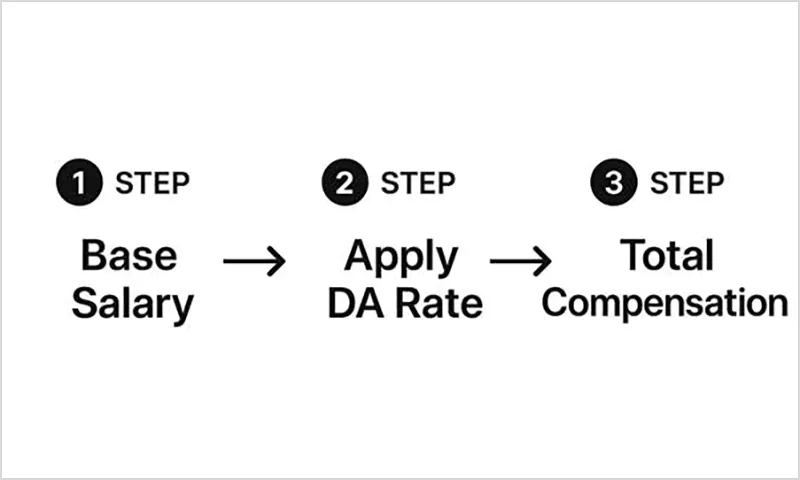
The Dearness allowance (DA) is calculated as a percentage of an employee’s base salary against inflation; the formulas adjust with cost-of-living changes and the changes in CPI.
The formulas to calculate DA are :
For Central Govt. Employees –
FORMULA
DA = (Base Salary × DA Rate) ÷ 100
Example: As an example, an employee’s salary is 20,000 Rs, and with the current DA rate, which is 58%, then our DA amount would be,
DA = (20,000 Rs × 58) ÷ 100 = 11,600 Rs
So, the employee will receive 11,600 rupees with the current DA rate on top of their base salary.
For Public Sector Employees –
FORMULA
DA = (Base Salary × DA Rate) ÷ 100
Example: As an example, a public sector employee’s salary is 30,000 Rs, and with their current DA rate, which is 55%, then our DA amount would be,
DA = (30,000 Rs × 55) ÷ 100 = 16,500 Rs
So, the public sector employee receives 16,500 rupees; the only difference remaining is that their DA rate is revised every 3 months, but the calculation method remains the same.
DA vs HRA vs Basic Pay: A Quick Comparison
Both DA and Basic Pay are very different and possess different characteristics, some of which are :
| Attributes | Dearness Allowance (DA) | HRA | Basic Pay |
| Purpose | Variable allowance used to deal with inflation | Designed to help employees with household expenses | Fixed, guaranteed amount for an employee |
| Percentages | Calculated as a percentage of base salary, updated twice a year in response to CPI changes | It is not determined as a part of a percentage of base salary | Fixed pay scale, changes made only during salary revisions |
| Applicability | Mainly provided to pensioners, the public sector and the government. employees | Available to both public and private sector employees | Applicable for all employees |
| Calculation | Added the base salary to the amount as the total salary | It is a component of an employee’s salary | It is the base for calculating PF and Gratuity |
Is Dearness Allowance Taxable?
Dearness Allowance (DA) is fully taxable as per the Income Tax department, as it is calculated as a percentage of base salary.
It is added on top of base salary (according to their salary slip) and considered in the total salary amount of pensioners, govt. and public sector employees who are eligible for it.
It is treated as income from salary during tax calculations, without any exemptions.
Conclusion
Dearness Allowance (DA) plays a pivotal role in providing eligible government employees with additional funds on top of their basic salary in response to rising cost of living. This helps employees and pensioners get through tough times of increased inflation. With this comprehensive guide, you should now have a good idea about what DA is, the role it plays and how it is different from base pay, among other things, which will help you plan your finances more efficiently.
FAQs
1. Is DA exempt from taxes?
Ans: No, Dearness Allowance (DA) isn’t exempted from taxes as per the Income Tax Department, as it is considered a part of gross or total salary.
2. What is the current rate of Dearance Allowance (DA)?
Ans: The current rate for DA is set at 58% of basic salary, as of 1st July, 2025, as per the 7th Pay Commission.
3. How many types of Dearance Allowance (DA) are there?
Ans: There are two major types of DA, namely, Variable Dearness Allowance (VDA) and Industrial Dearness Allowance (IDA). Both types contain different characteristics and their own rules.
4. What is CPI?
Ans: Consumer Price Index, also known as CPI, is a key economic indicator that measures the average change over time in prices paid by consumers for essential services or goods.
5. What is the meaning of “Dearness” in DA?
Ans: The term “Dearness” in DA refers to the rising cost of living and increased inflation, which means paying high expenses for essential and basic services like hospitals, electricity, water and more.