Understanding the PTO meaning and how it gets accrued is pretty simple, as PTO means paid time off, which is a benefit offered to employees that grants them a specific number of days as paid leave.
Furthermore, the employees can use these paid time off days as personal leave, vacation time, or sick leave to recover from illness. However, the allowance days depend on your employment contract, along with state and federal laws.
While paid time off might seem a confusing topic, we have prepared a comprehensive article that will assist you in understanding the essential aspects and benefits of PTO.
What Does PTO Mean?
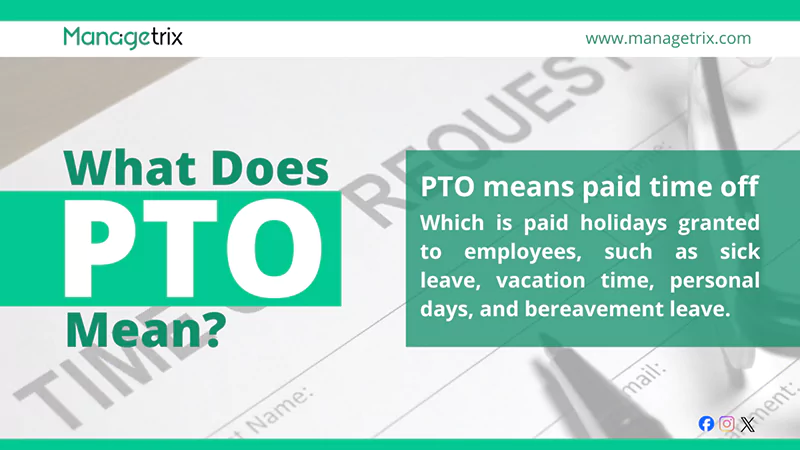
PTO means paid time off, which is a benefit provided by employers that grants employees leave or time off for a specific period, along with paying them regular remuneration for those days. However, the PTO meaning is entirely different from Voluntary Time Off (VTO), as these are paid leaves granted annually to employees.
In simple words, PTO is paid time off, which is paid holidays granted to employees, such as sick leave, vacation time, personal days, and bereavement leave. However, keep in mind that the number of paid-off time days varies based on the employer and the nature of employment.
The Benefits of Understanding PTO Meaning
Since you understood the PTO meaning, have a look at the certain benefits that paid time off brings to employers and employees.
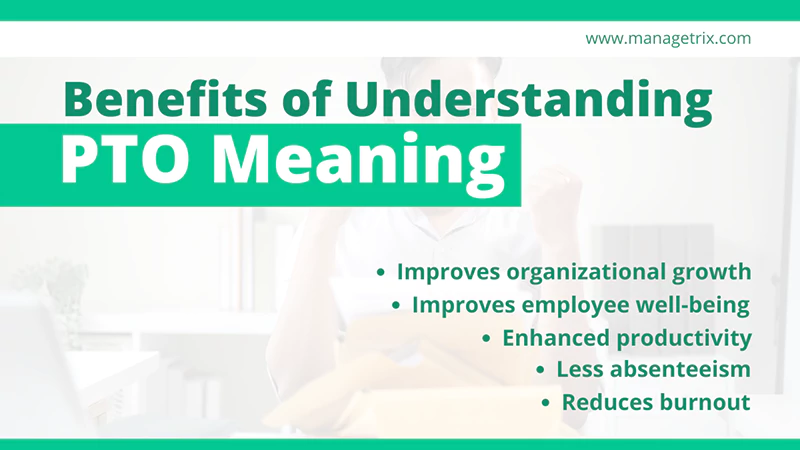
- Improves employee well-being & work-life balance: PTO time significantly improves the well-being of employees, as it provides them with rest and vacation time to boost mental and physical health, along with improving the morale of employees.
- Reduces occupational burnout: Since employees can feel exhausted due to their organizational duties, granting time off ensures they don’t feel the occupational pressure and burnout, along with preventing negative outcomes.
- Enhanced productivity: Understanding what does pto stand for and effectively implementing it can bring better mental and physical health to employees. Subsequently, they can perform their duties with better efficiency, which results in enhanced productivity with less stress.
- Improves organizational growth: As employees understand PTO meaning and feel refreshed due to vacation time, they will effectively contribute towards the organizational goals and assist in achieving long-term business growth.
- Less absenteeism & better retention of employees: By granting sick leaves, personal leaves, and parental leaves, workers won’t find a good reason to leave the job, which ultimately boosts employee retention and lowers daily absenteeism.
What are the Different Types of Paid Time Off (PTO)?
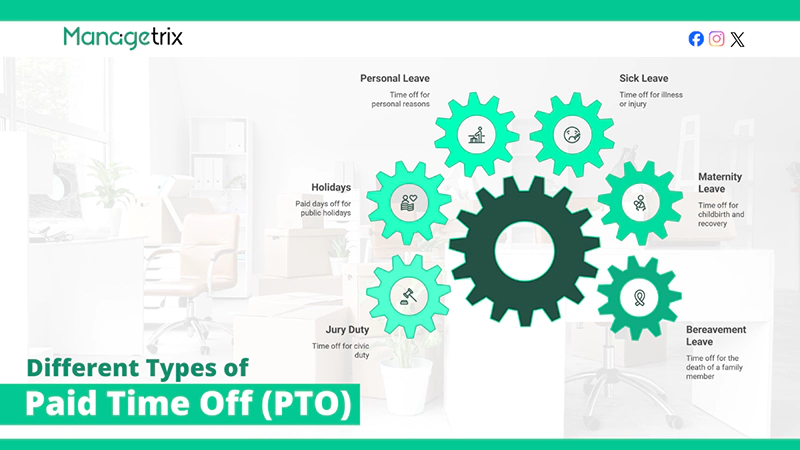
While you have learned what is PTO and its significant benefits are, check out its different types, as it is mainly categorized into sick leave, personal days, government-declared holidays, and bereavement leave.
- Bereavement Leave
A bereavement leave is provided to employees who are grieving the loss of an immediate family member or someone close.
With this paid time off, employees can attend or perform funeral arrangements, as it supports them to mourn the loss of their loved one. Furthermore, parents and spouses, along with children, siblings, grandparents, and grandchildren, are only considered as immediate family members.
- Maternity Leave
Maternity or parental leave is allowed for those employees who are becoming parents through birth, or even if they are adopting a child, or for foster care.
Subsequently, there is no designated number of maternity leaves in the US, as compared to a maximum of 52 weeks of allowed maternity leave in the UK. However, employees can still take up to 12 weeks of job-protected, unpaid leave.
- Sick Leave
Sick leave or medical leave can be taken by employees during the time of illness, injury, or an accident that hinders their ability to perform their work responsibilities.
In addition, employees become eligible to be granted sick leave if they have worked for over 1250 hours in the previous year and provide a medical recommendation for leave according to federal law (FMLA).
- Personal Leave
Since employees need rest and wish to spend some time on vacation with their close ones, they are granted personal leave for a fixed number of days that can be utilized for any personal reasons.
However, personal leave or vacation time is different from Voluntary Time Off (VTO), as employees get paid while utilizing these leaves. Besides this, the number of allocated leaves varies based on employer and employee agreements.
- Government-declared Holidays
The public holidays are government-mandated PTO time granted to employees, which are federal, state, and local judiciary holidays predetermined by the government as paid time off for all working professionals.
Subsequently, these PTOS leave includes New Year’s Day, Christmas, Labor Day, and Memorial Day in the USA, and they vary based on national and regional holidays in different states and countries.
- Jury Duty Leave
If a certain employee is required to fulfill their civic duty by serving on a jury, they will be granted paid time off.
Furthermore, states and regional policies often mandate employees to serve on a jury and fulfill their civic responsibilities, and this varies depending on federal and state laws and jurisdictions.
What are the Best PTO Paid Time Off Policies?
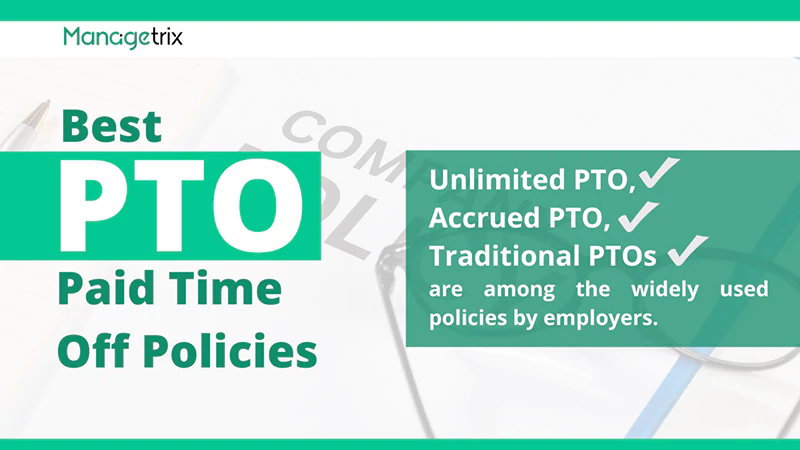
The number of days granted as paid leave depends on the PTO policies that are followed by your employer. However, unlimited PTO, accrued PTO, and traditional PTOs are among the widely used policies by employers. Check about them in detail below:
- Unlimited Paid Time Off: As the name suggests, unlimited PTO grants employees the freedom to take as many leaves as they require.
While it’s different from accrued PTO, employees still need to coordinate with management and obtain approval to ensure operational efficiency.
- Accrued Paid Time Off: This is the most common category of PTO which is followed by most of the firms and is mentioned in their employment contracts.
Accrued PTO works by allowing employees the time off based on their hours of service, which is granted gradually over the period of service.
- Flexible Paid Time Off: Flexible PTO time works as a combination of accrued and unlimited PTO, as employees earn their paid leave gradually over their period of service.
However, employees are allowed to take further time off if they require it due to personal reasons, maternity, or any other specific requirements.
- Traditional Paid Time Off: The traditional PTO time is among the most effective policies, as it separates the allowed leaves of workers into vacation time, sick leave, and personal days.
While it still requires the approval from your manager to claim the allowed PTOs in traditional time off policies, employers often grant leaves based on employees’ needs.
Also Read: 10 Certificate of Employment Samples for Official Purposes
Essential Elements of PTO Paid Time Off
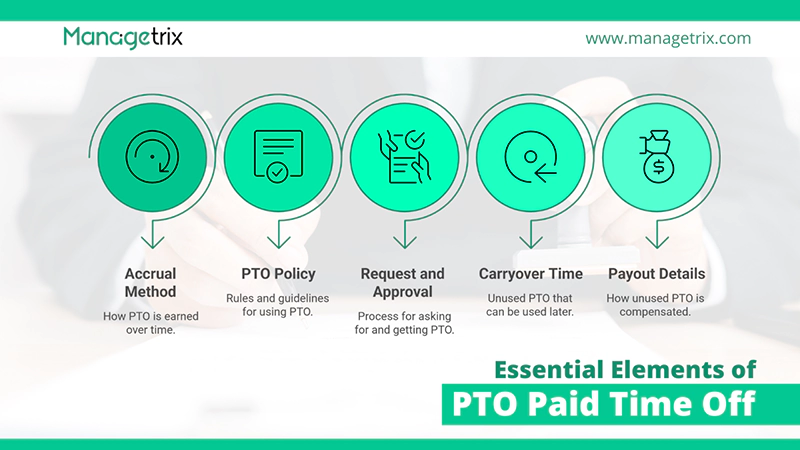
While organizations must follow a specific PTO policy and grant paid leave to their employees, it’s crucial to understand the essential elements of an effective PTO policy that your joining letter must contain. Learn about them in detail below:
- The method of accrual for allowances: This specifies PTO meaning and mentions details regarding how the time off days will be accrued to the employees. Subsequently, it specifies whether they earn leave monthly or annually, which will assist them in writing a leave letter appropriately.
- PTO policy for usage of allowances: Understand what does pto mean and check the details of the restrictions and allowances of PTO time for an employee during a specific period of time. Furthermore, it covers the essential points for the number of leaves that will be granted to an employee at once.
- The process to apply for a paid time off request and approval: The organization must have a clear and well-defined PTO policy that states the steps of requesting leave and its approval process, along with the notice period required.
- Details regarding carryover PTO time: An effective PTO policy must contain the details of unused PTO time that can be carried over to the next year, or whether it expires at the end of the year, and explain what is pto to its employees.
- Payout details of unused time off days: Another crucial aspect of an effective PTO policy is to check whether the unused time off days will be paid out to the concerned employee at the LWD if they don’t utilize them.
What are the Best Practices for Paid Time Off (PTO)?
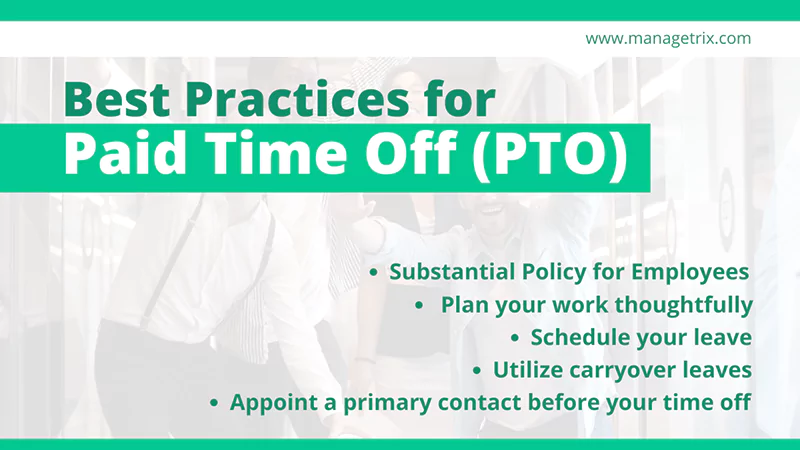
As you learned about what does PTO mean, along with its types and benefits, have a look at the best practices and plans that you must follow for paid time off.
- Schedule your leave: The most crucial aspect in planning your paid time off is scheduling it and planning so you can have ample time for designating and completing essential tasks, which ensures the successful completion of projects and requirements.
- Manage and plan your work thoughtfully: Ensure that you understand what does pto mean and plan your vacation time or personal leaves thoughtfully. Subsequently, it will assist you in managing your current projects, along with planning your meetings appropriately to avoid any negative impacts of your leave.
- Utilize carryover leaves: Since any unutilized leaves of your PTO paid time off from the previous year get carried forward in the next year in most employment bonds, make sure that you plan your time off appropriately.
- Substantial Policy for Employees: Ensure that your employer has clearly defined PTO meaning and its types, such as bereavement leave and personal leave, so you can communicate efficiently and plan your leave based on requirements.
- Appoint a primary contact before your time off: Identify and assign a primary contact before you get off for your PTO who can complete your pending tasks, along with replying to necessary emails, or can communicate with the clients for efficient workflow.
Also Read: What Does Semi Monthly Pay Mean? and How Does It Work?
The Myths and Facts of PTO Meaning

While most employees and certain employers often remain confused about the PTO meaning and its allowance, you can refer to the table below for common myths and facts to learn better about paid time off.
| Myths | Facts |
| PTO is granted only for vacations. | PTO means paid time off, and it is granted for specific days in a year and can be utilized for illness, bereavement, maternity, or personal reasons. |
| Employees can take as much paid time off as they want for unlimited PTO for business days in a year. | While unlimited PTO is different from traditional PTO, which grants a specific number of days, it still requires approval from management and can only be granted based on the operational requirements of the firm. |
| The unused PTO time will be lost at the end of the year. | The time off days that you have not utilized in the year often get carried forward to the next year in most employment bonds. Ensure that you check your appointment letter for detailed information on the firm’s policies. |
| Applying for PTO paid time off will give the impression that you are less committed to the work. | Employees are required to take vacation time and PTO days to increase productivity and reduce burnout and occupational stress. |
The Final Verdict
The PTO meaning is paid time off, which is the number of days allowed as paid leave to employees. However, the allowed leave varies depending on the federal laws, the nature of employment, and your days of service to the firm.
Besides this, it is advisable to utilize efficient and trusted HR software such as Managetrix for effective leave management, along with automating requests and tracking for enhanced transparency.
FAQs
1. What does PTO stand for in HR?
Ans: PTO stands for paid time off, which is designated time or a certain number of days granted as paid leave to employees, which they can utilize for personal reasons or for vacations.
2. How does HR software manage PTO leave management?
Ans: Efficient HR software such as Managetrix streamlines leave management by automating PTO tracking, along with managing approvals and the number of time off days taken by employees.
3. How does PTO work?
Ans: PTO is paid time off, which works by granting a specific number of days in a year to allow employees to take time off or leave for personal reasons, illness, bereavement, or vacations.
4. Can a personal paid time off be denied by the employer?
Ans: Since denying the personal leave is against federal law, the employer won’t deny your request for paid time off. However, if you have already utilized your paid time off or someone from your team has already requested PTO for the same day, the employer might deny your request.
5. How do I request PTO?
Ans: Plan your paid time off and effectively communicate with your reporting manager for PTO, along with ensuring necessary arrangements for the completion of your current tasks and providing an update for your return.