When you resign, you have to work for the next week or month under the employer. Do you know why?
It is because of the provisions of the notice period. But what is a notice period?
A notice period is the time between the approval of your resignation and your last working day.
So, here we will discuss how long it extends, what purpose it serves, and what is the role of HR in managing it.
What is a Notice Period?

The notice period is the duration between the acceptance of the resignation by the employer and the employee’s last working day. This time has been set to facilitate a gradual transition of the outgoing employee and the new joinee.
This interim period is governed either by the company’s policy documents or by the prevailing local laws. For example, in the US, the WARN Act regulates the notice period provisions. The act mandates a precise 60-day notice period before closure and mass layoffs.
The local governments have devised certain types of it to match the requirements of different sections of employees.
Suggested Read: 10 Employment Reasons for Leaving: Answer this Common Interview Question Effectively
7 Types of Notice Period
National labor and corporate laws of a nation provide for different types of notice periods to simplify the resignation and layoff procedures. In general, these types have been structured for employees at different designations in hierarchy and their type of employment.
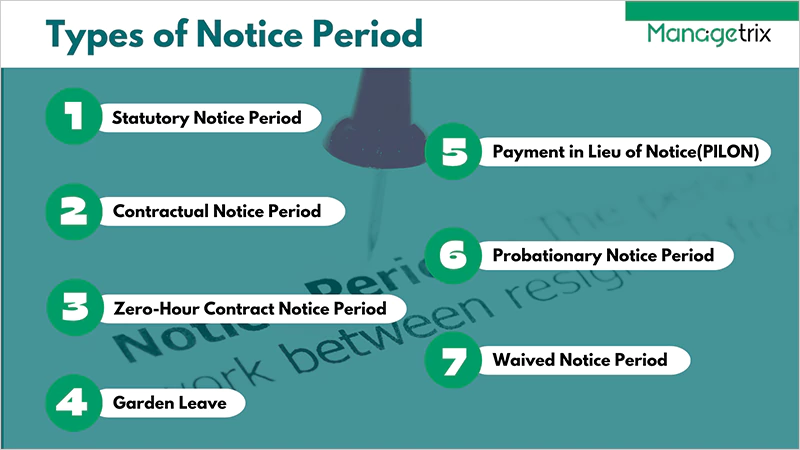
- Statutory Notice Period: It is the period for which the employee is obliged to serve after resignation as mandated by the prevailing laws. The term may vary as per the law of the land.
- Contractual Notice Period: The notice period is determined by the employer and the employee, as specified in the employment contract signed by both parties.
- Zero-Hour Contract Notice Period: In this type, the employee is not required to serve a notice period.
- Garden Leave: It is the period after resignation when the employee is permitted to remain away from the workplace, while continuing to receive full pay and benefits.
- Payment in Lieu of Notice(PILON): In this system, the employee is not obliged to work during the notice period, but still gets paid by the employer.
- Waived Notice Period: It is an exceptional type in which the notice period is waived after mutual consent of the employer and the employees.
- Probationary Notice Period: This type is generally opted for probationers who have to serve a shorter notice period than other employees.
Not all these types are applicable everywhere. But the majority of them have been implemented in most of the nations.
Notice Period Buyout: In this atypical arrangement, the employee leaves the firm without completing the full notice period. Instead, the employee pays the employer a sum to bypass the notice period.
How Long is a Job Notice Period?
The length of the notice period varies from state to state. It generally depends on the prevailing local laws and regulations. For example, the UK legislation provides for a total 1-week notice period for employees with less than 2 years of service and an additional 1-week notice period for each successive year of employment, until the employee achieves 12 years of service.
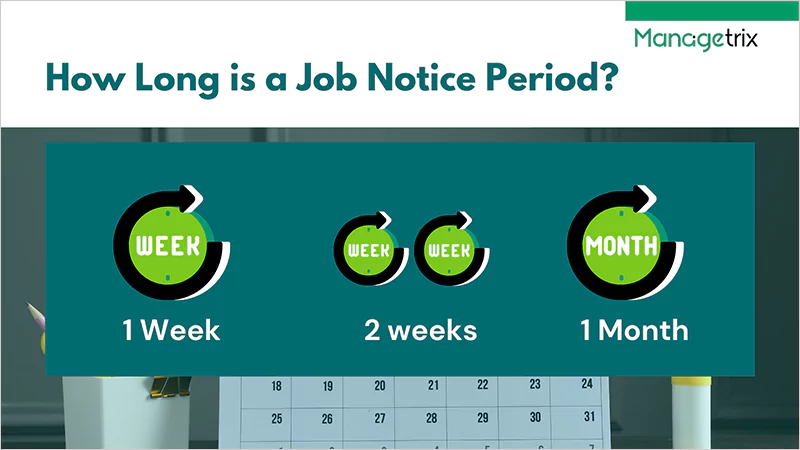
- 1 Week: This notice period is applicable for probationers and part-time employees. Being a short-term worker, they require less time to wrap up and shift to a new job.
- 2 weeks: People at the mid-level positions in a firm are typically required to serve a 2-week notice period.
- 1 Month: A one-month notice period is for employees serving at a senior level or working on a specialized designation. This long period is to enable the employer to shift the responsibilities to the potential employee and the employee to have a comfortable job transition.
However, the regulations for such duration changes with time, following the legal procedures.
For example, in May this year, a bill to include firms with 50 employees under the 60-day notice period provision was put forward to the governor of Seattle, US.
Similarly, Finland’s Ministry of Social Affairs has set up a working group to propose suggestions to amend the fixed-term employment laws. The group has recommended reducing the layoff notice period to 7 days.
As the corporate sector has changed, many firms have also allowed work from home (WFH) for employees on notice period.
Also Read: How to Become an HR Manager in a Company? (2025)
Why is a Notice Period Important?

The notice period is important for the employers, employees, and the firm as a whole, especially when the employee holds a significant position. When an employee leaves the firm, he/she take time to wind up their work, which takes time. The longer the term of the employee, the longer it takes to wrap up.
Here is why the notice period matters for all the mentioned stakeholders.
For Employers
- Start Fresh Recruitment: After accepting the resignation, the employer can begin the recruitment process for hiring a new potential employee.
- Reduce Occupational Disruption: If the outgoing employee is in a position of responsibility, then the employer utilizes this time to manage or shuffle the workforce to optimize the productivity of the firm.
- Complete Paperwork: The relieving workers require some documents from the firm to produce for the next firm they join. The notice period provides sufficient to the employer to prepare and hand over the documents.
For Employees
- Upskill the Successors: The notice period allows employees to select and inculcate the required skills and knowledge in the potential co-worker.
- Complete Unfinished Task: This period is productively used to finish the pending tasks and projects. It also strengthens professionalism and acts as a best practice for the other workforce.
- Clear Pending Dues: The unpaid dues, such as canteen dues, activity club fees, charity deposits, etc, are to be settled at this time. This can be ascertained through a no-due certificate issued by the firm.
- Return the Company’s Properties: If the company has provided you with a laptop and a personal ID card, you have to return them at the end of the notice period.
Collective Importance
- Helps Maintain Corporate Relations: As the employer has to find the required talent to replace the outgoing employee meanwhile the employee finishes the outstanding task, this helps in a smooth transition of employees and facilitates maintaining good corporate relations.
- Follow Legal Provisions: The local corporate and labour authorities, such as the US Department of Labour, regulate the provisions related to corporate functions. Following the notice period keeps the firm and the employee legally upright.
HR’s Role During Employee’s Notice Period
The HR executives and managers catalyze the onboarding and offboarding process by facilitating documentation formalities and managing the payroll process. Though some of the best HR management tools have automated most of the joining and relieving procedures, still, smart human intervention is highly required for concluding such official procedures. These responsibilities include:
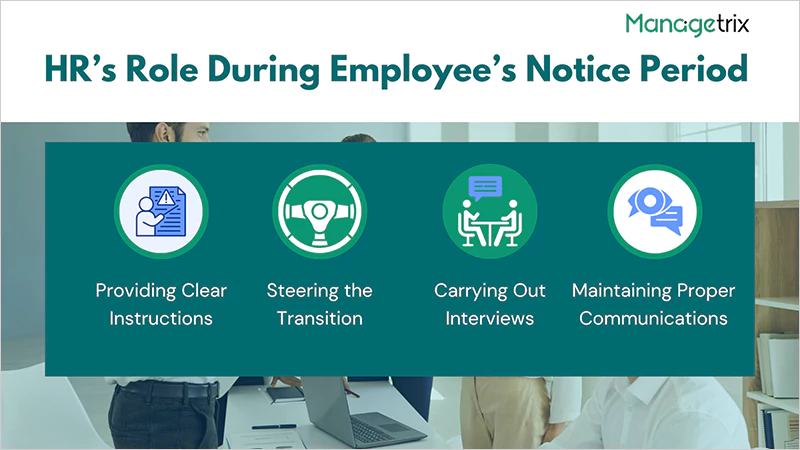
- Providing Clear Instructions: The HR has to put forward and explain the provisions and regulations related to the notice period to all the employees.
- Steering the Transition: The formalities related to documentation, clearing the dues, and ensuring adherence to the contractual mandates remain the responsibility of the HR.
- Carrying Out Interviews: To fill the vacancy that occurred because of the outgoing worker, the HR has to schedule and conduct the interview of the new joinee to hire an equally talented candidate.
- Maintaining Proper Communications: The HR department bears the sole responsibility of keeping clear communication with the outgoing employee and the new joinee.
In a nutshell, the HR team is responsible for preparing and providing important documents like a relieving letter to the offboarding employee and hiring new candidates to balance the overall workforce.
Conclusion
A notice period ensures a hassle-free transition during resignation, dismissal, and layoff situations by allowing time for knowledge transfer, proper handover, recruitment, and compliance with legal requirements. It benefits both employers and employees, minimizes disruption, upholds professionalism, and helps maintain healthy workplace relationships and operational continuity.
Next Read: HR Full Form, Roles, Responsibilities, and Challenges Explicitly Explained
FAQs
1. Is notice period paid?
Ans: Yes, notice period is paid. Your income will remain the same as before during the notice period.
2. Can I take leave on notice period?
Ans: Yes, you can take leave in the notice period. However, you need to review the employer’s handbook and policies to gain a clear understanding of your firm.
3. Does your notice start the day you hand it in?
Ans: No, your notice period starts the next day your resignation is accepted by your firm.
4. Can I resign without a notice period?
Ans: No, you can’t resign without a notice period. The labour laws framed for the formal workforce call for a mandatory notice period before leaving a job.
5. What is the best notice period for a job?
Ans: The best notice period for a job is 1 month’s notice period. It is considered the ideal time for ensuring a smooth transition of the employees.
6. What is the purpose of the notice period?
Ans: The purpose of the notice period is to provide a buffer period for the employer to hire a replacement and for the employee to have a smooth job transition.