Achieving a promotion appears to be one of the most impactful accomplishments to add to a resume- provided that it’s done in the right way. A promotion shows much more than a simple change in job titles; it informs the recruiter that your previous employer trusted you with more responsibility, that you did things well enough to get noticed, and that you didn’t change jobs to reach a higher level. Recruiters appreciate this kind of employment history because it promotes trust and confidence in the applicant’s potential for growth and reliability.
Promoting yourself is a great chance to utilize this fantastic experience on your resume and indicate that your career is flourishing.
Providing the information correctly will give you a chance to use your promotions to your advantage because it will allow employers to see how your position has evolved over the years. Instead of writing the experience section which might appear confusing or repetitive, you should indicate the company and specify each job held there and the duration of service.
How to Show a Promotion on a Resume
There are two standard formats for mentioning a promotion, and the choice of format depends on the variations in two roles held.
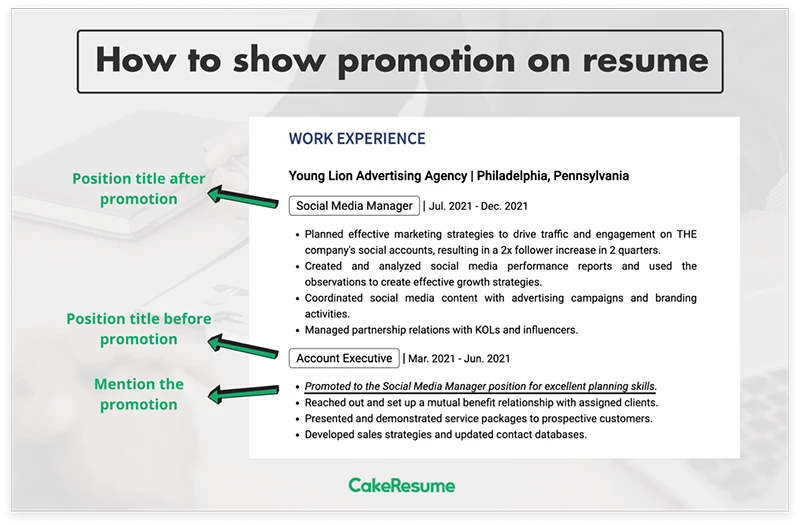
1. Stacked jobs under a single employer
One method of presentation is to mention the employer’s name only once, with each job under it mentioned in reverse chronological order. All dates and job descriptions must be included.
- Company Name – City, State
- Position Title – Date
In this case, employees may choose whether to have the points dedicated to each position mentioned separately at the end of each title or as a single combined list.
2. Separate listings of the positions
Another way of indicating the promotion is to describe each job separately even if it is the same company. This method is more appropriate if the job responsibilities significantly differ from one position to another.
Each job is viewed as separate, with the company name, periods, and bullet items stated under each one, no matter if the employer is identical:
- Employer Company Name, along with City & State
Senior Marketing Professional ( from March 2023 to present)
- Employer Company name, city, state
Sales Manager (January 2021 to March 2023)
This format of resume works when working in diverse departments, have enough remarkable achievements, and have been in the same position for a prolonged period.
Example of a Stacked Promotion
An example of a format being used sequentially. Here is how to show promotion on a resume
[Company Name]
Senior Marketing Manager (2024 – present)
Managed and supervised marketing campaigns.
Gained 30% more sales leads.
Manager of Marketing | 2022–2024
Responsible for digital campaigns and overseeing performance reporting.
Achieved +20% increase in conversion rates.
The source of the entry format is that the company name appears just one time, but in a way that properly indicates career growth.
Example of Separate Positions
Company Name— Senior Marketing Manager | 2024–Present
Oversaw strategic marketing initiatives and supervised a cross-functional team.
Company Name — Product Marketing Specialist | 2022–2024
Flush with product campaigns and supporting sales enablement.
Separate entries or positions work best when the jobs are significantly different, involve different departments, or feature a major increase in responsibilities.
The provided format suits best for this position, as these two positions both belong to the same department (account management), the promotion was made in a reasonable time, and the responsibilities increased without being changed into a completely different field.
How to List Promotions on a Resume
When detailing your promotions, ensure that your progression is understandable to recruiters. Consider the following points to create a resume showing promotions
- Mention the most recent job: Write down the job title you hold at the present moment.
- Add the original position: Format your previous position as subordinate to the job title being promoted.
- Use the employment dates: You should specify the duration for each job title.
- Make the promotion title stand out: Have a clear format for titles in order to emphasize the promoted position.
- Focus on achievements: Make sure to note your accomplishments rather than your daily tasks.
What to Include
There should be the following points in each promotion section:
- Job title — make sure that the official title is used
- The period of being in the position — state precise employment commencement and end dates
- Company name — mention it once if there are stacked positions and repeat it otherwise
- Main duties — mention the most important duties, especially if you have previously performed those tasks differently
- Achievements — give quantified information about your performance.
- Tangible results — such as numbers, percentages, dollar values, or team numbers that illustrate how their work is valuable.
- Expanded scope of responsibilities — some indicators giving information about the meaning of growth: budget, size of teams, number of clients, territorial jurisdiction, and power of decision-making.
So, all this information enables the recruiter to understand how the job he performed was altered.
How to Put a Promotion on a Resume
If it is the case that one needs to highlight a promotion on a resume, he/she needs to ensure that progression is visible via one’s resume. Here is how to put a promotion on a resume
- Keep all the formatting uniform: One should apply the same style to job titles, dates, and bullet points in the experience section.
- Distinction between jobs: Each job title should be written separately to indicate that the person has been promoted.
Should You Mention “Promoted” on Your Resume?
Certainly, stating “Promoted to [New Title]” can prove to be beneficial when the aim is to show growth in one’s career or simply to illustrate that the promotion was granted based on a good performance. It is crucial in cases when the changes in the position title cannot be deduced from employment dates.
A good example of using this phrase in a bulleted list is the following:
Promoted to Senior Marketing Manager after surpassing revenue goals.
What should be avoided, however, is using “promoted” too many times in this case. One good usage is usually enough, with the job title changes and employment dates conveying the rest of the message.
Best Resume Format for Showing Promotions
Here are some proven ways to create a resume showing promotions
Stacked Positions
- Best option for individuals who have had several promotions in one company.
- Helps to keep the resume short and without repetitions of the organization’s name.
- Makes for easy understanding of career development.
Separate Positions
- Best option for positions with different responsibilities.
- Useful for each position requiring skills, achievements, and keywords of their own.
- Good for positions in departments or spheres that are not related.
Hybrid Model
- Presents the name of the employer one time while mentioning each job title separately.
- Combines the benefits of separate listings with the advantage of a compact format of stacked positions.
- Useful in cases with persons having several promotions over a long time with the same employer.
How to Show Multiple Promotions on a Resume
If you have been promoted many times in the same company, it is worth presenting your career path logically and chronologically: here is how to show promotions on a resume
- List the job positions: put them in reverse chronological order starting with the last one.
- List each promotion separately: indicate the title of the position and dates of employment for each job.
- Avoid listing the same accomplishments: write different bullet points for each position to highlight the achievements specific for that period.
- Highlight growing responsibilities: show how your experience, skills, and scope of work changed after each promotion.
Example of several promotions
Here are examples of how to put a promotion on a resume
Company Name:
Senior Manager | 2024–Present
- Managed a team of 15 and worked on important strategic initiatives.
- Enhanced the efficiency of the department by 25%.
- Manager | 2022–2024
- Oversaw important projects and supervised 8 people.
- Improved delivery of the project by 20%.
- Team Manager | 2020–2022
Oversaw ongoing organizational activities and trained fellow employees.
Increased the overall productivity within the team.
- Assistant | 2019–2020
Assisted in the daily activities of the company while performing duties within the team.
Was able to achieve efficiency and production goals.
How to Indicate a Promotion on a Resume
While formatting is an important part of a resume, there are still several signals that a recruiter can utilize to understand the fact of a promotion without explaining it outright. Here is how to list promotions on resume
Use the job titles to show the career trajectory.
In most cases, the job title explains the promotion even without deep explanations from the employee; if one used to be a coordinator before, grabbing a position as a manager is quite understandable — no additional stroke of genius is necessary.
Use the word “Promoted” only when it’s really relevant.
As already mentioned, this word can be used once to create the strongest impact — that is, to specify the circumstance of the promotion if it has taken place earlier than usual, above the usual level, or is related to any major achievement.
Use dates to show the timeline.
Using clear and isolated dates for every title, you will provide proof of the timeline. It will take a recruiter seconds to look at the dates like “Jan 2021 – Mar 2023” and “Mar 2023 – Present,” and in no time understand not just the fact that you were advanced but also that you spent a certain period in each position.
Use accomplishment bullets to show that the work has changed.
This is the place where the explanation for the advancement is hidden. The accomplishment statements must not focus only on the changing of the position. They should pinpoint the change in the work done.
The bullet statement “After the promotion to the Team Lead, was responsible for the work of three directly managed people” is a good example showing that the change in the role was grounded in the actual responsibilities taken.
How to Write Resume Bullet Points After a Promotion
When you’re promoted, it’s important that your resume bullet points reflect this change in duties and responsibilities. Whenever you can, separate your accomplishments according to the position held. You should also focus on the measurable results.
- Distinguish the accomplishments by the job: Don’t repeat your accomplishments while describing the new position.
- Emphasize the results: Describe what you’ve accomplished instead of focusing on what you’ve done.
- Quantify your results: Mention your achievements in numbers or percentages.
- Show that you’ve moved along the career path: Show that you are promoted and promoted again.
- Use powerful action verbs: Use such verbs as: lead, increased, managed, developed, improved, implemented, etc.
Before your Promotion
Before your promotion, focus on your individual efforts, tasks and duties.
- Managed customer accounts and client relationships.
- Created monthly performance reports and analyzed campaign results.
- Improved email campaign engagement by 18%.
After the Promotion
Once you are promoted, stress the importance of management, tactics, team leadership, influence, and extensive dealings.
Directed a team of 8 marketing professionals and managed campaigns within the company.
Crafted marketing tactics based on which the number of qualified leads was raised by 30% per cent.
Supervised an annual budget of $500,000 and the revenue from campaigns grew by 25% per cent.
How to Show a Promotion on a Resume When the Job Title Changed
When it comes to explicitly listing different job titles in the bullet points to make it clear for future employers that you have advanced in your career. Use the name of the job provided by the employer and ensure that the timeframe is correct and matches the time of holding that job. Follow the guidelines on how do you show a promotion on a resume
- You need to describe the process of changing the official title.
When the new title appears because of the promotion, this is not just part of the text that states the change. It needs to be stated in a separate bullet point in accordance with the rules of writing presented above. Even if it seems negligible, note down the new title.
- Always utilize the formal title instead of a non-conventional one.
When you are giving the title, provide it in the same form as you received it in your HR papers or offer letters — not the informal version that is used internally on the team. For example, if your team called you “Team Captain” but your official title was “Shift Supervisor,” you should describe yourself according to that official title. The recruiters and verification procedures will be scrutinizing the official title; any inconsistency can lead to questions about your past job.
- Use known equivalent terms for ease of understanding and searching
If your official title sounds unconventional and very company-specific (for example, “Growth Ninja” or “Solutions Sherpa”), mention it beside the more commonly used conventional equivalent of that title.
- Make sure that all dates associated with titles are accurate.
This applies especially when titles are unorthodox because it makes things complicated for the recruiter even more; if the date is inaccurate or there is a duplication, the timeline will become even more obscure. As with any other promotion, use start and end dates for each title.
How to Show a Promotion on a Resume for Different Situations
The way in which the promotion is indicated depends on the changes in your position, duties, and job type; use the format that makes everything easier for the recruiter to comprehend.
Here is how to show promotion on resume
Promotion in the Same Department
You should keep the titles under the same company and list all of the works with the dates and achievements that were accomplished. Using this method, you can keep the experience section short while still showing the growth gained in your career.
Promotion to a Manager Position
Emphasize the growth of your leadership and strategic functions compared to earlier positions.
- Do not forget to underline the size of the team you were in charge of.
- You should also give information about hiring, teaching, and mentoring.
- Provide information about finances and projects you managed as well.
Promotion Following a Short Duration
If you have been promoted in a shorter duration, show the accomplishments leading to this promotion without too much detail. A bullet such as “Promoted to Senior Analyst within a year due to surpassing performance targets by 20%” indicates a good success.
Multiple Promotions at the Same Company
List all the job titles in reverse date order, but keep that section clear. Focus on major achievements in each position without writing the repetitions of the same tasks in each position.
Promotion with a New Function
If the promotion involved a new position and function, mention both titles separately and name the change. Talk about the transferable skills and the fact that the new position increased the responsibility level, impacted the decision-making process, and affected the business.
Common Mistakes When Showing Promotions on a Resume
There are common errors you need to steer clear of when naming your promotions, which would enable understanding of your development in your career:
- Only naming your top position: Concealing past positions makes it complicated to interpret your career development. Describe the significant previous jobs that prove your progress.
- Using identical bullet points: Focus on the uniqueness of achievements within different positions rather than on copying the same points for each job.
- Specifying obscure dates: Make sure you provide accurate dates for every position to facilitate tracking of your career.
- Making the achievements difficult to find: Use straightforward formats in order to provide easy recognition of the advancement.
- Cluttering your CV with minor positions: Merge closely related job descriptions when changes in title do not imply a serious change in your responsibilities.
- Utilising exaggerated job titles: Follow the official titles to create the necessary names and resort to equivalents only if it provides better understanding.
Tips for Making Promotions Stand Out to Recruiters and ATS
Adhere to straightforward, uniform formatting and incorporate relevant keywords to ensure easy recognition of your positions by both recruiters and applicant tracking systems (ATS).
- Use conventional job titles: Utilize, where necessary, widely acceptable titles to facilitate recognition of your experiences by recruiters and ATS software.
- Include relevant words: Add skills and terminology that are in line with the industry you are targeting.
- Format numerous promotions correctly: Demonstrate this by listing every position and its period separately.
- Include impactful achievements: Implement numbers; these could be your earnings, increase in sales etc.
- Use uniform dates: Use similar dates and formats in each entry.
- Prioritize significantly relevant achievements: Ensure that you place the most effective achievements at the top of the position in the resume.
- Avoid elaborate formatting: Try to remain simple when making your resume as ATS like simple resume formats.
Promotion on Resume Example
Below is a full illustration that demonstrates several promotions within the same organization, with increasing levels of responsibility and outcomes.
ABC Technologies
Senior Marketing Manager | 2024 to date
Promoted from Marketing Manager position because of the objectives achieved.
Led a team of ten marketing experts and managed marketing activities for the whole company.
Grew the number of the qualified leads by 35% thanks to implementing marketing strategies based on data.
Controlled the yearly marketing budget of $500K and improved the efficiency of marketing campaigns by 25%.
Marketing Manager | 2022 to 2024
Promoted to that position from Marketing Specialist according to the good performance.
Worked with digital marketing campaigns using a variety of channels.
Was able to raise conversion rates by 22% due to the optimization of campaigns.
Provided mentoring for junior colleagues and coordinated projects with cross-functional teams.
Marketing Specialist | 2020 to 2022
Created content and email campaigns to attract customers.
Increased email engagement rates by 18% through segmentation of the audience.
Tracked the performance of the campaigns and offered ways for their improvement.
The format of this example shows the promotion history, showing levels of increasing responsibilities, leadership, and business impact at each of the levels.
Final Word:
Displaying promotions on your CV can indicate a successful climb up the career ladder. It is advisable to use a stacked format for promotions related to jobs performing similar duties at the same company. However, it is better to split job entries or put them separately if the responsibilities of job positions were significantly diverse.
Use each entry as a way to show how your contribution to work changed over time by indicating clearly noticeable results of each position of employment. Stick to a common standard in terms of presentation.
FAQ
1. How to show promotion on a CV?
Ans: There is no need to repeat the name of the company while listing the jobs held there. Each job title should be written with the exact dates of employment and major events achieved during the period of time.
2. Do you need to mention every promotion made?
Ans: Mention promotions only if they indicate growing responsibility, ability to lead or other skills gained. Chapters with insignificant changes of name can normally be treated as one.
3. Should I use the term “Promoted” on my CV?
Ans: Yes. The answer is to include the phrase “Promoted to [Job Title],” which is likely to indicate career growth, particularly if the promotion was received soon or involved the transfer of important responsibilities.
4. Should I add my former job title after getting promoted?
Ans: Yes, particularly if having this former position confirms career advancement or gives some experience. Be sure to arrange your data in reverse chronological order with the correct dates.
5. What is the right way to mention several promotions in one company?
Ans: You have to mention the company’s name once and put all the positions below, indicating the dates and accomplishments in bullet points for every position.
6. How to reflect the promotion to a management position in a CV?
Ans: Be sure to focus on the leader’s functions, including the size of the team, hiring and coaching process, costs management, and inherent results in work, thereby giving measurable results.