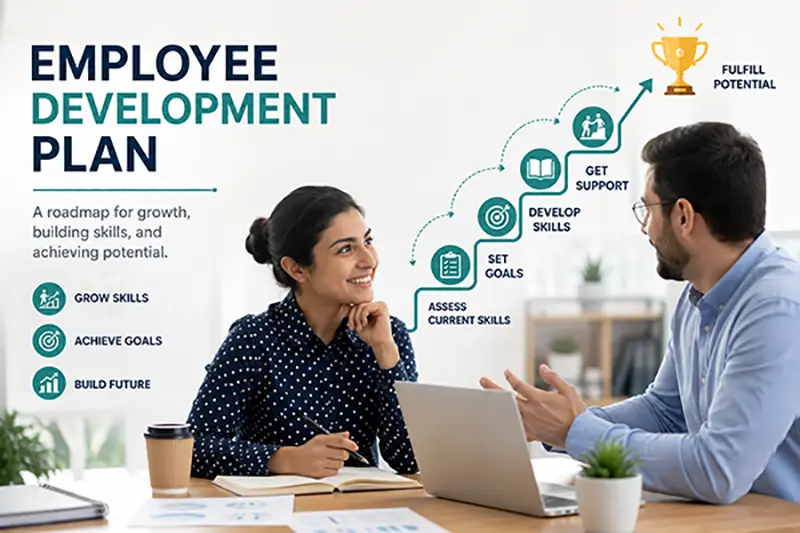
An employee’s development plan is a structured framework and document that maps out an employee’s professional goals, major skill gaps, and the actionable steps needed to support their growth within the organisation. According to the World Economic Forum, nearly 63% of employers identify skills gaps as a primary barrier to business transformation, which showcases the dire need to map employee development.
Development plans can be different, from skill development to performance development plans; they benefit employees and employers alike. The key to building a robust employee development plan is assessing strengths and skill gaps, setting measurable goals, identifying resources, scheduling check-ins and feedback, and evaluating progress.
This article covers everything from what an employee development plan means, its types, examples, and templates.
What Is An Employee Development Plan? Major Types of Employee Development Plans
An employee development plan is a structured framework and a document that is designed to strengthen employees’ skills and abilities to improve their performance. In simpler terms, it outlines the goals, skill gaps, and actionable steps to ensure their professional growth in the organisation.
What are the Different Types of Employee Development Plans?
Skill development, succession planning, personal, career, and performance improvement are the major types of employee development plans.
Here’s everything you need to know:
- Performance Improvement Plan (PIP): Unlike other development plans, a PIP is a more stringent tool used by employers to address certain behaviour gaps or shortcomings in an employee’s performance.
It sets clear and measurable goals to be achieved within a specific timeline, typically 30 to 90 days, or face termination.
- Skill Development Plan: A skill development plan focuses on improving an employee’s current abilities and task-specific skills and knowledge gaps while also scheduling learning resources to improve their job-related competencies and adapt to new technologies.
- Succession Planning Development Plans: The succession planning development plans include identifying high-potential employees, mentoring, and preparing them for future leadership roles, and developing their abilities to take on critical responsibilities over time.
- Career Development Plans: Career development plans focus on the holistic development of an employee and their long-term career goals. The main aim is to enhance their skills and capabilities for better opportunities within the current company or in new roles.
- Personal Development Plans: A personal development plan focuses on employees’ personal goals, interests, and areas they want to improve in, which might be directly linked to the organisation.
It may include better communication and critical thinking skills, public speaking, and more.
How to Create a Robust Employee Development Plan: A Step-By-Step Guide
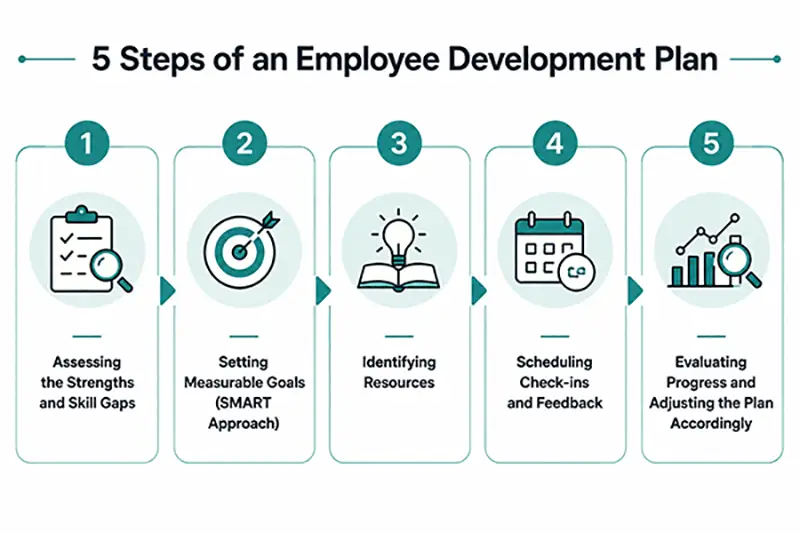
To create a robust employee development plan, first assess the current skills, strengths, and major skill gaps, set specific, quantifiable goals, identify the resources required, set a clear timeline, monitor progress regularly, and review the plan to adjust accordingly.
Here’s a step-by-step guide to create an employee development plan:
Step 1: Assess Current Strengths and Skill Gaps
The foundational step for building an employee development plan is to identify the core competencies, current skills, strengths, and the major skill gaps. Ideally, both job-specific and broad competencies should be considered for better career growth.
To identify this, feedback and regular competency assessments are crucial. It may be quantitative, like analysing performance metrics, or qualitative, such as feedback from managers and supervisors.
Roadmap:
Define Expectations >> Analyse Past Performance Metrics >> Identify the Strengths and Skill Gaps
Step 2: Set Specific and Measurable Goals
The next step to build an EDP includes the use of the SMART (Specific, Measurable, Achievable, Relevant, and Time-Bound) method for goal-setting. Ensure open communication with the employee and set achievable and realistic goals that align with the employee’s and organisational goals alike.
For example: If you have identified the skill gap in an employee’s data analysis capabilities, the SMART goal should be “Complete the SQL certification course within 5 months, and write SQL queries to provide business insights”.
Roadmap:
Open Communication for Aligning Goals >> Set Small Quantifiable Goals >> Allow for Stretch
Step 3: Identify the Resources Required
Different skill gaps require different resources to learn. For example, an employee might need a training program, while another may need mentoring. Hence, determine individual needs and then identify the resources required to fulfil the objectives. It may include training programs, workshops, mentoring sessions, certification courses, and more.
For example: To enhance an employee’s communication skills, provide resources such as “a public-speaking workshop and mentorship from the senior manager”.
Roadmap:
Identify the Individual Resources Required >> Allot the Resources >> Define a Clear, Achievable Goal After Training
Step 4: Set a Clear Timeline
Define a clear timeframe for when these specific goals are expected to be achieved. A clear timeline offers motivation to the employees and helps them manage their development activities with their regular workload. Set clear milestones and define the timeline beforehand.
Step 5: Monitor Progress and Provide Feedback
Regularly monitor the progress and provide constructive feedback. Schedule one-on-one sessions with the manager or supervisor for regular check-ins, progress reviews, and address the challenges hindering progress.
Offer constructive feedback that acknowledges achievements, boosts morale, provides feedback on areas that need improvement, and allocates additional help or resources that might help them achieve the development goals.
Roadmap:
Monitor the Progress >> Identify Achievements and Shortcomings >> Schedule Regular Check-Ins >> Offer Constructive Feedback
Step 6: Review and Adjust
As the performance is regularly monitored and reviewed, analyse the developments and new insights and adjust the plan accordingly. If an employee achieves the plan sooner or later than expected, adjust the plan accordingly.
Another equally important step to evaluate is the effectiveness of the strategy. Was it efficient? Were the outcomes favourable? Can this be implemented in the future again? This effectiveness can be judged based on employees’ performance and feedback throughout the development process.
Roadmap:
Review the Performance >> Adjust the Plan >> Final Strategic and Performance Review
Employee Development Plan Examples
Leadership development, technical skills development, cross-training, mentorship, certification plans, career advancement, and performance improvement are some common development plan examples for employees.
Here are the employee development plan examples:
1. Skill Enhancement Plan
A skill enhancement plan focuses on refining the skills, strengths, and capabilities required for the current role and future responsibilities. This plan helps employees strengthen the technical knowledge required for their current position or future role.
Example: An employee working in data analysis may want to improve their knowledge of SQL and Power BI. Their development plan could include completing online courses, working on practical projects, and applying these skills to company reports.
Key Goals Include:
- Learning New Software and Tools
- Developing Soft and Hard Skills
- Completing Certifications
- Applying Newly Acquired Skills to Workplace Projects
2. Performance Improvement Development Plan
A performance-focused development plan helps employees address specific skill or performance gaps. Rather than simply identifying weaknesses, it provides clear actions and measurable outcomes for improvement. However, a PIP is a more stern approach, and failure to achieve expected outcomes may lead to termination.
Example: If an employee consistently submits reports with errors because they are unfamiliar with the company’s reporting software, then instead of immediately placing them on a formal PIP, the manager can create a 60-day development plan. With additional software training and weekly check-ins, the progress will be measured by gradually reducing reporting errors.
Key Goals Include:
- Targeting specific task-related skills rather than holistic development
- Provide training and resources
- Offering a fair opportunity to improve before considering a formal disciplinary action.
3. Career Advancement Plan
A career advancement plan is created for employees who want to move to a higher position or transition into another role within the organisation. It connects an employee’s long-term career goals with the skills and experience they need to acquire.
Example: An HR executive who wants to become an HR manager may need to develop people management, employee relations, workforce planning, and strategic HR skills. Their plan could include managing an HR project, mentoring junior employees, and completing an advanced HR certification.
Key Goals Include:
- Identifying the High-Potential Employees
- Develop Required Skills for Advancement
- Gain Relevant Work Experience
- Prepare for Internal Promotion Opportunities
4. Mentorship-Based Development Program
A mentorship plan pairs an employee with a more experienced colleague who can provide guidance, knowledge, feedback, and career advice. It is particularly useful for employees who are developing leadership skills or preparing for a new role.
Example: A junior employee interested in management could meet with a senior manager once or twice a month to discuss career goals and workplace challenges, leadership practices, and professional development.
Key Goals Include:
- Receive Career Guidance
- Build Professional Network
- Learn from Experienced Professionals and Gain Real Workplace Experiences
5. Cross-Training Development Plan
A cross-training plan allows employees to learn about responsibilities outside their primary role. It helps organisations build a more flexible workforce while giving employees broader knowledge of business operations.
Example: A marketing executive could spend time working with the sales team to understand lead conversions and customer interactions. This experience can help them understand how different departments contribute to overall business objectives.
Key Goals Include:
- Improving Collaboration Across Teams and Departments
- Develop Broader Business Knowledge
- Build Flexibility and Job Readiness
A General Template for Creating an Employee Development Plan
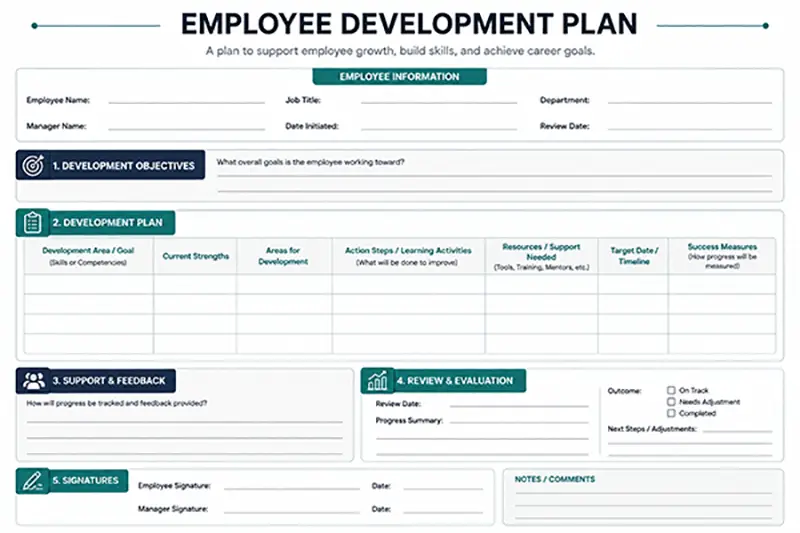
Ideally, an employee development plan must include the following elements:
| Category | Details |
| Name | [Employee’s Name] |
| Job Title | [Insert Your Job Role] |
| Department | [Insert Department’s Name] |
| Manager’s Name | [Name of the Manager] |
| Start Date | [Starting Date of Employee Development Plan] |
| Completion Time | [Expected Date of Completion] |
| Strength and Current Skills | Mention the relevant skills and strengths the current employee possesses. For example: Strong data analytics and problem-solving skills. |
| Skill Gaps | Clearly outline the areas that need improvement and the skills gap, which is crucial to overcome for the current role. For Example: Develop communication and project management skills for handling high-stakes projects. |
| Development Goals | Define the specific and measurable goals the employee wants to achieve. For Example: “Learn Python, SQL, and Power BI in 7 months”. |
| Plan of Action (PoA) | Define the steps that the employee and the employer will take to reach the desired goal. For example: “Enrol in a 6-month project management course, and complete a small project by the end of the course”. |
| Timeline | Add the expected time of the development plan’s completion. For example: “Complete the SEO course and handle a project within 5 months”. |
| Resources Required | Mention the resources, such as workshops, mentoring sessions, training programs, or certification courses. For example: “SEO course, access to analytics tool, certification program, and mentor support”. |
| Feedback and Adjustments | Schedule for reviewing the progress and updating the plan accordingly. |
| Final Outcome | Enter the expected result after the completion of the development plan. For Example: “Demonstrated SEO proficiency and readiness for advanced responsibilities”. |
Difference Between Employee Development Plan (EDP) and Performance Improvement Plan (PIP)
Here are the major points of distinction between an Employee Development Plan and a Performance Improvement Plan (PIP):
| S No. | Points of Distinction | Employee Development Plan (EDP) | Performance Improvement Plan (PIP) |
| 1 | Definition | EDP is a structured plan made to improve employees’ skills and capabilities for professional growth and career development | PIP is a strict process to address performance deficiencies and an opportunity to improve before disciplinary actions. |
| 2 | Scope | Long-term plans with flexible timelines. | Short-term plan with a strict time frame. |
| 3 | Focus | To strengthen the holistic career and skill development of an employee | To address performance deficiencies; if not improved, it may lead to termination. |
| 4 | Outcome Expectations | Enhanced skills, capabilities, and knowledge for career advancement and future roles. | Improved performance as per pre-defined standards; otherwise, disciplinary actions will be taken. |
| 5 | Support Provided | Training Programs, Workshops, Mentorship, Certification Courses | Targeted training to overcome the specific performance deficiencies. |
Final Thoughts
To sum up, an employee development plan is one of the best opportunities to improve skills, technical know-how, and strengths for professional growth and career advancement. The key to a successful development plan is to properly assess individual needs and skill gaps, identify the resources, monitor progress, and adjust the plan accordingly. By investing in employee development plans, companies not only build an excellent workforce but also support business continuity with efficient employees.
Frequently Asked Questions (FAQs)
1. What is a development plan for an employee?
Ans: An employee’s development plan is a structured framework and document that maps out an employee’s professional goals, major skill gaps, and the actionable steps needed to support their growth within the organisation.
2. What is the difference between PDP and PIP?
Ans: While a PDP focuses on skill enhancement and overall career development of an employee, a PIP (Performance Improvement Plan) is a strict process to address performance deficiencies and an opportunity to improve before disciplinary actions are taken.
3. How often should an employee development plan be reviewed?
Ans: Micro day-to-day check-ins and a formal review every 3 months are enough to review and monitor employee development plans.
4. What should an employee development plan include?
Ans: Skill and strengths assessment, SMART goals, actionable insights, resources required, a specific timeline, and consistent reviews and check-ins are some must-have elements in an employee development plan.
5. What are some development plan examples for employees?
Ans: Common development plan examples for employees include leadership development, technical skills development, cross-training, mentorship, certification plans, career advancement, and performance improvement.