“The future belongs to those who believe in the beauty of their dreams.”
– Eleanor Roosevelt (Ex-US First Lady)
A master’s degree or PhD surely opens doors in your career. But it does not automatically open the door to a U.S. green card.
For advanced-degree professionals, realizing that US dream requires more than strong credentials. It requires meeting specific USCIS eligibility rules and, for a National Interest Waiver (NIW), proving that your work serves a broader national interest. So, how do you know whether your education, experience, and professional achievements actually qualify you for EB-2? The answer starts with understanding the legal requirements and how your evidence fits them.
What the Law Actually Requires
US companies are expanding their teams, but just being qualified doesn’t cut it. Let’s start straightaway with what the US government says about what the requirements and conditions are. According to the USCIS Policy Manual, a beneficiary can satisfy the EB-2 advanced degree requirement by holding either a U.S. master’s degree or higher (or a foreign equivalent), or a U.S. bachelor’s degree plus at least five years of progressive, post-degree job experience in the field.
That’s the actual legal foundation everything else builds on. It’s a meaningfully accessible standard; plenty of professionals working in research, healthcare, engineering, and technology already meet it without realizing their credentials line up with a specific, well-defined green card category.
Speaking of valuable credentials, a Cisco CCNA certification can really boost your IT career.
Two Different Roads to the Same Destination
These were just the basic requirements every contender has to fulfil. Now, you’ve choice to go with one of the two forked routes:
Employer-sponsored EB-2. A U.S. employer files a PERM labor certification, proving no qualified U.S. worker is available for the role, then submits the I-140 petition on your behalf. Your position stays tied to that employer throughout the process, and the PERM step alone typically adds well over a year to the timeline, since the Department of Labor has to independently verify the labor market conditions before anything moves forward.
EB-2 National Interest Waiver (NIW). In this, you file the petition yourself. No employer sponsor, no PERM labor certification required. Instead, your case has to clear a specific national interest standard on its own merits. And if your priority date is current, you can sometimes submit the I-140 and adjustment of status together, which can meaningfully shorten the overall wait.
The NIW route has grown in popularity for exactly that reason; it detaches your green card process from any single employer’s willingness to sponsor you, and it gives professionals the freedom to change jobs, start their own ventures, or pursue independent work without jeopardizing their immigration status along the way.
But strong evidence to survive USCIS scrutiny would require you to have a certification like Microsoft Azure AI Fundamentals (AI-900) that can start your career in emerging fields like AI.
What Makes or Breaks an NIW Case
The NIW process is something like this:
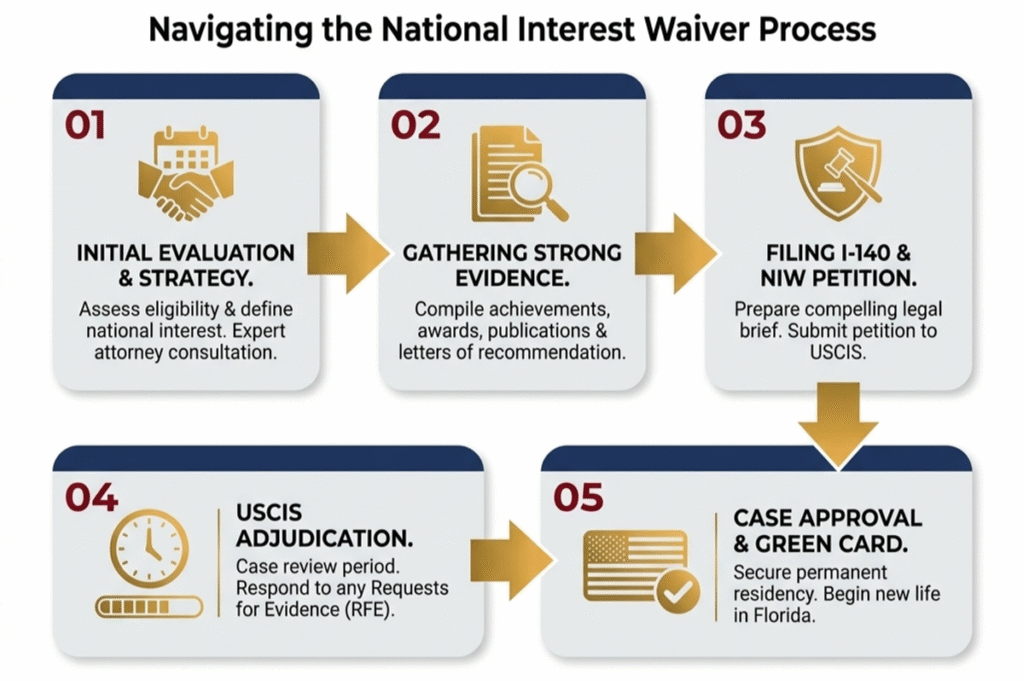
This self-petitioning route seems easier, right? Well, it stops being appealing as soon as you get to know what USCIS actually requires. Under Matter of Dhanasar, an NIW petition has to prove three things at once: the proposed endeavor has substantial merit and national importance, the petitioner is genuinely well-positioned to advance it, and on balance, the nation benefits more from waiving the job offer requirement than from enforcing it.
Three requirements, one unified argument, not three separate boxes to check. This is where a lot of self-filed petitions fall apart, strong credentials presented as a list rather than woven into a coherent narrative that actually satisfies USCIS’s standard.
The best course of action in cases where you’re in doubt is to always hire a professional, experienced EB-2 Attorney. Robinson Immigration Law builds each case around detailed evidence mapping, connecting publications, patents, and professional recognition directly to the Dhanasar framework, instead of assembling a petition around impressive credentials and hoping the connection speaks for itself.
What Actually Strengthens an Advanced-Degree Petition
The majority of weak petitions fall apart under USCIS scrutiny due to common mistakes. A handful of concrete factors tend to separate strong petitions from weak ones:
- Publications, citations, and peer recognition that demonstrate genuine standing within a specific field
- Evidence that the proposed work connects to a national priority area, such as public health, STEM research, or infrastructure
- A track record showing real progress, not just credentials, toward the specific endeavor described in the petition
- Clear, well-organized, and coherent documentation of your achievements narrative, instead of a disconnected list of wins.
None of these elements work in isolation; they need to build toward the same overall argument, which is exactly why petition strategy matters as much as the underlying credentials themselves.
Who Actually Fits This Category
Advanced-degree EB-2 eligibility can apply to professionals across a wide range of fields, including:
- Researchers and scientists: Even better chances if you work in emerging, priority areas like biotech, clean energy, etc.
- Physicians and public health professionals: Those whose work addresses important healthcare or public health needs.
- Entrepreneurs: Company founders whose ventures can demonstrate meaningful economic or broader impact.
- Educators and policy professionals: Individuals whose work addresses significant challenges affecting communities or society more broadly.
You see, any particular occupation has little importance. The common thread is a demonstrated body of work with an impact that extends beyond an individual’s personal career.
Conclusion
Qualifying for an EB-2 green card as an advanced-degree professional is decided by two distinct questions: does your education and experience meet the underlying legal standard, and if pursuing the National Interest Waiver route, does your work genuinely satisfy the Dhanasar framework’s three-part test?
Many capable professionals already hold the required credentials. But they feel uncertain about how those achievements translate into an actual immigration strategy. Understanding this framework is what turns a vague sense of eligibility into a concrete, evidence-based path toward permanent residency.
FAQs
1. Does a master’s qualify me for an EB-2 green card?
Ans: No. A US master’s degree or a foreign equivalent can satisfy the advanced-degree component of EB-2 eligibility, but it does not by itself guarantee a green card. You must also qualify for an EB-2 position and, depending on the pathway, satisfy additional requirements.
2. Can I qualify for EB-2 with a bachelor’s degree instead of a master’s degree?
Ans: Yes. A professional may generally qualify through a U.S. bachelor’s degree or foreign equivalent combined with at least five years of progressive, post-degree work experience in the specialty.
Ans: The standard EB-2 route generally requires a U.S. employer to sponsor the worker and obtain labor certification through the PERM process. An EB-2 National Interest Waiver allows an eligible professional to self-petition and request that the job-offer and labor-certification requirements be waived because the proposed work is in the U.S. national interest.
3. What is the difference between EB-2 and EB-2 NIW?