Competency assessment is a formalized process of evaluating a job applicant’s or employee’s required skills based upon the position, not just a person’s resume and past interviews. It is basically to calculate the difference between what a candidate says they can do and knowing what they can actually do.
So, to hire the exact skilled professional your position requires, this guide covers competency assessment meaning and its benefits, illustrates real examples, common challenges and solutions, and tells you how to determine if your competency assessments are producing the results you want.
Quick Answer
Competency assessment meaning says it is a process used to check whether an employee or job candidate has the skills, knowledge, and behaviors needed to do the respective job well. It compares a person’s actual abilities against the standards set for the particular role to make informed hiring, promotion, and training decisions based on evaluations.
What is a Competency Assessments?
Competency assessment is the structured process of evaluating an employee’s or candidate’s skills, knowledge, and performance abilities against the specific job role standards and requirements. Instead of relying solely on the polished interview, it is used to check technical proficiency, communication skills, decision-making abilities, or leadership.
Think of it as the difference between a resume and a road test. A resume tells you what someone claims, whereas a competency assessment tells you what will happen when they are assigned real tasks.
Most hiring managers or other authorities run these at a few moments:
- During hiring: To check if a candidate’s actual abilities match the job requirements.
- During Onboarding: To identify early training needs.
- During Performance Reviews: To track the growth and skill gaps that need attention and improvement
- Before Promotions: To confirm by what time the employee will be ready to take over senior roles.
Benefits of Competency Assessment
- Better Hiring Accuracy: It helps the hiring manager evaluate candidates against defined objectives, including skills and job role responsibilities, reducing overall hiring misconduct.
- Clear Development Paths: Employees get a clear picture of exactly which competencies to work on to move forward, eliminating all the guesswork that wastes time and resources.
- Lower Turnover: The employee who understands the objectives they are evaluated upon and plans their path forward is more likely to continue and be retained.
- Improved Workforce Planning: Leadership gets a real-time view of skill gaps across teams.
- Data-Driven Performance Management: It provides measurable insights into complete employee performance that include capabilities, skill level, behavior, and overall contribution.
Pros and Cons of Competency Assessment
Before moving forward with the evaluation of competency assessment, you should know the pros and cons to make an informed decision.
| Pros | Cons |
| Replaces subjective data with measurable data. | Poorly built assessments may carry bias |
| Improves hiring and promotion accuracy | Requires tracking daily employee performance |
| Educates employees with a clear roadmap | It can be time-intensive while managing other important tasks. |
| Helps identify the skills gaps that comprise business growth | |
| Unbiased evaluation across teams |
10 Competency Assessment Examples for Different Roles
Different roles and methods call for different competency assessment methods. Below are 10 examples of commonly used approaches in any organisation.
1. 360-Degree Feedback
Feedback about the employee’s behavior is collected from managers, peers, direct supervisors, and customers. Best suited for assessing interpersonal and leadership competencies where the employees may have a distorted perception of how others perceive them.
2. Structured Behavioural Interviews
Past work experiences of the candidates provide answers to behavioral interview questions. Best suited for measuring a candidate’s ability to use judgment, communicate effectively, and solve problems.
3. Work Sample Test
An actual example of the work to be done is writing a sample report, creating a solution to a mock technical problem, and making a phone call to a mock customer. These tests require a candidate to actually perform a representative piece of work; they demonstrate better reliability for predicting on-the-job success than do tests that only measure what a candidate knows.
4. Simulation
A work-sample test goes one step further than a simulated version of a workplace scenario. For example, dealing with a real-time customer or negotiating with another department or fixing a malfunctioning computer network. An assessor will be able to observe how well a candidate makes decisions while under time pressure.
5. Employee Self-Evaluation
Employees rate their own competencies against defined criteria. Generally never used by itself, but it is helpful when it is compared to evaluations completed by managers or co-workers.
6. Manager Evaluation
One of the oldest forms of evaluation, the present supervisor provides the rating of the competencies of the employee. While effective when combined with other forms of evaluation, there is always the potential for bias in a single evaluator’s ratings.
7. Psychometric and Personality Assessments
Standardized instruments designed to measure regular characteristics such as flexibility, emotional intelligence, work ethic, and learning style. These are especially useful for evaluating soft skills that don’t show up clearly in interviews.
8. A Competency Matrix/ Skill Matrix
The use of a grid to map employees to job-related competencies and their respective proficiency levels. While this is an assessment process, it is much less about an “event” and more of a tracking tool for employees and teams that will be used by them as they continue working together.
9. Assessment Centres
A candidate completes a variety of tasks and is assessed over a full day. This method is commonly used for developing future leaders within organizations with a large number of competencies to assess simultaneously.
10. Peer Review
Peers in similar positions will review each other based on specific competencies. It comes out to be useful when employees are involved in projects or groups where they have opportunities to see what others do.
Competency Assessment Challenges and Solutions
Here are the common challenges along with the solutions you might need to refer to while conducting the competency assessment.
| Challenge | Solutions |
| Assessments feel subjective or inconsistent across evaluators | Use structured scorecards and standardized evaluators with shared examples before the scoring begins. |
| Competency frameworks become outdated as roles change | Review and update the frameworks at least once a year with the current role requirements. |
| Soft skills are often hard to measure objectively | Combine multiple methods like psychometric tests, structured interviews, and more to leave no room for doubt. |
| Employees may perceive assessments as a form of punishment | Frame the results around development, not just evaluation, and pair scores with a clear growth plan. |
| Collected data goes to waste | Integrate results into performance management and promotion planning that actually impact decisions |
Mandatory Steps to Follow in Conducting a Competency Assessment
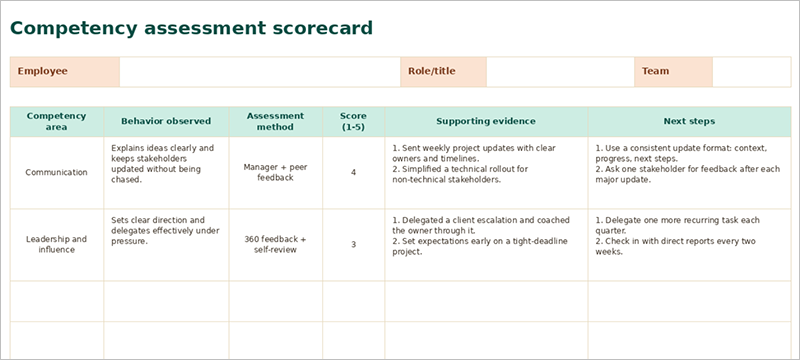
There are four steps to follow when planning to conduct the competency assessment: define the required competencies, conduct the competency assessment, ensure the assessment reliability, and at the final stage analyze the results and identify gaps.
Step 1: Define Required Competencies
Start by sorting out what the job actually requires. Plan a discussion with the hiring manager and the team manager, and analyze the top employee performance and responsibilities. For a better lineup, separate the technical competencies (job-specific skills) from the behavioural ones (communication, judgment, and teamwork).
Step 2: Conduct the Competency Assessment
Collect the data through interviews, work samples, manager ratings, and feedback. Remember to use more than one method if possible to avoid any room for doubt. Last but not least, brief the evaluators with guidelines about how the process works and tell them to avoid letting their perspectives interfere.
Step 3: Ensure Assessment Reliability
Train and guide the assessors together with some rigid guidelines and provide some example scores so that everyone remains on the same scale while evaluating. When the scoring is done, check where the raters diverge and note down the gaps to conclude your findings.
Step 4: Analyze Results and Identify Gaps
Now it’s time to turn the scores into decisions. Look at the patterns and the scores and note down the employee’s weaknesses, what skill gaps need to be filled, and what performance indicators affect business growth. Lastly, turn every gap into a specific next training and mentoring step.
How to Measure Competency Assessment Effectiveness?
You can tell a competency assessment program is working when it changes real outcomes that include hiring quality, retention, and performance. Here’s how to actually track the change and results.
Track Hiring Quality Over Time
One of the best ways to evaluate a competency assessment is to look at the quality of the employees hired through it. Track factors such as job performance, productivity, retention, and manager feedback over time. If employees who perform well in the assessment consistently perform well on the job, it indicates that the assessment is helping identify suitable candidates.
Monitor Promotion Success
Monitor the performance of the employees after they are promoted and compare it with their assessment results. Compare the initial scores with actual on-the-job output and gather multi-source feedback to evaluate the effectiveness of the competency test.
Check inter-rater reliability
Assign the competency test to different assessors, and let them score the same employee with their different perspectives, and check the outcomes. Compare their scores and feedback to identify whether they reach similar conclusions and determine the consistency and fairness of the assessment process.
Compare Results with Business KPIs
Compare the competency test results with key business performance indicators (KPIs) to determine whether employee competencies are contributing to improved business outcomes. Analyze factors such as productivity, quality of work, sales performance, customer satisfaction, efficiency, and achievement of targets.
Evaluate Employee Retention
Compare the retention rates among the employees who participate in competency-based training with those who do not. Organizations can also review employee satisfaction, engagement, career growth, promotion opportunities, and reasons for leaving to make future assessment tests.
Conclusion
Competency assessment is simply replacing guesswork with evidence. It helps you hire the right people, promote the deserving candidates, and analyze the skills gaps before they turn into a reason for the business downfall.
By performing the competency assessment test twice (or as per your company’s requirements) in a year, it helps the organization address the skill gaps before they start affecting output and catch early training or other needs to contribute the best toward the business growth.
FAQs
1. What is an example of competency assessment?
Ans: A coding challenge given to an IT developer or a blog topic given to a content writer can be some of the common examples of competency assessment.
2. What are the 7 basic principles of competency assessment?
Ans: Validity, reliability, fairness, transparency, authenticity, manageability, and alignment with learning outcomes are some of the basic principles of competency assessment.
3. What are some of the competency assessment tools?
Ans: SHL, TalentGuard, Berke, SkillPanel, and WorkHub are some of the tools for competency assessment.