
Companies are trying to scale without letting hiring costs spiral. But in addition to skilled talent, they’re also looking for what works well with their existing team, fits the budget, and can start contributing quickly.
Oyster reported a 68% increase in hiring in Colombia, making the country one of the fastest-growing remote hiring markets. Colombia combines a growing pool of skilled professionals with competitive hiring costs and a time zone that makes collaboration with North American companies unusually straightforward.
The country’s adept at remote work. Colombia’s Ministry of Information Technologies and Communications found that 67% of surveyed public entities believed telework increased productivity, while 40% cited lower operating and facilities costs as a major incentive.
More companies are building remote teams in Colombia due to a combination of talent, economics, time-zone compatibility, and an increasingly mature remote-work ecosystem.
Colombia’s Business Environment: Quietly Built for This
None of this transpired by accident. Colombia spent the better part of two decades building out the infrastructure, talent pipelines, and legal frameworks that global employers actually need. Companies looking to hire in colombia step into a mature ecosystem, one that trims risk and gets teams producing results faster than most founders expect.
Cities That Grew Up Fast
Medellín, Bogotá, and Cali aren’t just rising tech hubs anymore; they’re the real deal. Reliable high-speed internet, co-working spaces on every other block, and genuine startup energy. Medellín especially has undergone a remarkable change; it now shows up regularly on global innovation city lists. That kind of cultural shift doesn’t happen without deep institutional momentum behind it.
Talent That’s Actually Ready
Colombian institutes push out thousands of STEM graduates every year. Strong programs in IT, finance, marketing, and creative services. And English proficiency? It’s climbing steadily, especially among younger professionals actively chasing international roles. The talent isn’t just abundant; it’s oriented toward what global companies need right now.
To monitor these workers efficiently, employ top remote employee monitoring software.
The Real Competitive Advantages of Hiring Here
Okay, so the base is solid. But what does that actually mean for your bottom line? Let’s get specific.
Cost Savings That Genuinely Compound
Senior Colombian specialists in tech, marketing, or finance typically earn 40–60% less than equivalent U.S. or Western European hires, with no drop in output quality. That’s not a rounding error. For a scaling company, that margin compounds fast. Colombia outsourcing has pushed well past “fallback option” territory. It’s now a deliberate cost strategy that CFOs are bringing to the table.
Time Zones That Don’t Wreck Your Calendar
Colombia runs on EST. Year-round. No daylight saving shuffle. That means your Colombian team members are online during your normal business hours, no heroic early-morning calls, no async handoffs that bleed into the next day. For companies that had a bad experience with offshore teams in Southeast Asia or Eastern Europe, this factor single-handedly tips the decision.
Compliance Without the Headache
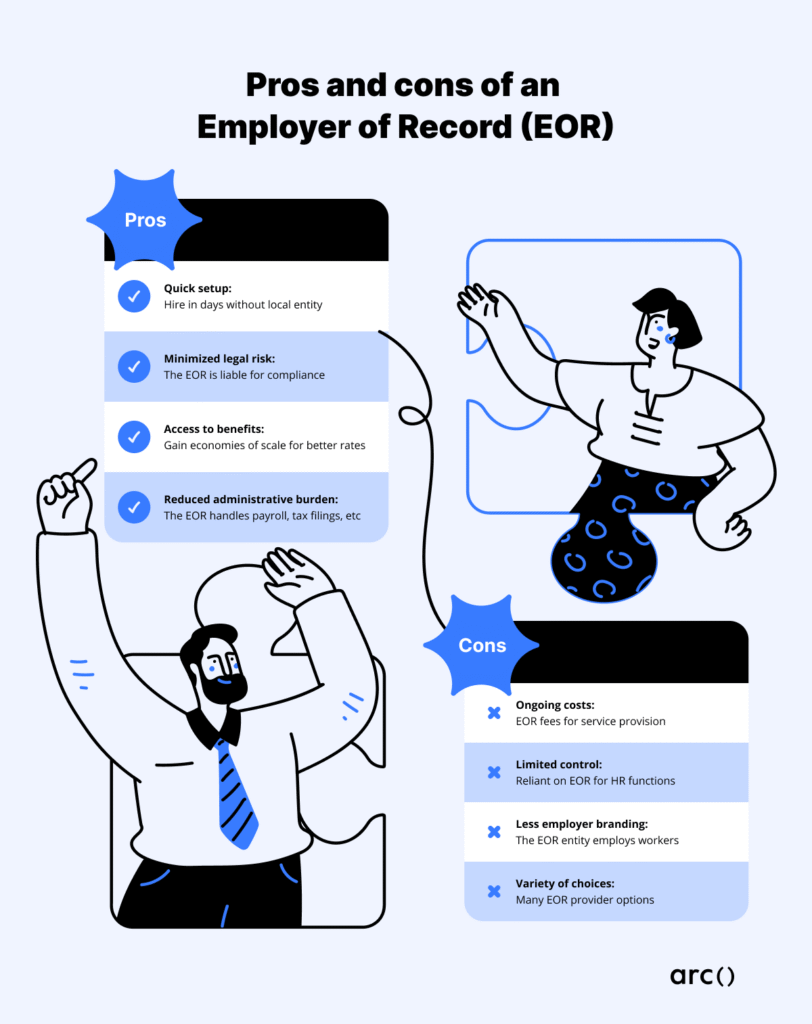
Colombia has transparent remote work legislation and a growing number of compliant pathways for foreign employers, including Employer of Record (EOR) arrangements that let you skip setting up a local entity entirely. Established EOR partners manage:
- Payroll
- Taxes
- Benefits
- Local compliance
You stay focused on actually running your business.
But for an informed decision, here are all the pros and cons of EOR:
What Companies Are Reporting on the Ground
The plan sounds good on paper. But what are companies actually experiencing? Turns out, the benefits of remote teams in Colombia show up in some pretty concrete ways.
Hiring That Scales With You
This isn’t a place where you’ll hit a ceiling at five or six hires. Companies like Rappi, Google, and Capital One have made long-term operational commitments in Colombia, not pilots, not experiments. Real expansion. Oyster reported a 68% growth in Colombia placements in 2024 alone. That’s not a blip; it’s a signal.
Professionals Who Actually Stick Around
Turnover in nearshore markets can be brutal. Colombia bucks that trend. Colombian professionals are strongly committed to their roles, and retention tends to be meaningfully better than other comparable markets. Communication, responsiveness, clarity, and follow-through consistently exceed expectations from global employers who’ve worked in multiple regions.
Cultural Fit That Reduces Daily Friction
Colombian professionals are familiar with U.S. business norms:
- Deadline expectations
- Accountability culture
- Communication standards
That alignment is genuinely hard to put a dollar figure on. But after the first few weeks of working together, you feel the difference immediately.
Your Competition is Already Running This Calculation
Affordable senior talent. Real-time collaboration. Transparent compliance pathways. Strong work culture. The case for hiring remote workers in Colombia doesn’t require a leap of faith; it requires a spreadsheet and a conversation. Why firms expand to Colombia isn’t some mysterious strategic secret.
It’s a straightforward equation that keeps paying off. If your team isn’t already exploring it, someone else in your space almost certainly is, and they’re building a head start you’ll someday have to close.
FAQs on Companies Considering Colombia
1. How do companies stay compliant without setting up a Colombian entity?
Ans: Most firms use an Employer of Record (EOR) provider to hire employees legally in Colombia without creating a local entity. The EOR handles employment contracts, payroll, tax withholding, statutory benefits, social security contributions, and local labor-law necessities, helping companies reduce administrative overhead while maintaining compliance.
2. Which cities are best for hiring tech talent?
Ans: Bogotá and Medellín are the best markets for tech hiring because they offer the largest pools of experienced developers, engineers, and digital professionals. Cali and Barranquilla are also growing as technology hubs and can provide access to skilled talent at somewhat lower salary benchmarks, depending on the role and experience level.
Ans: Yes, especially among university-educated professionals and Colombian candidates actively pursuing roles with international companies. English proficiency has improved as more professionals gain experience working with global crews and employers. However, proficiency still varies by candidate, so companies should assess business communication skills during the hiring process rather than relying on assumptions.
3. Is English proficiency actually strong enough for international roles?