HR leaders who are involved in tech scaling often treat it as something like an automation problem. But it actually breaks when the company tries to run it in different jurisdictions because it can’t handle that. The thing here is not that automation is bad, but that the systems are not built for local products and have limited awareness of them.
Read the full blog to learn more about the math behind why templates don’t transfer and how localization decides if the process is legal.
Why Global HR Rollouts Stall on More Than Efficiency
Most global HR leaders scaling technology across countries think of it as an automation issue: pick a platform, roll it out, digitize the paperwork, done. That framing works well for a single-country deployment. It begins to break the moment a company operates across three, five, or a dozen jurisdictions, each with its own labor code, statutory contributions, and payroll mechanics that a generic system was never designed to handle.
The gap shows up silently. A workflow that seems complete on a dashboard in one country turns out to be missing a mandatory filing step, a leave entitlement, or a contribution calculation in another. Nobody pays attention until an audit, a labor inspection, or an employee complaint surfaces the mismatch. By then, the fix charges far more than the platform did.
This part uses the Philippines as a working example of what generic HR systems tend to miss. The country has statutory benefits, payroll rules, and recordkeeping needs that carry actual legal weight, and they don’t map cleanly onto templates designed for other markets. The pattern is worth understanding as it repeats everywhere a distributed workforce operates, not just in the Philippines.
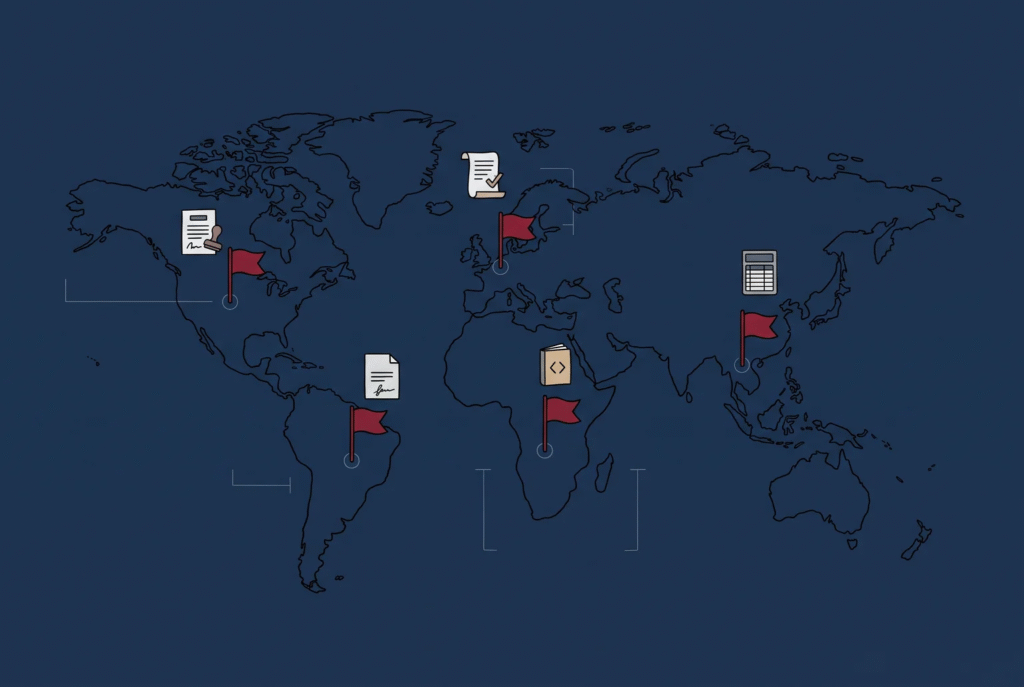
Every flag on this map shows a different rulebook, not just a different form to fill out.
The argument here isn’t that automation is not the correct goal. It’s that automation built on a system unaware of local law produces confident-looking output that is silently wrong.
The Math Behind Why Templates Don’t Transfer
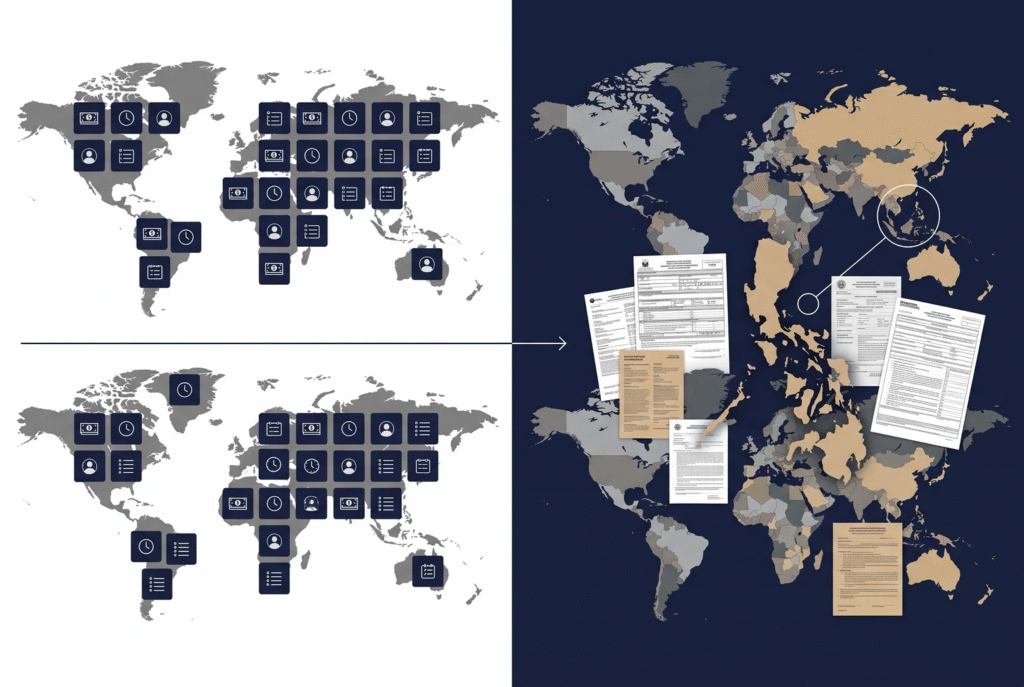
A generic HRIS built for one country focuses on treating tax and benefits as a single configurable field: set a rate, apply it to gross pay, finished. Statutory systems don’t work that way. Contribution bases, salary ceilings, employer-employee splits, the agencies involved, and eligibility rules differ substantially from one jurisdiction to another, and a system built around one country’s logic has no natural place to put the differences it hasn’t been told to expect.
Leave rules compound the issue. Annual leave, sick leave, parental leave, accrual, carry-over, and cash-out policies vary by jurisdiction, which makes a single hard-coded leave model unsafe once a company runs in more than one place. Tax withholding adds another layer: tax tables, residency rules, exemption thresholds, and treatment of benefits in kind all shift by country, so a platform that hard-codes one country’s tax logic will misfire the moment it’s asked to operate another’s.

One gear, three incompatible sockets: generic automation logic was never designed to fit every jurisdiction’s rules at once.
None of this shows the software itself is broken. Analysts who study failed HRIS rollouts point to governance gaps, missed requirements, and inadequate payroll checking as the real culprits, not flawed code. The system does what it was designed to do. It just wasn’t built for the jurisdiction now depending on it.
What A Philippine Payroll Run Actually Requires
Pag-IBIG contributions show the point well. As of 2025, both employer and employee contribute 2% each toward the Home Development Mutual Fund, but that percentage applies to a fund salary capped at ₱10,000 a month, which covers basic pay plus certain allowances. The output is a maximum monthly contribution of ₱200 from each side, regardless of how much someone genuinely earns above that ceiling. A payroll engine that treats statutory deductions as a flat percentage of gross salary will get this wrong the moment an employee’s pay crosses the cap. SSS and PhilHealth operate on their own separate contribution tables, so a system designed for one country’s single-fund logic has no natural home for three parallel, differently structured deductions.
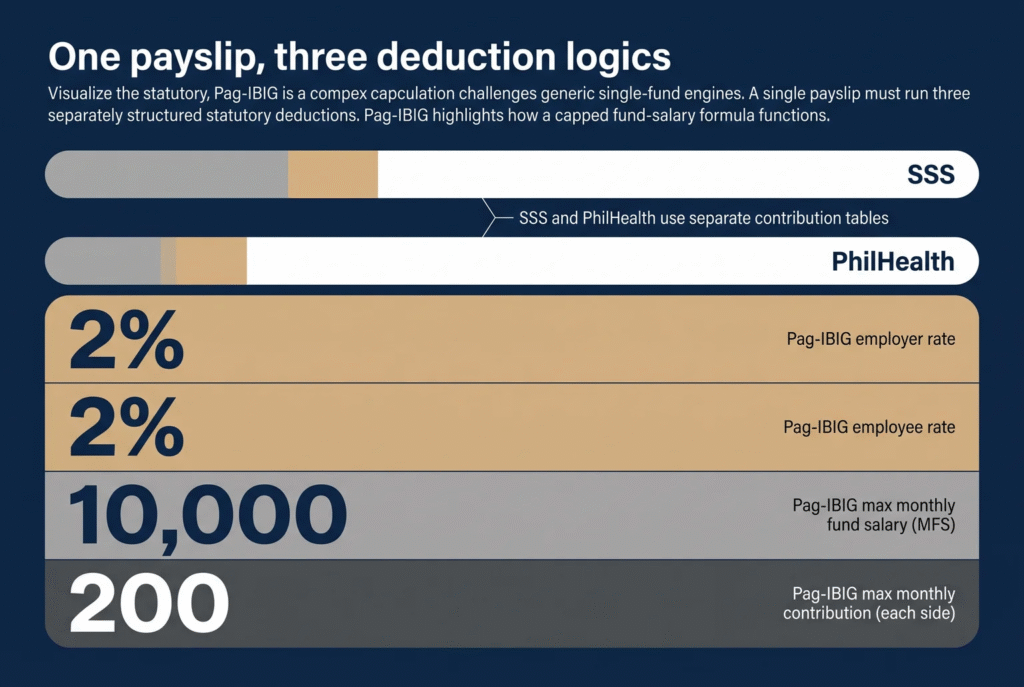
Pag-IBIG’s capped fund salary formula is just one of three incompatible deduction reasons a single payslip has to reconcile.
Recordkeeping adds an extra layer. Philippine employers maintain what’s known as a 201 file for every employee, a personnel record that includes identity documents, employment contracts, government ID numbers, benefits enrollment forms, payroll history, tax records, and leave data. Under DOLE Department Order No. 238-2023, core employment records must remain on-site and be retained for at least three years from the last entry, ready for labor checking or benefits verification at any time. A generic HRIS built around a simple employee profile field has no structure for this kind of consolidated, audit-ready file.
Termination adds a procedural layer most global templates don’t consider. Philippine labor law needs a twin notice process: a first notice detailing the specific acts or omissions justifying termination and giving the employee a chance to reply, followed by a second notice communicating the final decision. Systems need to monitor just-cause and authorized-cause terminations differently, since the needed steps diverge depending on which applies.
None of this is an exception by local standards. It’s the baseline mechanics of running payroll and HR systems compliantly in the Philippines, and it’s accurately the kind of layered, interdependent reason that a system built around one country’s assumptions tends to flatten into something easier than the law allows.
Automation Speeds Up A Process. Localization Decides If The Process is Legal
Automation and localization solve different issues. Automation removes manual steps from a workflow that’s already accurate. Localization makes sure the workflow reflects the real legal environment before anything gets automated. Operate automation on a system that miscalculates Pag-IBIG contributions or mishandles twin-notice termination needs, and the output is a compliance gap delivered faster and at greater volume than a manual process would produce.
That’s the distinction global HR leaders often skip when evaluating HR tech for multi-country teams. A vendor demo demonstrating fast approvals, clean dashboards, and automated payroll runs looks impressive regardless of whether the underlying logic fits Philippine labor code or SSS contribution tables. Speed and correctness are different questions, and only one of them shows up in a sales pitch.
Localization is what makes automation genuine at scale. Once a system’s calculations, recordkeeping, and termination workflows are designed around the rules of a specific jurisdiction, automating those processes is low-risk. Ignore that step, and every automated run multiplies whatever the system got wrong in the first place, across every payslip, every 201 file, every termination case.

A Five-Point Checklist for Evaluating Multi-Country HR Systems
Assessing a system for compliance fit means asking specific questions instead of trusting a features list. Five checks hold up across markets.
First, does it include country-specific labor law, tax, and statutory contribution rules, with a process for keeping those updated? Second, does payroll cover local earnings, deductions, and benefit rules locally, or does it depend on a third-party bolt-on that may lag behind local requirements? Third, how are regulatory changes monitored, and how fast do configuration updates reach the system after a rule changes? Fourth, can the employee database hold local fields, such as national ID formats or country-specific employment classifications? Fifth, does the architecture standardize core workflows universally while still allowing local variation in leave, approvals, notice periods, and reporting?
Applied to the Philippines, this means evaluating whether a system automatically handles SSS, PhilHealth, and Pag-IBIG parts, whether it calculates 13th-month pay, holiday premiums, and night-shift differentials accurately, and whether its reporting supports both head office consolidation and local audit requirements.
QWORK Human Resource Information System was designed around these specifics rather than adapted to them after the fact. Its self-service workflows include 201 file access, leave, overtime, loan, and Certificate of Employment needs, and its timekeeping data feeds directly into payroll calculation, which closes the gap between attendance records and what actually shows up on a payslip.
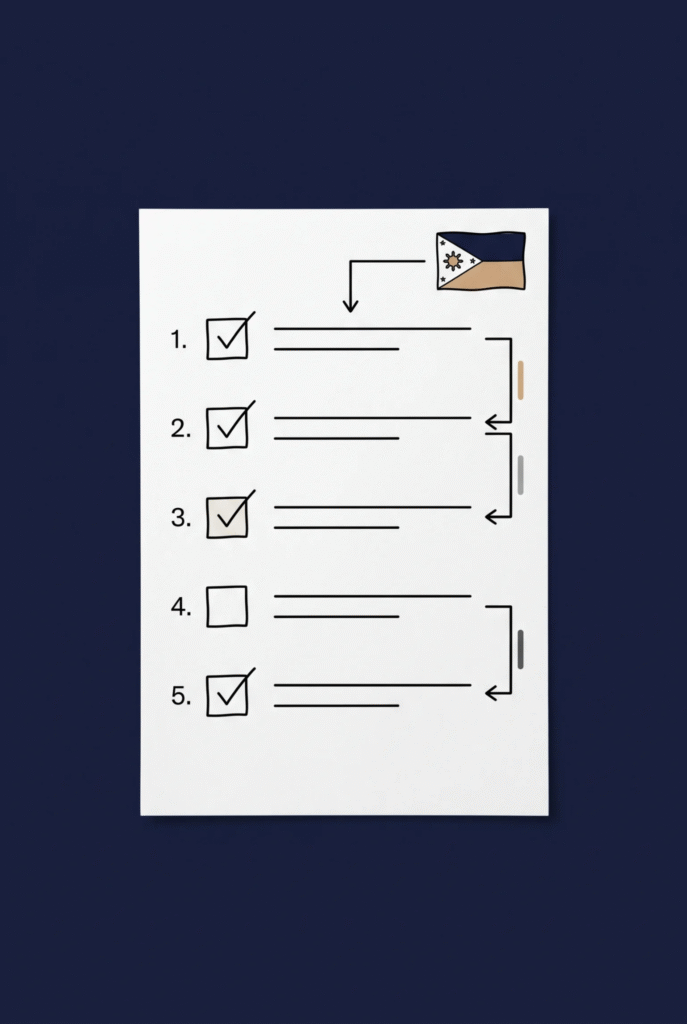
A good compliance-fit HRIS should be able to answer five specific questions for any country it claims to offer, not just the ones it was built for.
None of these five checks need a vendor to operate in every country a company hires in. They need the vendor to show its work for the countries it does serve, which is a fair thing to ask before rollout, not after.
The Same Checklist Works Everywhere
The five-point checklist applies to any country a distributed team functions in. Vietnam has its own social insurance brackets. Indonesia has its own severance formulas. India has provident fund and gratuity rules that vary by state in practice, if not by statute. None of these will match SSS, PhilHealth, or Pag-IBIG, but the checking questions are identical: does the system manage local statutory rules natively, how fast does it update when regulations change, can the employee record hold local identifiers, and is reporting satisfactory to both head office and local regulators.
Treating the Philippines as a one-time integration project loses the point. A distributed workforce means repeating this scrutiny for every market added, on a schedule, not as a reaction to a compliance failure already in progress.
Turning The Checklist Into A Shortlist
Applying that checklist requires research, not guesswork. A useful starting point for Philippine-market evaluation is the HRIS Philippines Resource Hub, which walks through how local HR software manages statutory contributions, DOLE recordkeeping, and payroll preparation specific to the country. It’s worth reading regardless of which vendor a team ends up picking, since the compliance questions it raises apply across systems.
For HR leaders handling Philippine teams directly, that same scrutiny extends to platforms like QWORK HRIS, which builds employee records, leave and overtime approvals, and payroll preparation around local rules instead of bolting them on afterward.
None of this replaces a proper evaluation process. But beginning with a market-specific resource, instead of a generic HRIS comparison, saves time and surfaces the right questions earlier.
FAQs
1. What is the biggest challenge facing HR professionals today?
Ans: The biggest challenges that HR professionals are facing are adopting AI, retaining top talent, reducing administrative burden, and updating skills and training.
2. What are the major problems facing the IT industry?
Ans: The major problems faced by the IT industry are cybersecurity threats, talent shortages, and complications in the adoption of AI.
Ans: The top three trends in the HR industry are artificial intelligence adoption, employee well-being, skill based hiring.
3. What are the top three trends in the HR industry?