
In today’s world, businesses run on software, and healthcare is also one of them. Over the last two decades, healthcare has increasingly relied upon high-tech software platforms. Teams run Preferred Provider Organizations, Accountable Care Organizations, self-funded employer plans, and stop-loss programs know this pressure well.
Managed Care Systems focuses on exactly these problems and builds automated managed care software and shows it with practical implementation and support for PPOs, ACOs, and self-funded employers.
Why Healthcare Administration Is So Hard to Get Right
Healthcare administration is difficult because every task depends on a few other tasks being correct. A single assertion touches provider contracts, member eligibility, benefit rules, pricing schedules, and sometimes risk transfer terms. If any one of those pieces is off, the whole result is wrong.
The cost of that complication is huge. A 2019 study published in JAMA estimated that administrative intricacy accounts for roughly $265 billion in wasted spending in the U.S. healthcare system every year. That money goes to rework, refused claims, phone calls, and staff hours spent tracking information that should have been right the first time.
The Hidden Cost of Manual Work
Analog processes create risk at every handoff. When a team member copies data from one system into another, mistakes slip in. When pricing rules live in a spreadsheet rather than a system, only one or two people truly understand them. And that knowledge takes off the door when those people leave.
The most common pain points include:
- Contract pricing errors caused by outmoded or poorly tracked fee schedules
- Eligibility mismatches between employer files and claims data
- Slow claims turnaround that annoys providers and members alike
- Inconsistent reporting that makes it hard to spot cost trends or catch problems early
- Heavy dependence on a few staff members who hold essential process knowledge in their heads
Start by listing which of these issues show up most often in your own mission, since that list will shape every software choice you make later.
What Healthcare Administration Software Actually Does
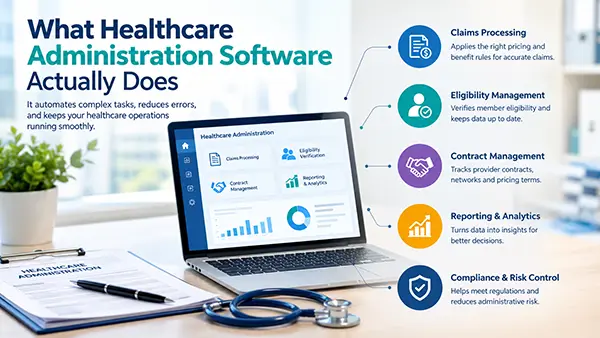
Healthcare administration software systematizes the rules-based work that people currently do by hand. It takes in data, applies the correct contract or benefit logic, and produces a precise result: a priced claim, an adjusted price report, a qualification record, or a stop-loss filing. The difference between good and average software comes down to fit. A general platform built for a large underwriter often struggles with the specific needs of a regional PPO or a self-financed employer. Purpose-built tools match the way these associations actually operate.
Core Functions to Expect
Strong managed care platforms normally cover a core set of jobs. Network management tracks providers, credentials, and contract terms. Claims adjustment applies the correct negotiated rate to each claim. Entitlement management keeps member data current. Reporting turns all that activity into numbers policymakers can use.
For stop order carriers (insurers that protect self-funded plans from very large claims), the software also needs to track claims against specific and combined boundaries. That way, the carrier knows exactly when coverage kicks in and can process compensation without guesswork.
How Different Organizations Use It
Each type of organization has a different priority:
- PPOs need correct contract management and fast claims repricing across large provider networks.
- ACOs need clear data on cost and quality so they can track shared savings and meet performance goals.
- Self-funded employers need visibility into what their health plan actually costs and where the money goes.
- Stop-loss carriers need exact claim tracking against policy limits and clean, timely reporting.
Match your shortlist of sellers against the needs in your category first, before you compare prices or feature lists.
How MCSI Approaches Healthcare Administration
Rather than forcing a PPO or stop-loss carrier into a comprehensive system, the company designs its managed care tools for the special contracts, pricing rules, and reporting needs these groups deal with each day.
That focus matters. A self-funded employer and a protective stop carrier may look at the same claim, but they need very different information from it. Software that understands both views saves everyone a lot of back and forth.
Automation That Reduces Errors
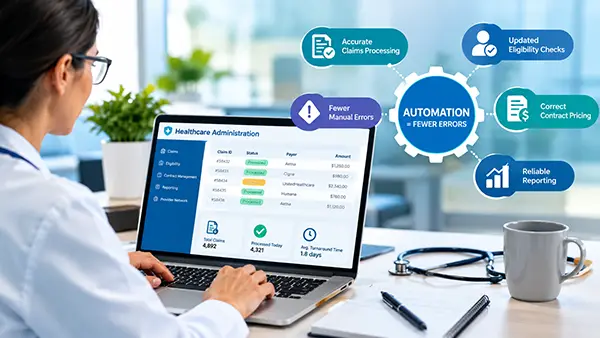
Automation removes the repeated steps where most mistakes happen. When the system applies pricing rules directly from kept contract terms, nobody has to look up a rate or type it in by hand. Claims move faster, errors drop, and staff can focus on the exceptions that truly need a human eye.
Implementation and Support That Stay With You
Software alone does not fix a managerial problem. The setup process and the support afterward decide whether a new system actually works. MCSI handles execution directly, which means its team helps set up contracts, load data, and connect the new system to existing tools.
After launch, ongoing support keeps things running as contracts change, ordinances shift, and the organization grows. This is where many merchant relationships fall apart, the sale ends, and the help departs. Ask any dealer you consider exactly who you will call when something breaks six months after go-live.
How to Choose the Right Healthcare Administration Solution
Choosing software is a business decision, not just a specialized one. The right system should fit your process, scale with your growth, and come with people who understand your industry.
Follow these steps to make a clear, confident choice:
- Map your current processes. Write down how claims, appropriateness, pricing, and reporting move through your organization today, including every manual step.
- Identify your biggest bottlenecks. Pick the two or three problems that cost you the most time or money.
- Check for industry fit. Confirm the merchant has real experience with your type of organization, whether that is a PPO, ACO, self-funded plan, or stop order carrier.
- Ask about implementation. Find out who handles setup, how long it usually takes, and what your team needs to provide.
- Test the support model. Request source and ask current clients how quickly the vendor responds to problems.
- Review reporting options. Make sure the system produces the reports your guidance, clients, and controller actually need.
Common Mistakes to Avoid
Many organizations pick software based on a glossy demo alone. A demo shows the best-case scenario; your daily reality includes unstructured, odd contract terms, and last-minute changes. Ask the seller to walk through one of your real, complicated cases instead. Another frequent mistake is underestimating the time staff needs to learn a new system. Build training into your timeline from day one, not as a reconsideration.
The Payoff of Getting Administration Right

Better administration pays off in ways that reach far over the back office. Providers get paid faster and with fewer arguments. Employers see clearer data on their health spending. Members experience fewer billing surprises. And administrative teams finally get comfort from the constant cycle of fixing avoidable errors.
Precise data also supports smarter decisions. When a self-funded employer can see exactly which services drive costs, it can adjust plan design with confidence. When an ACO can track performance in near-immediate time, it can step in before small problems turn into missed targets.
Making the Right Call for Your Organization
Healthcare administration will always involve rules, but it does not have to involve endless manual work. The right technology manages the repeated tasks, cuts down on costly errors, and gives teams the clear information they need to run their programs well. Companies like MCSI show what this looks like in practice, software built for the specific needs of PPOs, ACOs, internally funded employers, and stop-loss carriers, paired with execution and support that continue long after launch.
Your next step is simple. Pull together a list of your three most time-intensive administrative tasks this week, then use it to start conversations with sellers who specialize in your corner of healthcare.
FAQs
1. What type of software is used in healthcare?
Ans: Healthcare relies on digital tools to manage patient care, daily operations, and medical data.
2. What does healthcare administration software actually do?
Ans: Healthcare administration software automates and centralizes the non-clinical, operational, and financial tasks of hospitals, clinics, and medical practices.
3. How to choose the right healthcare administration solution?
Ans: To choose the right healthcare administration or hospital management solution, start by mapping your facility’s daily patient volume, speciality focus, and workflow gaps before evaluating software features.