Unlimited PTO (Paid Time Off) refers to the policy where employees are allowed to take unlimited paid leave from the organization, unless it affects their work timeline. It might be a dream come true for employees while hunting for a new job.
Where most of the organizations offer a fixed amount of paid leave, employees can leverage such a fruitful policy, allowing them to balance their leaves and workload accordingly.
Let’s understand how unlimited PTO works in practical scenarios in more detail.
What Does PTO Include and How is it Different?
Unlike traditional PTO systems, where the paid time off is categorized into sick leaves, casual leaves, emergency leaves, and festive leaves, which are amalgamated under one category without any limit, the unlimited PTO doesn’t comprise anything.
Compared to the traditional paid leave policy, unlimited PTO offers the following:
- Flexibility to take leave
- Enables employees to plan their future vacation better
- Foster harmony and trust in the organization
- Doesn’t bind employees to handle emergency situations and take leave, worrying about salary deduction
In many cases, employees are offered unlimited PTO based on incentives and exceptional past work results. If the company finds a particular employee to be more responsible and maintains a particular benchmark, such policies act as an appreciation for them.
No pre-defined limit, and no strict tracking is enforced. The entire idea of introducing such a system is to ensure employee productivity and reduce mental stress; the process to avail PTO might differ from organization to organization.
Understanding the Unlimited PTO Process
While unlimited PTO offers greater flexibility, employees must still meet certain requirements and follow specific approval procedures.
- Eligibility Requirements: If an employee meets a certain criterion, whether in terms of performance, time period, or project competition timeframe, they automatically become eligible for unlimited paid leave.
- No Leave Accrual System: With an unlimited leave system, the concept of an accrual leave system gets automatically eliminated.
- Limitations for New Joinee: In the case of an incentive-based unlimited PTO, new joiners might not be entitled to avail themselves of such benefits.
- Fixed Approval Process: It is obvious that all the leaves will be approved by the manager or the concerned authorities, and the intervention ensures that the workload remains unaffected. Planning your PTO in advance allows managers/team leaders to split the workload accordingly and ensures the management of operations.
- HR Involvement: In many cases, employees might also be asked to contact the HR department as well to keep track of leaves and manage the records.
Benefits of Unlimited Time Off

Introducing the unlimited leaves policy benefits both employees and the organization, as per the business perspective, they are fostering a less strenuous environment where employees are able to maintain work-life balance.
This also simplifies HR payroll as VTO no longer comes into the role and administration policy, making the management more streamlined.
From an employee’s perspective, unlimited PTO makes the:
- Mental stress management more effective
- Facilitate better time management for personal work
- Allows employees to spend crucial time with family
- Plan a vacation in advance without last-minute chaos
- Promote better assistance to take care of personal medical needs
- Eliminates any constraints where you have to worry about eliminating your leave quota
Ultimately, it improves employee retention, boosts workplace morale, and keeps employees in a healthy mental state. All of these beneficiaries ultimately contribute towards better productivity and results.
How to Effectively Utilize Unlimited PTO?
It becomes the responsibility of the employees not to misuse such a policy and keep the trust of the employer intact. Unlimited time off should be utilized in such a manner that it doesn’t affect the workload and allows you to fulfill your purpose.
To effectively manage your PTO, ensure all your work is wrapped up, and your manager is pre-informed of your leaves. In case of health emergencies or sudden mishaps, clear communication should be established.
Unlimited PTO isn’t just an attraction policy to hire fresh talent, but an actual need to prevent burnout and improve wellness.
Key factors of an effective use of the unlimited paid time off policy include:
- Making sure that your workload is delegated
- A major task is completed before taking leave
- Managers and concerned personnel are informed in advance
- Workflow disruption is minimized
- Important deadlines, if any, are communicated to the reporting managers
Unlimited leaves are subjected to performance and benchmarks completion rather than the strict monitoring of attendance. The entire foundation is laid upon mutual trust and accountability, and effectively managing your leaves fosters the trust and harmony between employees and employer.
Challenges With Unlimited PTO
The unlimited paid time off policy revolves around mutual trust and clear communication. But what if an employee started to misuse the policy and exceeded the number of leaves beyond the acceptable limit?
An unclear definition and policy surely create a challenge and might even lead to dispute and chaos if not properly executed into the organization.
Initially, some of the evident challenges that both employer and employee might face are:
- Uneven Leave Distribution: The organization holds hundreds of employees at a time, and catering to each one of them with unlimited time off won’t make sense. This would lead to uneven distribution of leaves and create disappointment among a few, where some might be getting more leaves while others might not get enough due to a clash.
- Potential Misuses: It is a fact that an unlimited paid time off policy is a dream come true for the employee. However, expect the misuse of such flexibility if strict accountability is missing.
- Neglects the Crucial: If the policy of unlimited PTO is heavily relied upon for performance, employees with the most dire need might be left unattended. Imagine a scenario where an employee was neglected, leaves for a serious family emergency due to poor work performance.
- Problem With Delegation: If an employee is taking a long leave, delegating the role and responsibility might get a bit tough. If the other teammates might get to face excessive workload, the entire concept of reducing burnout might fall into the void.
To implement this policy successfully, managers and top management need to lay out a perfect employee management system so that each employee can avail themselves of their benefits.
What Happens if an Employee Violates This Policy?
The entire basis of unlimited paid leave is based on trust and mutual understanding. It’s the duty of the employee not to misuse such golden opportunities.
However, in case an employee is found to take excessive leave and misuse the policy, the organization holds the right to withdraw such leave policy or even terminate the employee. But, the consequences of misusing the unlimited leaves may vary from organization to organization. As an employee, it’s your sole duty to get clear communication and all the clauses with PTO.
Is It Really Worth Implementing Policy?
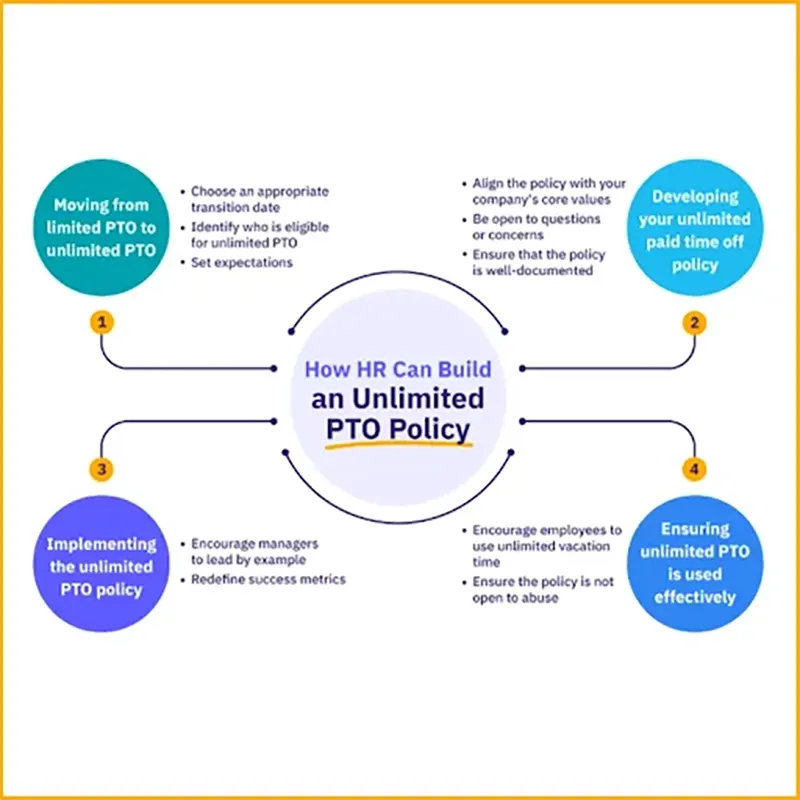
Now, from an organization’s perspective, the question arises whether such a policy is really worth it, especially if there aren’t any clear restrictions.
The answer lies in its nature of flexibility; unlimited PTO is just an idea that organizations can mold as per their requirements. Work-life balance is an important aspect in employee life, and employers should give focus on it to make the most out of the workflow.
Moreover, rewarding them with a well-deserved vacation and time off from the office reduces the chances of burnout and mental stress. It’s the way to honor and value your employees, thus reducing employee turnover rate.
Implementing an effective unlimited paid time off with a smart attendance time tracking policy enables organizations to foster healthier working environments.
Conclusion: Why Companies Are Adopting Unlimited Time Off Policies?
When employees feel valued and respected, they are more likely to remain committed to the organization, and this is exactly what unlimited PTO does. Modern organizations are adopting unlimited time off policies to build trust and increase productivity.
Implying such an approach is a step towards breaking the taboo and truly bestowing trust in employees. Unlimited PTO ensures that the workforce remains a valuable asset without compromising on deadlines, and at the same time, fulfills their personal responsibility.
Read Next: LWD Full Form Explained: Last Working Day In A Job
FAQs
1. What is the difference between traditional PTO and unlimited PTO?
Ans: Unlimited PTO allows employees to take paid leave without a fixed limit, subject to company approval and policies. Traditional PTO, on the other hand, provides employees with a specific number of paid leave days each year.
2. Are Flexible Time Off and Paid Time Off different?
Ans: Yes, there is a slight difference. Flexible Time Off (FTO) allows employees to take leave as needed without a predetermined limit, while Paid Time Off (PTO) typically provides a fixed number of paid leave days.
3. Do employees take more leave with unlimited PTO?
Ans: Surprisingly, many employees take less leave under unlimited PTO policies. This is often due to workplace culture, self-management, and a desire to maintain trust and accountability.
4. Is unlimited PTO good for mental health?
Ans: Yes, unlimited PTO can support better mental health by giving employees greater flexibility to rest, recharge, and maintain a healthier work-life balance.
5. What industries usually offer unlimited PTO?
Ans: Unlimited PTO is most commonly offered in industries such as SaaS, technology, marketing, content creation, consulting, and other knowledge-based sectors.
6. Is unlimited PTO suitable for every organization?
Ans: No, unlimited PTO is not suitable for every organization. Industries that require strict staffing levels, such as healthcare, education, manufacturing, and some startups, may find it challenging to implement effectively.