The 9 Box Grid Talent Management Model uses a 3 x 3 Matrix of employee positions based on two elements of an Employee that are “Current Performance” and “Future Potential.” Using this model, managers can determine which employees are best candidates for promotion, development, redeployment, or coaching out.
Here, we will explain how the 9 Box Grid Talent Management Model works, what to expect during your employee review, and common pitfalls to avoid.
What Is the 9 Box Grid?
The 9 Box Grid is an assessment tool for determining talent. It evaluates what you are currently doing to produce results (performance) versus your ability to do something else (potential), in either a greater or lesser capacity than what you are doing today. This is done by using three levels of each criterion.
Basically, it is a 3 x 3 matrix that assigns all employees according to their current performance as well as their potential for development into other positions. This enables management to be more strategic when making decisions regarding employee growth, promotions, and succession.
The 9 Box talent matrix has its roots in some form of consulting work in the 1970s, when a variation of this matrix was developed to help companies assess different business units prior to being applied to individuals today. The 9 Box matrix is now the core of most 9 Box Talent Management Programs. It can be referred to as the “Nine-Box”, “9-Box”, “9-Box Matrix,” or “Nine Block Assessment”, all of which relate to the same concept.
Why Do Companies Use the 9 Box Talent Review?
A 9-box Talent Review provides an organization with a common framework for making talent-related decisions as well as a snapshot of its talent bench. The benefits of using this process are as follows:
- Having a clear view of the organization’s talent pool in order to identify where the most talented employees are located, where there may be talent deficiencies, or other areas that need attention.
- Promotion/Development Decisions will be made consistently throughout departments.
- Identify High Potential Employees prior to them being recruited by another organization.
- Develop targeted development plans rather than providing all employees with the same level of training and budget.
- Help Calibrate Managers’ Rating Scales (i.e., help managers understand how others assess performance).
The honest truth about the 9-Box Grid is that it is only as good as the data upon which it was built. We’ll discuss this further.
How Do the 9 Boxes Work?
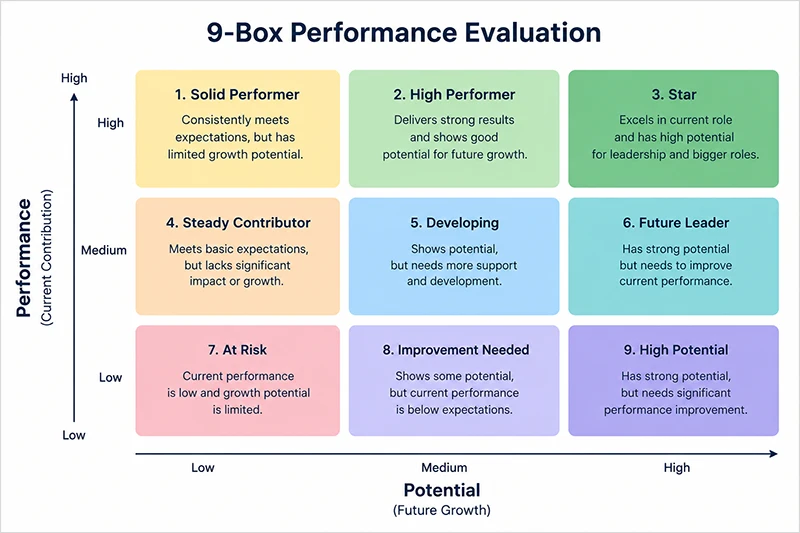
The 9 boxes work by combining three performance levels (low, moderate, high) with three potential levels (low, moderate, high). Each employee lands in exactly one box, and each box points to a different action.
Box names vary between organizations, so treat these labels as common conventions:
| Box | Label | Performance | Potential | What it means | Typical Action |
| 1. | Solid Performer | High | Low | Consistently meets expectations, with limited growth potential | Recognize, keep engaged, use as a mentor or specialist |
| 2. | High Performer | High | Medium | Delivers strong results and shows good potential for future growth | Offer stretch goals and prepare for a bigger scope |
| 3. | Star | High | High | Excels in the current role and can grow into leadership | Fast-track, retain, and plan succession |
| 4. | Steady Contributor | Medium | Low | Meets basic expectations but lacks significant impact or growth | Clarify expectations, offer skill-building |
| 5. | Developing | Medium | Medium | Shows potential but needs more support and development | Coach, set clear goals, and add training |
| 6. | Future Leader | Medium | High | Has strong potential but needs to improve current performance | Mentoring, leadership exposure, and performance coaching |
| 7. | At Risk | Low | Low | Low performance and limited growth potential | Improvement plan, role change, or exit |
| 8. | Improvement Needed | Low | Medium | Shows some potential, but performance review is below expectations | Diagnose the cause, then coach and set milestones |
| 9. | High Potential | Low | High | Has strong potential but needs significant performance improvement | Check role fit, remove blockers, and support closely |
1. Stars, High Performers, and Future Leaders (Boxes 3, 2, and 6)
Box 3 contains the best of the future, individuals who are high achievers today and ready to move up. They may be coming from either Box 2 (the High Achievers) or Box 6 (Future Leaders). It’s on you to keep them here and accelerate their careers through additional responsibilities, a mentor in their industry, and visibility to career advancement opportunities.
As you develop your leaders for the future, make sure you’re pairing that growth with performance coaching as well, this will turn tremendous potential into tremendous results.
2. The Middle: Developing, Steady, and Solid (Boxes 5, 4, and 1)
The middle consists of three boxes, Developing, Steady Contributor, and Solid Performers (boxes 5, 4, and 1). These groups have people who have shown potential but may be in need of further guidance to develop their skills or those who are reliable contributors to keeping day-to-day operations up and running smoothly.
Solid Performers can also act as a resource for mentorship and as an authority on specific subjects. Boxes like this should never be viewed as being a “fail” box. If you were to make your entire team of high performers (stars), they would quickly burn out, and there would be no one available to do the “steady” work.
3. The Bottom Row: At Risk, Improvement Needed, and High Potential (Boxes 7, 8, and 9)
To be most effective this row will need to be given serious and rapid consideration. Box 7 (at risk) requires a well-defined action plan. Boxes 8 (improvement needed) and 9 (high potential) have great potential but are missing that right now.
More commonly than not, an employee’s performance in these boxes can be traced back to a bad fit with their role, unclear expectations, ineffective management of the employee by their immediate supervisor, or a personnel/personal problem as opposed to the employee being incapable. Take time to diagnose prior to making a decision.
How to Run a 9 Box Talent Review
The following is the process you can follow to conduct a 9 box talent review. Define your evaluation criteria, collect the necessary evidence, have managers evaluate employees using those criteria, hold a group calibration meeting, and convert the 9-box placement into an Action Plan.
- Write down how you will measure Performance & Potential for all managers to use it to evaluate their employees.
- Gather all relevant information that demonstrates an employee’s performance (past performance evaluations, project successes/delays), and potential (360-degree feedback).
- Managers are asked to evaluate each of their direct reports based upon the defined criteria, and write 1-2 sentences explaining why they placed that employee in a specific box.
- Hold a session where all the Leaders of the various teams meet together to discuss and debate their ratings and come up with a “final” rating.
Pro Tip: Review one function or level per session. Discussing 80 people in two hours makes every conversation shallow.
Read Next: What is Workforce Optimization? Benefits, Core Components, Best Practices, and More
How to Measure Performance and Potential
The first step for an equitable 9-box performance evaluation is understanding how we measure performance versus how we measure potential.
Performance is measured by what has happened in the past as it relates to your job. This can include:
- Effectiveness: The positive effect you had on the organization with your work
- Quality: How consistently and accurately you do your job
- Efficiency: How quickly you completed the tasks assigned to you compared to quality
- Quantity: The amount of work you completed in a specific time frame (usually monthly or quarterly)
Potential, on the other hand, is an educated guess about future behavior. Potential includes:
- Your ability to learn new things and adapt to changing environments
- Your leadership qualities, whether you have been formally designated as one or not
- How motivated you are and if you have long-term ambitions
- If you are willing to accept greater responsibilities
Common Mistake: Treating high performance as proof of high potential. A great individual contributor does not automatically make a good manager.
9 Box Grid for Succession Planning
The 9 box grid supports succession planning by showing you which employees are ready, nearly ready, or years away from critical roles. It turns to “who could replace our head of sales?” into a concrete shortlist.
A simple way to use it:
- Map critical roles first. Identify the positions that would hurt the business most if vacated.
- Pull candidates from Boxes 9, 8, and 6. These are your likely successors.
- Rate readiness separately. Potential tells you who could grow into the role. Readiness tells you when.
- Check for single points of failure. If a key role has no one in the top-right boxes below it, you have a risk to address.
- Build development plans for successors, including rotations, mentoring, and exposure to senior leaders.
For 9 box succession planning to work, treat the grid as the starting point. You still need interviews, assessments, and judgment before naming a successor.
Benefits and Limitations of the 9 Box Model
The advantages of this model include:
- The ease with which the model can be understood (even by non-technical Human Resource professionals).
- Its visual appeal, allowing an entire organization’s view to be seen by a team of executives simultaneously.
- It provides a clear link to action, including both employee development and succession planning.
- The encouragement of inter-team calibration.
However, there also exist some disadvantages. These include:
- Subjective assessment, particularly along the potential axis.
- Risk of bias, i.e., favoritism toward those that resemble present-day leaders.
- Label effect or demotivation by labeling someone average.
- Snapshot thinking where a single moment in time may be misinterpreted as a permanent state of being.
- Three levels per axis potentially hiding actual nuances.
Common 9 Box Grid Mistakes to Avoid
Most talent review failures stem from just a few of the same mistakes. Avoid these pitfalls, and you are way ahead of your competitors in this area:
- Sharing where boxes have been placed as labels. All grids are confidential, so to be able to provide developmental opportunities, you need to have conversations about the grid.
- Not calibrating. If you do not do that, an easygoing manager has a group of stars.
- Only rating based on personal feelings or “gut.” This should always be done using established criteria and evidence.
- Only doing one review and then never thinking about it again. The grid was created for the purpose of creating long-term solutions for the employee and organization; it was not created as a temporary fix.
- Ignoring those in the middle (core employees). Those core employees want to grow and get recognized.
- Using it as the only tool. Talent Review should be used in conjunction with performance reviews, feedback, and career development discussions.
Read Next: What is Employee Appreciation Day and When it is Celebrated in 2026?
Conclusion
The 9 Box Grid will never make your people decisions for you. It will, however, make those decisions clearer, fairer, and easier to justify. With clear and honest criteria, calibration, and follow-through, it will also allow you to identify potential future leaders at an earlier stage as well as help develop the rest of your employees.
Frequently Asked Questions
1. What is the 9 box grid used for?
Ans: It is used to assess employees on performance and potential so leaders can plan development, promotions, and succession. It also helps identify retention risks and talent gaps.
2. What are the differences between an employee’s 9 Box Grid and Performance Review?
Ans: An employee’s Performance Review is for evaluating the amount of success they had when trying to meet objectives over a certain time frame. On the other hand, the 9 Box Grid extends this evaluation into the realm of Future Potential; it is used to identify whether there is additional growth that could happen as the employee grows within future job positions.
3. When is it best to do a 9 Box Talent Review?
Ans: Typically, most organizations complete a 9 Box Talent Review one or two times per year. This usually happens around the end of each performance cycle. Organizations with rapidly changing teams may choose to evaluate the talent much more frequently based on large changes in job functions.