The process of changing careers can be tough and confusing. The whole process is repetitive and a headache. AI job search platforms can be a great help in situations like these.
They help people change careers from one field to another. Stuff like auto-applying to relevant roles, tailoring documents to each posting, and even coaching through the interview itself, plus more useful features, can be accessed.
Here are five best AI job search platforms for anyone who needs them
AI job search tools built for career transitions
Career changers face a problem that normal job boards just don’t solve: a resume from one field rarely reads well to hiring managers in another, and volume counts more when you’re breaking into unknown territory. The platforms here are about both sides, getting more applications out and making each one land better.
1. RoboApply
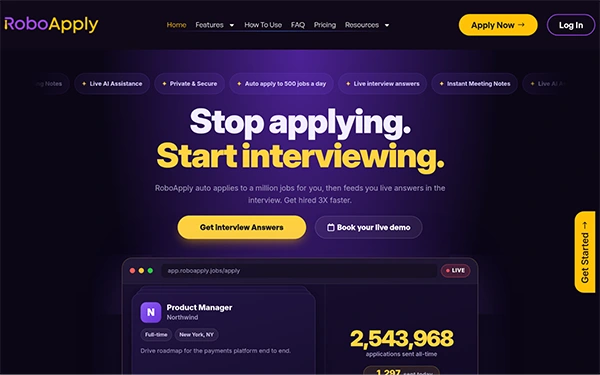
RoboApply’s clearest strength is having high-volume auto-apply and live interview coaching in a single subscription. The Auto Apply engine works on 40+ job boards – LinkedIn, Indeed, Glassdoor, ZipRecruiter, Dice, and more – rewriting the resume and cover letter to fit each posting before submitting. Monthly plans run $47 to $389 and have 129 to 1,617 AI-tailored applications depending on the tier. The platform reports a 4.8/5 average from over 6,200 reviews, and its FAQ says that tailored resumes make a 4x higher chance of an interview call versus a normal one.
The AI Interview Copilot is what really separates RoboApply from most auto-apply tools. It listens during a live video call on Zoom, Google Meet, Teams, or Webex and surfaces resume-grounded answers in around 300 milliseconds, structured in STAR format; it also has technical interviews on HackerRank and CoderPad. Full Copilot access comes with the $129 plan, and a standalone Copilot subscription starts at $29.50 a month for anyone who only wants interview support.
Career changers who need to frame experience from one job into language that fits in another will find both things very useful together. But there are limits one should know: the Auto Apply engine works via a Chrome extension on desktop, the laptop needs to stay on with Chrome open in the background, and there’s no permanent free plan, only a $9 three-day trial and a free 10-minute Copilot session to start.
2. Simplify
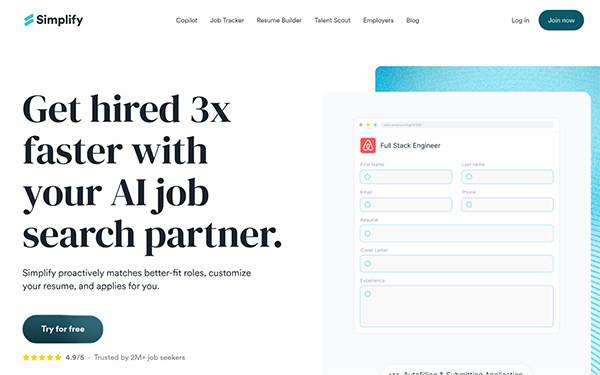
Simplify started in Y Combinator’s W21 cohort and has grown to 124 workers as of mid-2026. Its main product pulls job offers from 50+ boards and autofills application forms on company career sites via a browser extension called the Copilot. The platform says it saves users over five hours a week on applications and has a 4.9/5 rating from more than two million users.
Here’s the thing: what makes Simplify worth trying for career changers specifically is the resume tailoring layer. It extracts useful keywords from each job description and rewrites resume bullets to fit, so each submission is changed to the posting’s language, not just blasted out as the same boring document everywhere. There’s also a consolidated job tracker that pulls all submissions into one dashboard; that’s really useful when you’re applying in multiple industries at the same time.
Simplify has a free base tier with unlimited job tracking, and the premium Simplify+ subscription adds advanced autofill and tailoring options. The company was co-founded by Rushil Srivastava and Michael Yan and counts investors including Global Founders Capital among its backers. For career changers who want solid automation without a heavy monthly commitment, it’s a good starting point.
3. LazyApply
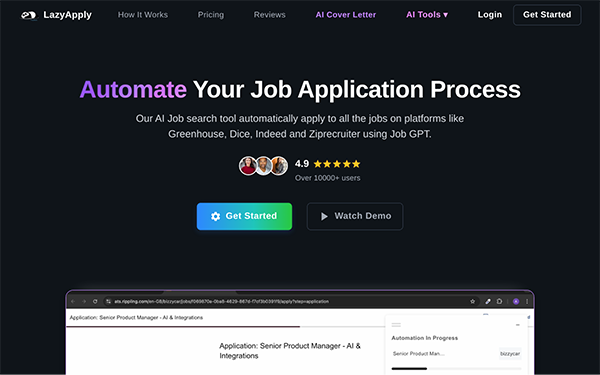
LazyApply focuses squarely on volume. Founded in 2020 and based in Bangalore, the platform applies to jobs in Greenhouse, Dice, Indeed, and ZipRecruiter using its Job GPT engine, which fills application fields from a user’s stored profile. And the smart referral feature – which sends outreach emails to employees at target companies with each application – is a real edge for someone trying to make a foothold in a new industry by warm introductions.
The platform has over 10,000 users and has a 4.9 rating. Pricing is annual: Basic at $99/year lets you send 15 applications a day, Premium at $149/year goes up to 150, and the top tier at $999/year covers 1,500 a day with 20 resume profiles and priority support. All plans come with an analytics dashboard to see applications and referral emails in real time, and a 30-day money-back guarantee applies to the board.
The entry price is really low compared to monthly-subscription competitors. So if you’re changing careers on a low budget, LazyApply needs a serious look; the referral email feature alone is something most auto-apply tools skip fully.
4. Teal
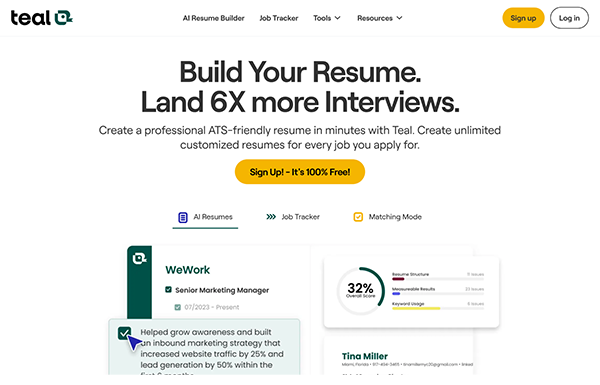
Teal takes a slower, better approach than the auto-apply tools. Started in 2019 and based in Miami, the company’s $29/month Pro plan centers on an AI resume builder that takes keywords from job descriptions and flags gaps in an existing resume, with a job application tracker that saves listings from multiple boards into one organized view.
The platform has raised $20.7 million in funding from investors like Flybridge Capital Partners and City Light Capital. It’s made for job seekers who want to manage multiple, heavily tailored resume versions for different target roles, a common case for career changers applying to two or three different industries at once. You’ll see that separate resume variants can be made and handled within the same account, which is a small but useful detail.
But Teal won’t submit hundreds of applications by itself. For someone who wants to understand exactly why their resume isn’t landing and iterate before sending, tho, it’s a great tool. The free plan has unlimited job tracking, making it easy to test before deciding.
5. LoopCV
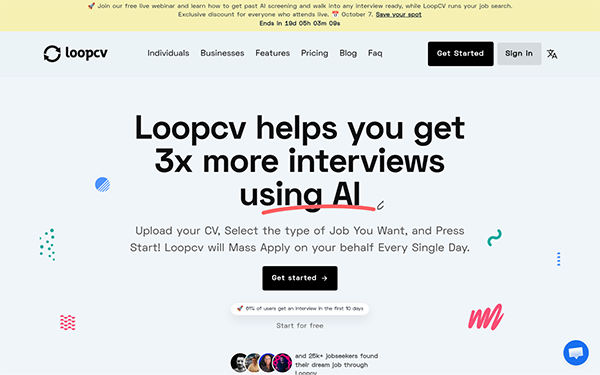
LoopCV is a Greek startup founded in 2019 that works in 90+ countries and has processed applications for 50,000+ job seekers. Its auto-apply feature works in 30+ job boards and pairs with automated email outreach to recruiters, a combination that’s rare at this price point. Paid plans start at €9.99 a month for unlimited applications, and the Pro plan at €29.99 a month adds mass apply, advanced filters, and multiple job searches at the same time.
The free-forever plan stands out most. It needs no credit card, auto-applies to a limited number of matching jobs daily, and exists in a market where most tools charge from day one. LoopCV also has CV analysis and improvement tools, a CV builder, and machine-learning-based job matching; it has a 4.1-star rating on Trustpilot from 122+ reviews.
For career changers looking in international markets – or anyone wanting an actually free way to test auto-apply before spending money – LoopCV fills a gap that few competitors touch.
What matters most when you’re changing careers
Auto-apply volume gets the most attention in reviews, but for career changers, resume tailoring is the more important thing. A resume written for one industry usually uses terminology that doesn’t carry over to another, and a tool that fires off a normal document at high volume is going to produce rejections, not callbacks. The trick is finding platforms that rewrite content per posting,g not just autofilling fields with static text.
Interview preparation is the second thing career changers tend to underweight. Getting to the interview stage is only half the problem; explaining why a background in one field makes you a strong applicant in another takes real work. Some tools here manage that by live coaching during the call itself; others focus on pre-interview study.
So here’s something worth reading before you decide on any plan: the gap between advertised daily limits and real monthly capacity. “150 applications a day” sounds like a lot until the monthly cap works out to 10 to 15 days of full-rate use. That monthly allowance number counts more than the daily ceiling for any sustained search.
Bottom Line
Top AI job search platforms for people changing careers fall into two broad camps: high-volume auto-apply tools that look for reach, and resume-plus-tracking tools that favor quality per application. LazyApply and LoopCV go toward volume and low cost. Teal and Simplify go toward tailoring and organization. The choice comes down to where the search is stalling: not enough applications going out, or not enough callbacks once they do.
Frequently Asked Questions
1. Are free AI tools as effective as the paid ones?
Ans: The effectiveness can vary. Some free tools can be very good for tasks like resume building or initial content generation. Paid tools have more advanced features, deeper analytics, and specialized functionalities. It’s better to start with the free ones to understand your needs.
2. Can a recruiter know that I use AI?
Ans: Some recruiters may use tools to detect AI-generated content; the main problem is the quality and relevance of your application. If you’ve used AI to create a highly tailored, keyword-rich, and well-written application that shows your skills, it will be fine. The goal is to use AI to enhance.
3. How do I use AI while keeping work honest?
Ans: Use AI to save time on repetitive tasks and improve clarity; keep every claim, story, and decision rooted in your real experience. Check everything and verify facts yourself, and make sure the final product represents you.