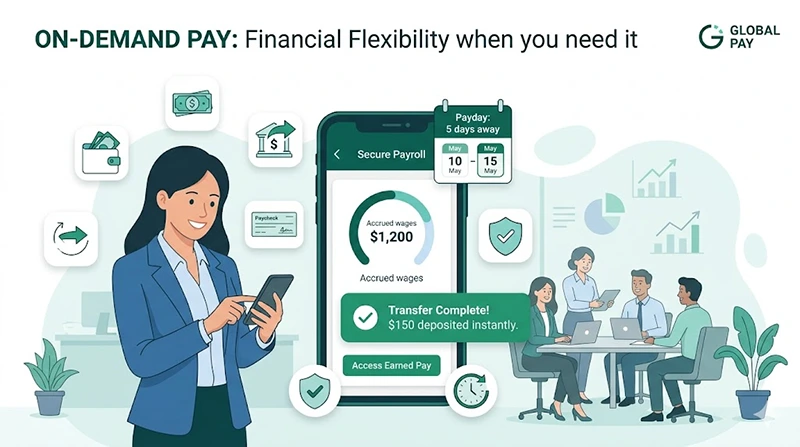
Organizations have lately adopted various remuneration payment methods, and one of them is on demand payment. On demand pay refers to a benefit where employees can access their earned wages in case of any emergency situation before the next paycheck date.
This helps employees manage unexpected expenses without relying on high-interest loans or credit.
Many organizations are adopting on demand pay to support employees. So, as an employee, you must know what on-demand pay is, how it works, the benefits and the challenges you will face if you go for this service.
What is On Demand Pay, and How Does the Service Work?
On-demand pay allows workers to get paid for hours they’ve already worked whenever they need the money, instead of waiting for the scheduled payday. This service allows employees to claim the salary they have earned without waiting for the next paycheck. Some people might confuse this with a payday loan that charges a flat interest rate on instant transfer.
On demand payroll gives employees more control over their finances, and once the approval has been given by the employer, the amount gets transferred on the same day without extra paperwork.
Some organizations have an integrated employee management system through which employees can request a demand pay service.
All the deductions and carry-forwards are automatically revised on the system and require less intervention by the employer or HR.
The other method for employees to access their earned demand pay is by defining a certain timeframe. Once completed, the employee can withdraw the amount without any hassle.
Rules and Regulations for On Demand Pay Services
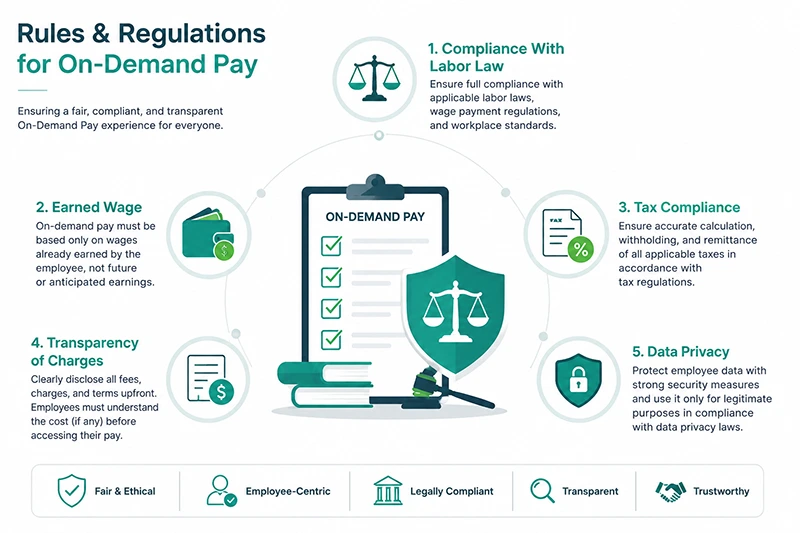
Integration of on-demand pay needs to comply with labor laws, payroll regulations, tax requirements, and data security standards.
However, these regulations vary by country, state, and jurisdiction, and no such rigid framework is being followed. So, while adopting such flexible payment in your organization, consider the following important considerations:
1. Compliance With Labor Law
Employers must ensure that overtime compensation and minimum wage are not affected while incorporating demand pay.
Organizations should ensure proper maintenance of:
- Hours worked
- Wages earned
- Payroll deduction
- Final paycheck calculation
- Paid leaves and comp off
All of these recordings should adhere to local state laws and payroll audits.
2. Earned Wage
The entire foundation of demand pay revolves around the fact that employees are accessing their earned wages. It does not allow employees to withdraw future earnings or give employers any right to charge interest.
Employees should not confuse this with a lending or credit loan.
3. Tax Compliance
One thing that needs to be cleared by the employer is that early access to wages does not eliminate the tax deductions. They must continue to calculate and withhold applicable tax deductions as per state law.
Some general deductions include:
- Pension
- Healthcare contribution
- Social Security Contribution
- Income Tax Withholding
The payroll system should actively and accurately consider these factors.
4. Transparency of Charges
While employers are in a legal position to charge fees and premium transfer fees. However, employees should be informed. This level of transparency is crucial to avoid disputes and distrust between employee and employer.
5. Data Privacy
Employees hold the right to protect their data. While all the calculations and transfers are being processed through the platform, necessary security measures should be implemented to:
- Protect payroll records
- Secure personal employee information
- Encrypt banking details
- And hide payment details
Compliance with these data privacy regulations is necessary to uphold trust and adhere to global data security compliance.
Benefits of On Demand Pay for Employees
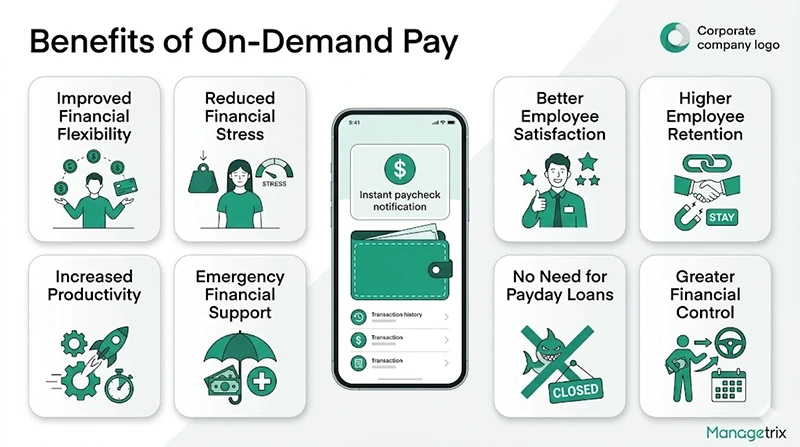
From the employee perspective, getting early access to earned wages to tackle uncertainty isn’t the only benefit they are getting.
Globally, 57% of the population lives paycheck to paycheck, and unexpected expenditures will surely put them in financial stress.
To understand this in depth, human psychology and behavior come into account. Some major noticeable benefits that are derived from the employee’s perspective include:
1. Reduced Needs of Bad Loans
By demanding pay and getting the wages early, employees can tackle uncertainty without falling into bad debt. There are tons of payday loans and third-party credit services that charge higher interest rates, which troubles the employees.
But by offering such a viable, flexible option, it allows them to avoid getting tangled with such scenarios, allowing them to work mentally free.
2. Help Employees Feel Supported
This flexible demand pay allows employees to withdraw their wages at any point in time. The reason could be due to covering personal expenditure or even something more serious like a medical emergency.
This flexible withdrawal structure acts as a support system to make them feel less vulnerable and provide an extra layer of security.
3. Reduces the Penalties and Late Interest Fees
For an employee, landing in a situation where they have to bear late interest fees is quite common.
To cover that up, relying on borrowings and high-interest payday loans is quite common. However, having a system like demand pay allows them to settle such payments and manage short-term gap flow effectively.
4. Support Budgeting Habits
By bestowing such a flexible pay system in the organization, employees get a sense of responsibility and a better idea of how they can manage their cash flow. It serves as a constant reminder of what went wrong and how they can manage their income better.
5. Provides Peace of Mind
Employees waiting for payday and being in a situation where they had to borrow from friends or family won’t have to worry about them anymore.
The flexible access to their income keeps them in a much more secure position and offers independence.
Advantages of On Demand Pay for Employers
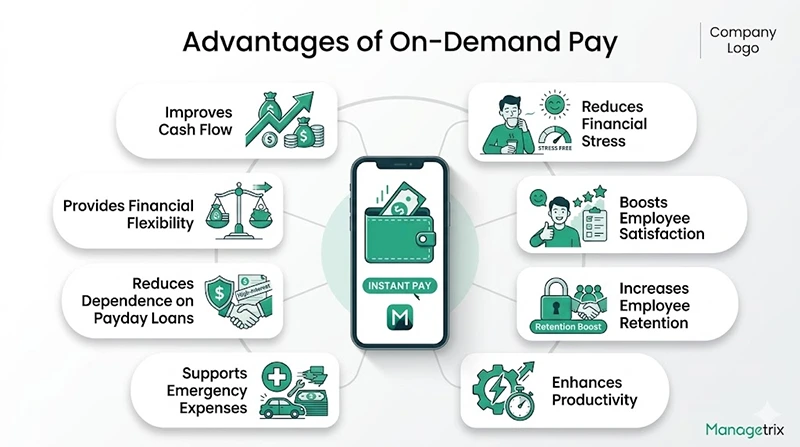
The benefits of having a demand pay system benefit both employers and employees.
1. Fosters Trust
Having such a flexible system where employees can access their earned wages at any moment showcases trust and openness in the work culture.
This ultimately reduces employee turnover and acts like an investment or a show of support to the employee. And from the employee side, you can expect high morals and work ethics for long-term resilience.
2. Boosts Productivity
The entire concept of demand pay is to create an assurance and comfortable atmosphere, making employees feel like their hard-earned money is just for them. This creates a harmonious environment that positively affects their work and outcome.
3. Provides Competitive Business Advantage
This is probably the best way to showcase why talented professionals should join your organization. Such a flexible payment system acts as a perk, allowing you to get noticed by sharp minds and retain existing talents.
4. Supports Financial Wellness
As an employee, they are prone to facing sudden unexpected expenditures or may end up under financial pressure. Having such a pay-up system reflects the fact that, as an employer, you truly care about the sentiments of your workforce and provide a broader wellness strategy.
Challenges With the On-Demand Pay System
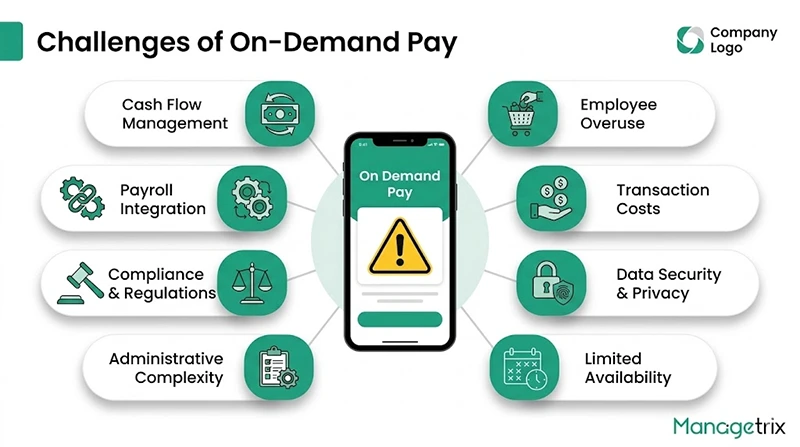
First of all, generating payroll itself is a time-consuming task, and by having this additional complicated layer, things might get chaotic.
But that’s just the tip of the iceberg, because the real challenges start when you truly incorporate such a framework.
1. Transaction Fees
Having such a system creates the primary challenge, and that is transaction fees. Employees are required to bear the premium transaction fees to pay the premium transfer service charges.
It is important that each and every employee be aware of it; generally, the amount is quite low compared to penalties and late charge interest.
2. Over-Reliance on Early Wage Access
Let’s take a hypothetical scenario where we assume the entire workforce is heavily reliant on such a flexible system. It completely slashes the concept of payday, and the funds that could be withdrawn during emergencies are not being extracted every day.
To enforce its function and ease the load, certain rules and regulations can be imposed.
3. Budget Management
This one acts as a latent issue for employees. Accessing hard-earned wages might seem like a quick way to resolve sudden expenditure stress, but ultimately, your pay grade remains the same and doesn’t really allow you to cover extensive expenses.
And if the early withdrawal continues to accumulate, it gets difficult to plan the expenditure and personal investments.
4. Compliance
Employers need to be aware of all the compliance strategies and volatile tax laws. This becomes necessary to safeguard the organization against any legal obligations.
Is It Worth Adopting?: Final Thoughts
The choice of whether a demand pay-up system is truly a worthwhile perk depends on how organizations are willing to treat their employees. Surely it’s a great initiative; however, employers must be prepped with the challenges too.
Offering flexible and on-demand pay can surely create a positive impact, and various pay-demand platforms are ready to integrate into your existing system.
One such reliable system that can be equipped to the existing system is Paylocity’s Pay Advance system, which provides a centralized payroll dashboard.
Read Next: How To Track Field Employee Productivity Without Micromanaging Your Team
FAQs
1. How much of my earned wages can I claim earlier?
Ans: The policy differs from organization to organization as many employers allow employees to access 30% to 80% of wages before payday.
2. Does claiming demand pay affect my paycheck?
Ans: Absolutely! If you are accessing your demand pay before the paycheck date, the claimed amount will be deducted from the full amount.
3. Does demand pay really improve the financial condition of employees?
Ans: Demand pay allows employees to mitigate unnecessary expenditure or tackle an emergency situation, which acts like a placebo effect. However, their salary remains the same; it’s just that they are accessing their wages a bit earlier.
4. Does on-demand pay change the payable tax?
Ans: No, our demand pay does not change the tax payable obligation. The earlier withdrawn wages are subject to deductions and reporting to the IRS.
5. How quickly does an employee get the funds through on-demand pay?
Ans: Honestly, the duration depends on organization to organization; in some cases, it gets credited within a few minutes, and in some cases, it might take an entire day.