


Most HR management tools start failing when it comes to hiring a 15-year-old, rather than adult hires, because the software cannot account for the shift in school timings and after-school practices on some days.
This is exactly why most of the rules that come along with hiring a minor for your small business have nothing to do with the payment, and everything to do with the hours they can spare and the time you need them in.
Softwares which are designed to help HR operations for normal businesses rarely ever get the feature installed for situations like this, which is exactly why they fail here.
This guide will hence tell you what the federal law limits are when hiring a minor, where the job listings matter more than the hours, and why modern HR systems start failing whenever a school schedule comes into the picture.
Key Takeaways:
- Federal law only allows a limited amount of time that a minor, especially 14- and 15-year-olds, can spend working at a business. The restriction sits at about 3 hours per day on a school evening and 18 hours in total, given that it is a school week.
- A business also has to take special permits by explaining what kind of work they require a minor for,r and without that, no job can be listed for 14- and 15-year-olds.
- Most violations that occur in a minor working for a business rarely come because of the hiring process. It is almost always directed to the schedule settings and agreement between the employer and the employee.
What the Law Actually Limits
According to the Fair Labor Standards Act, there is a minimum cap on the working hours of fourteen- and fifteen-year-olds. This means that no business is allowed to make minors work above the given limit, no matter the salary they are offering. Moreover, hourly pay is also set by this convention to protect minors from exploitation.
Eight hours once school is out for the day. Forty once it’s out for the season. One common misconception that most employers make while hiring a 15-year-old is that they read Friday as the weekend, except it’s not. As stated by the Fair Labor Standards Act, Fridays are counted as regular school days.
| Age Band | Hours on a School Day | Hours in a School Week | Time of Day | Job Restrictions |
|---|---|---|---|---|
| 14-15 | 3 maximum | 18 maximum | The usual time frame falls between 7 in the morning and 7 at dusk. However, an exception is made from 1st June to Labour Day, when this frame can be extended till 9 p.m. | Closed list of permitted jobs; everything else barred |
| 16-17 | No federal cap | No federal cap | No federal limit | Non-hazardous work only |
| 18+ | No federal cap | No federal cap | No federal limit | None |
All of these aren’t just some random figures; rather, these are figures that are directly issued by the Department of Labor. Looking at these numbers, one can easily figure out that sixteen years of age changes almost everything in how work culture is managed because a sixteen-year-old is available to work for as long as he’d like because the federal law states so. The only condition to this is that the job shouldn’t be hazardous in a way that risks his life.
Common Mistake: Most business owners tend to opt for the 9 p.m. extension for fourteen- and fifteen-year-olds, which is allowed by federal law. What they don’t take care of is that this extension only lasts from 1st June to Labor Day. This is why most of these businesses still keep working on this schedule at least until late September, when the limit has already been cut down to 7 p.m.
The Job List Matters More Than the Clock
The clock is the easy part.
The harder part and the reason why most people prefer not to hire minors, especially fourteen- and fifteen-year-olds is the constraints which comes while assigning work to them. This is because under federal law, it is stated that minors in these age groups are not allowed to conduct any work if that specific work has not been given permission by an authority figure of the government.
This is the part where it gets tricky, and most business owners don’t find getting these permissions a useful use of their time.
There is usually a category under which permitted and prohibited tasks fall. While this category is not particularly described with strict boundaries, one can figure it out themselves. Most of the permitted work that is allowed to be carried out by kids in these age groups are chores which happen in public or directly visible to a law-bound section of the business, like clerical tasks, cashiering, light clean-up,p and limited food prep.
Anything which is considered harmful to the kid’s safety is prohibited. Most tasks that involve the use of heavy machinery or toxic chemicals are prohibited, like most cooking and all baking, freezer and meat-cooler work, loading trucks, ladders, and warehouse work beyond the office.
So the deli slicer is out. So is the stockroom ladder, the trash compactor, the delivery run in someone’s car, and the mixer in the back. A fifteen-year-old can ring up the sandwich and cannot legally cut the meat that went into it. Once you’ve noticed that line, it’s everywhere.
There’s a Program That Breaks All of This
There’s a federal carve-out called WECEP, a school-run work program, and it rewrites the numbers entirely. A fourteen-year-old enrolled in an approved one can work twenty-three hours in a school week, and some of those hours can fall during school itself.
Twenty-three. Almost no employer will ever use it, which is part of what makes it worth knowing about.
Why the Schedule Is Where It Breaks
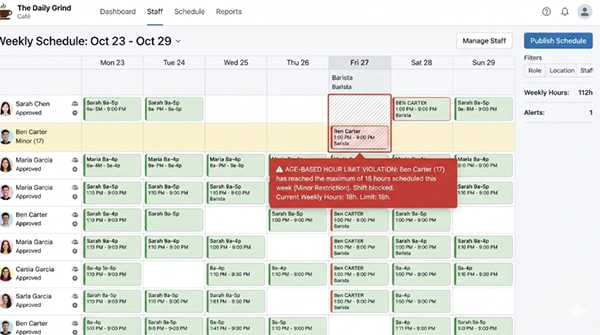
1. Build the Age Rule into the System
A handbook paragraph won’t stop a shift lead from publishing a Tuesday close. A hard cap in the scheduling tool will.
2. Lock the Time Window by Season
Business owners should treat 7 p.m. as their standard time deadline, after which minors cannot work. Build the exceptions, like the summer extensions,s from this standard. This way, you will always know what time the extension ends and will help you follow the law better. Dated exceptions beat standing permissions.
3. Track the Local School Calendar
School hours are set by the district where the minor lives, not where your premises sit. Draw staff from two districts, and you’re tracking two calendars.
4. Audit the Timesheets Monthly
It is very difficult to even notice a violation in the work hours listed for minors under federal law simply after reading a schedule that is planned for them. This is because you automatically assume that the rule is being followed, but sometimes that’s not the case.
This is why monthly checks are so important rather than annual reviews because you can catch the violations better in a timesheet that is being updated monthly. The observations you notice in an annual review do not matter because a lot of time has passed for your business to be committing the violation without you knowing.
Note: Do not directly assume that just because there’s a federal law, nothing can overturn it. Most states have their own set of rules and regulations for majority things, including work hours and wage rates for minors so checking in with your local laws is a better option rather than to know about it when it’s already too late. One such instance is that while a federal law allows unlimited working hours for a sixteen-year-old, several states put a cap on them.
Who Actually Needs the Training
Most youth-employment training is aimed at the wrong person, because the teenager isn’t the one who publishes the schedule.
A sixteen-year-old can’t approve their own close. A shift lead can, and often does, without registering that the rules changed in the second week of September when school went back.
Short-form material survives a break room better than a policy document does. Some teams script the rules once and generate the clips, and text to video AI tools are one route to that; others film a two-minute walkthrough and reshoot it when the law changes.

One rule per clip, dated, with the hour limits on screen.
The handbook still matters for the record. It just isn’t where anyone looks at six on a Thursday evening.
Wrapping Up!
Youth hiring isn’t harder than adult hiring. It’s shaped differently, with the risk sitting in the calendar rather than the contract, and it moves twice a year without anyone sending a notice.
The businesses that get this right aren’t the ones with the longest policies. They are actually the ones who have trained their HR software in a way that sets 7:00 p.m. as the standard time instead of shifting it between seasons. This way, nobody has to remember what month it is because the standard has been set. Such situations decrease the risk of violations occurring, which will help your business in the long run.
FAQs
1. Can a 14-year-old work during school hours?
Ans: No, outside an approved school-run program such as WECEP. Otherwise, the hours fall before or after the school day.
2. Do the federal hour limits apply to 16- and 17-year-olds?
Ans: No. Federal law sets no hour or time-of-day cap for them, though state law often does and hazardous-job restrictions still apply.
3. Does a parent’s written permission override the hour limits?
Ans: No. The limits are statutory, so a signed note from a parent carries no weight.
Ans: The public school district where the minor lives, which can differ from where your business operates.
Ans: Partly. A youth may work for a parent in a solely owned non-agricultural business, though manufacturing, mining, and hazardous work stay off-limits.
4. Who decides what counts as school hours?
5. Can a minor work for a family business under different rules?
Sources
- FLSA Child Labor Rules for 14- and 15-Year-Olds — U.S. Department of Labor
- FLSA Advisor: Hours Standards for Youth Employment — U.S. Department of Labor