

Ever wondered why some projects move fast while others get stuck in the endless and time-consuming email threads? The answer is a cross functional team. It is a group of people that come together from different departments and team up to chase one shared goal.
Curious how CFT teams work? Here are the cross functional team meaning, its benefits, how it is different from functional teams and common challenges this teamwork ends up facing.
What is a Cross Functional Team? Why do you Need One?
A cross functional team is a group of people with different skills, expertise, or departmental backgrounds, brought together to work on a shared project and goal. Instead of each department working alone, like marketing, sales, design and engineering, members from each respective team collaborate and share ideas to achieve the desired objectives.
Think of a cross-functional team like a soccer team. The goalkeeper blocks shots, the defenders hold the line, the midfielders control the game, and lastly, the striker scores goals. Different players with different job roles working together for the same mission, winning the match.
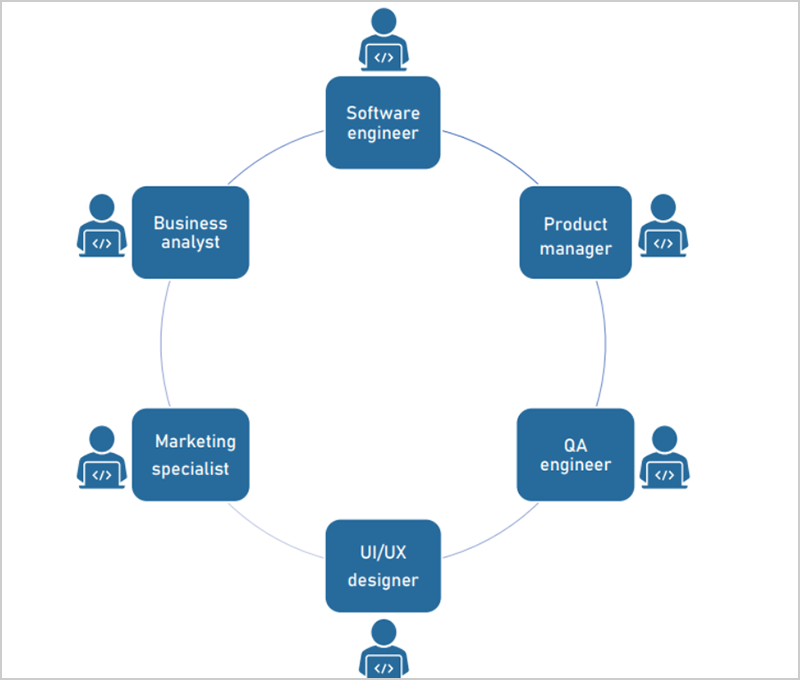
Why do you Need a Cross Functional Team?
A cross functional team allows different skill sets to collaborate on solving problems much faster than they would have if working individually in separate groups. Here are some reasons why you need a cross functional team:
- It eliminates departmental silos. They are freer to communicate and share information openly with each other.
- Accelerate decision-making by having all experts under the same roof, eliminating lengthy and time-consuming approval processes.
- Generate better ideas by combining differing views or perspectives, resulting in more innovative or creative solutions.
- Everyone is accountable for the outcomes of their work, giving less room for blame-shifting.
- Lastly, combined skill sets also make it easier for cross-functional teams to be flexible when the original plan changes.
Practical Examples of Cross Functional Teams
Here are examples how does a cross-functional team looks like in real life:
Example 1: Product Launch Squad: The designers develop the feature, the engineer builds it, the marketer explains why the customer should use it, and the customer support helps with the queries raised by the customers post-product launch.
Example 2: New Hire Onboarding: HR does all the necessary paperwork along with the orientation, IT configures the new employee laptops and updates the access to the systems, and reporting managers create a plan for the training of the employee for a couple of weeks.
Check out: What Is a Relieving Letter? Format, Importance & How to Write One
Benefits of Cross Functional Team
Cross functional team brings the diverse skilled employee together to work on a common goal. Here are some benefits:
- Faster Problem Solving
Experts from the different departments can solve the problems quickly under one roof instead of passing them between departments, waiting for approvals and losing time.
- Better Decisions
Shared perspectives are included during decision-making, which reduces blind spots. The team finds out the issues in the early stages and makes choices that work well for everyone.
- Innovative Ideas
People put together from diverse skill sets and backgrounds often develop ideas that no single department would have developed on its own.
- Improved Efficiency
With less back and forth between teams and fewer approval delays, leading projects move from idea to completion much faster.
- Reduced Silos
As departments collaborated, they started understanding the other department’s challenges and workflows, leading to improved collaboration even after the completion of the project.
- Better Customer Experience
Each team brings a combination of expertise to the table; the client receives solutions to problems based upon multiple angles and POV’s.
- Higher Employee Engagement
Employees who work alongside new people & learn new skills find their workplace more interesting and build connections across different departments.
What is Cross Functional Team Leadership?
Cross functional leadership means guiding a group of people from different departments toward a common goal. The leader’s work is to connect different skills, working as a single unit rather than separate parts.
Core Responsibilities of a Cross-functional Team Leader are:
Set Clear Goals: Ensure that everyone understands the shared objective and how their work fits into it.
Assign Roles: Define who owns what, so tasks don’t overlap or fall through the cracks.
Manage Communication: Keep information flowing between departments and clear up the confusion due to different styles of work.
Handle Conflicts: Steps in when priorities conflict and helps the team find a fair way forward and maintain the work ethic.
Track Progress: Monitors deadlines and deliverables to keep the project on time.
Make Final Calls: Owns key decisions when the team can’t agree.
Build Trust: Creates an environment where people feel comfortable sharing ideas and concerns across different departments.
Read Next: How to Write a Leave Letter for Work? Here is the Format with 10 Unique Samples
Difference Between Functional and Cross Functional Teams
Check out the difference between functional and cross functional teams for better clarity.
| Attribute | Functional Team | Cross Functional Team |
| Members | People from the same department sharing similar skills. | People selected from different departments like design, marketing, and sales working together as a team. |
| Reporting | Reports to one manager. | May report to a team lead or multiple managers across departments. |
| Goal | Focused on goals that matter to that one department. | Focused on one shared goal that benefits the whole company. |
| Structure | Permanent and stable with routine tasks assigned. | Often temporary, formed for a specific project with new tasks daily as per the requirements. |
| Skill Set | Specialized in one area | Broad and varied, combining different skills to solve the full problem |
| Flexibility | Lower (Since the team follows set roles and processes daily). | Higher (the team can adjust quickly when priorities or goals shift). |
| Example | An entire HR department handling all HR tasks. | HR, IT, and a hiring manager teaming up just for onboarding. |
| Best Suited for | Routine and ongoing work with clear and repeated processes. | Complex problems that often need input from multiple areas of expertise. |
Suggested Read: What is Unlimited PTO and How to Utilize It Effectively?
Common Challenges Faced by Cross Functional Teams with Solutions
According to Harvard Business Review, “75% of Cross-Functional Teams Are Dysfunctional”. The only reason behind this can be the common challenges faced by the teams that go unresolved. Below are the common challenges along with the solutions that you need to note from the start.
Challenge 1: Unclear Roles and Responsibilities
Team members generally do not understand who is responsible for which part of the project. This leads to either an overlapping of duties or a lack of performance in areas that need to be completed.
Solution: Before you start the project, write out what role assignment is expected from each member and select a single point of contact or, say, a cross-functional team leader for the final as a final decision marker for every area.
Challenge 2: Poor Communication
Departments use various tools, terminology and procedures to communicate information among themselves, resulting in poor understanding.
Solution: Use a single platform to provide communication to all members. Utlilize basic and same measures when providing status reports.
Challenge 3: Conflicting Problems
Depending on how individual members report to their managers, the department’s goals may conflict with the overall project’s goals.
Solution: Obtain buy-in from all department heads at the beginning of the project. Clearly define the single objective of the project.
Challenge 5: Lack of Accountability
Since the responsibility for the success of the project is shared, no one feels responsible for the specific tasks.
Solution: Identify and assign the ownership of the project in the beginning and track the process through in a central location or sheet.
Challenge 6: Resistance to Collaboration
The majority of members have worked alone and may be resistant to giving up control or being held accountable by others.
Solution: Establish clear goals and metrics that indicate success is dependent upon all team members, not just individually.
Key Takeaways
- A cross functional team combines individuals from various functions (i.e., marketing, sales, design, etc.) working towards a common objective.
- Cross functional teams accelerate problem solving and decision making.
- Common benefits include faster execution, better-informed decisions, more innovative ideas, stronger cross department relationships and higher employee engagement.
- Functional teams are permanent, specialized, and report to one manager. On the other hand, cross functional teams are usually temporary and pull together a wider mix of skills for one specific project.
- The biggest challenges are unclear roles, poor communication, conflicting priorities, and low accountability.
FAQs
1. Do cross functional teams work remotely?
Ans: Yes, cross functional teams can work remotely by staying connected on a single digital communication medium and updating all the work reports and status to the cross functional team leader.
2. What is cft team full form?
Ans: The CFT full form is a cross functional team.
3. What are the cross-functional teams examples?
Ans: A product development team is one of the examples where developers, designers and marketers work together to achieve a common goal.
