

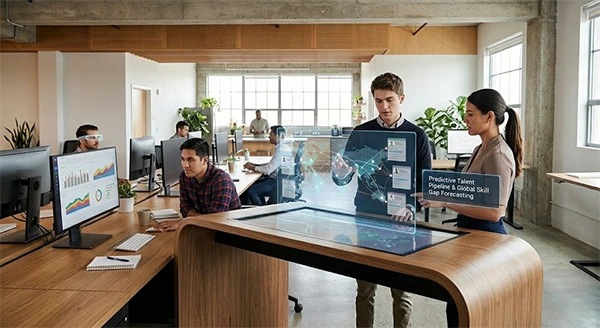
Have you noticed how data science has quietly started reshaping most of the recruitment hiring? From the traditional processes of manual resume review and dependence on gut feeling, businesses have started relying on automation and market data.
As a result, workforce demand decisions have become predictive, practical and realistic. Considering the rising growth, experts have asked professionals to go for data science courses for a bright and in-demand future.
Continue reading to learn how data science is transforming hiring and workforce demand.
Key Takeaways
- Data science is transforming hiring from a gut-based process to data-based decision-making.
- Businesses now take advantage of predictive tools to prepare for the future workforce demand and skill gaps.
- Future hiring trends will depend more on practical skills, automation and workforce reskilling.
The Growing Role of Data Science in Modern Recruitment
A few years back, recruitment was all about manual and lengthy processes. HR teams have spent days reaching out to the right candidates, then conducting screening rounds, interviews and manual decisions.
But in today’s technology-driven market, recruiters leverage data science and analysis to conduct massive hiring in real time. While the experience and the education still play a crucial role, recruitment professionals now move smartly with behavioural analysis, skills compatibility and long-term performance metrics.
Understanding this shift, students are encouraged to enrol in the Data Science course that teaches them practical skill-building and data analysis.
How Companies Use Data to Identify Top Talent
With the traditional approaches, a major challenge to better identify the right talent was critical. Analysis was limited to academic qualifications and previous experience. But for selecting a perfect fit for the role, relying only on these factors is not enough:
Data science allows companies to look beyond surface-level information.
Hiring professionals now look for behavioral assessments, work history patterns, learning skills, and communication and collaboration skills.
With this detailed analysis of the candidate profile, including confidence levels, problem-solving skills and additional insights, companies can leverage data to reduce uncertainty and identify the top talent.
The Impact of Predictive Analytics on Workforce Planning
In this uncertain job market, candidates have various options to switch. Using predictive analysis for building future workforce planning is essential.
When used the right way, predictive analysis helps businesses to forecast staffing demands, skill gaps and future hiring trends based on history and real-time data.
For instance, companies can understand industry growth patterns, productivity levels, and seasonal staffing demands to create and reshape hiring strategies even at the last minute or for urgent requirements.
This proactive planning not just prepares an organization for urgent needs, but also saves time, boosts productivity and helps businesses remain competitive.
Why Data Science Skills Are in High Demand Across Industries

The effect of data science is not limited to technology companies and can be easily seen in various other industries such as healthcare, finance and education. This is because of the widely present data. Customer service, sales management and other workforce – all produce valuable data at every moment.
As a result, organizations look for professionals who can truly analyze this data and turn it into valuable insights. This rising demand for data science skills has boosted the value and demand for data analysts, machine learning engineers and AI researchers.
Interesting Fact
A recent workforce analysis has shared that 1 out of 10 job postings now share data science skills, even in non-technical roles. (Source: LinkedIn)
AI and Data-Driven Decision-Making in HR Management
Human resource management has majorly evolved with the integration of AI and data science technology.
A few years back, HR teams managed administrative tasks such as attendance tracking and payroll management. But today, intelligent systems automate many such processes while providing deeper workforce insights.
AI-powered tools can now screen resumes with AI, recommend suitable candidates and even take over their online interviews. This creates a more adaptive and employee-focused workplace environment.
Future Hiring Trends Shaped by Data Science and Automation
The future of hiring is continuing to be increasingly intelligent, automated and skill-focused.
With the growth in AI tools, companies are designed to rely more on predictive hiring systems that ensure the fulfilment of the workforce and meet emergency needs.
Several other hiring trends in the future will include
- Skill-based hiring: Companies shift focus from degree-based hiring to skill-based hiring.
- AI-assisted recruitment: Recruiters are more likely to rely on AI-assisted hirings than manual ones.
- Remote global hiring: Data-driven hiring platforms will make it easier to choose the best talent from all around the world.
These advancements are not to replace humans, but to make their process easy, effective and advanced.
Conclusion
At the end of the day, data science is not just limited to technical departments and scientific research. It effectively directs the way organizations hire, organize the management structure and make decisions accordingly.
Businesses can take advantage of data analytics and AI tools to find the right talent, boost their productivity at work and align their business professionals from the industry.
As hiring gets advanced with smart systems and data science skills, it will remain a key force to define the future and fulfil demand worldwide.
FAQs
1. How is data science changing the hiring process?
Ans: Data science helps organizations to continue the hiring process more smartly, with ease and with AI tools.
2. Why are data science skills becoming so important?
Ans: Because every industry produces data, and every industry wants to make better decisions while utilizing those.
3. Will AI replace humans?
Ans: No, AI is not here to replace human beings but to make their work smarter, more effective, and more precise.
