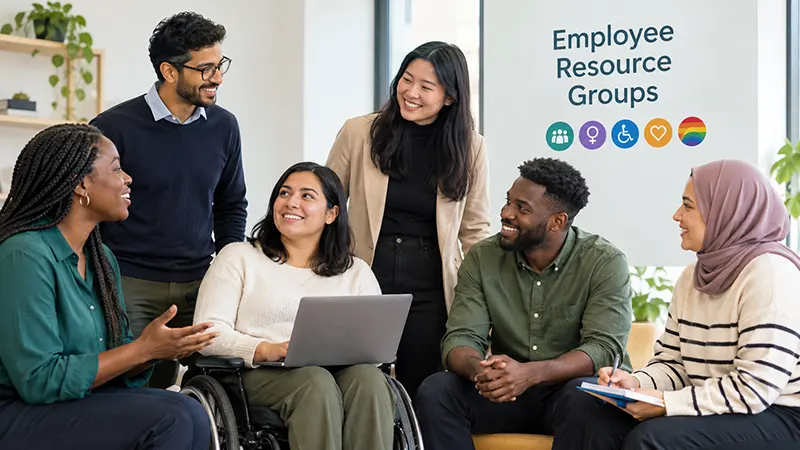
Employee Resource Groups (ERGs) are voluntary, self-made groups based on shared identities and life experiences, such as gender, race, ethnicity, cultural backgrounds, disabilities, and more. To establish an inclusive and successful ERG, identify the need, find suitable founding members, create an action plan, secure resources, and finally establish one.
According to McKinsey, 90% of the Fortune 500 companies have ERGs, which highlights their essence and importance for an organization to be successful and inclusive. It helps attract and retain top talent, foster belongingness, and create a safe and inclusive space for employees, ultimately improving their performance. Follow this article to learn more about what employee resource groups are, their benefits, how to build one, and best practices.
What Is an Employee Resource Group? Why Is It Beneficial?
The Society for Human Resource Management’s definition of ERGs, or employee resource groups, states that they are voluntary, employee-led groups that aim to create a more inclusive work environment by fostering a sense of belonging for individuals with shared identities or experiences.
Also known as affinity groups or business resource groups, these are sponsored by the organization and aim to represent underrepresented groups, such as women, people with disabilities, LGBTQIA+, the Black community, and more.
Here are the characteristics of Employee Resource Groups (ERGs):
- ERGs offer voluntary participation.
- These are centered around shared identity, such as gender, race, disability, sexual orientation, ethnicity, and veteran status.
- ERGs now also include shared life experiences, such as parenthood, caregiving, and physical and mental health.
- Backed and sponsored by organizations with a dedicated operational budget.
- ERGs promote diversity, equity, and inclusion (DEI), which can boost job satisfaction and engagement.
- Offers skill-building platforms and overall professional development.
What Are the Benefits of Employee Resource Groups?
The benefits of ERGs include:
- Supports DEI Initiatives: ERGs complement an organization’s Diversity, Equity, and Inclusion (DEI) initiatives, making the workplace a safe, inclusive space where employees are respected and heard.
- Improve Employee Engagement and Job Satisfaction: By enabling employees to voice their concerns and participate in meaningful initiatives, ERGs significantly boost engagement and connection with an organization.
- Establishes a Sense of Belonging: ERGs bring employees with shared identities, experiences, or interests together and create a supportive community, which reduces the feeling of isolation and creates open spaces for communication and peer support.
- Supports Branding and Innovation: ERGs function as a mini think tank in many organizations, and their diverse knowledge and perspective on consumer-sensitive branding drive market growth and relevance.
- Leadership Development: ERGs are best known for providing professional development opportunities through their training programs, leadership roles, and mentorship, which support employees’ professional development and help them assume leadership roles.
What Are the Different Types of Employee Resource Groups?
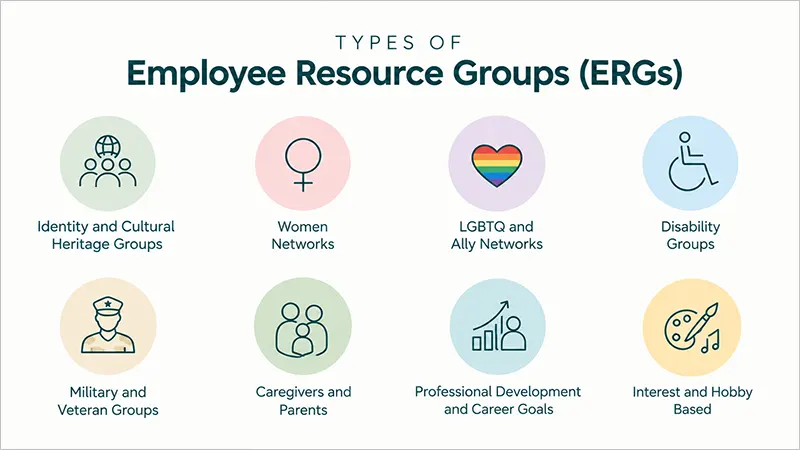
Employee Resource Groups (ERGs) are centered around various identities, including gender, race, ethnicity, disability, veteran networks, and more.
Here are some common types of employee-led groups that you must be aware of:
- Identity and Cultural Heritage Groups: These ERGs focus on shared race, ethnicity, cultural backgrounds, or nationality. For example, Hispanic cultural groups, Black employee networks, etc.
- Women Networks: Aim to empower women and non-binary communities by providing training and mentorship programs while supporting women in STEM roles.
- LGBTQ+ and Ally Networks: Help create a safe and inclusive workplace for queer groups and allies by offering inclusive policies.
- Disability Groups: ERGs based on disability groups advocate for physical, digital, or neurodivergent accessibility across the workplace.
- Military and Veteran Groups: Support military veterans, their smooth transition into civilian life, career development, addressing unique needs, and upskilling through veteran-friendly policies.
- Caregivers and Parents: Unite working mothers, fathers, and employees taking care of the elderly by offering support and resources.
- Professional Development and Career Goals: Group employees with the same ambitions and long-term career goals, specifically young professionals, to provide employee development plans, career opportunities, and mentorship.
- Interest or Hobby-Based Groups: Connect workers with the same interests, hobbies, personal wellness goals, or community services.
How to Build Employee Resource Groups (ERGs)? Step-By-Step Process
To build employee resource groups, first, identify their need and purpose. Then, find suitable leaders and founding members and create an action plan outlining the short- and long-term objectives.
Secure resources, communicate about your ERG, and finally launch with proper debriefing. Here’s a step-by-step process of building an ERG:
Step 1: Identify the Need
Begin by identifying why the ERG is needed and which employee group or shared interest it will advocate for. The key is to communicate with employees, understand their concerns, and find the gaps.
Important Questions To Address Before Building an ERG
- Is there any underrepresented community that needs upliftment?
- Do employees with shared interests feel gaps in belongingness?
- What are the communities that exist informally and can benefit from improved support?
Therefore, start by talking to employees. Here’s what you need to do:
- Identify an employee group or community that needs support.
- Gather feedback and suggestions.
- List the concerns and aims of the ERG.
- Ensure that the ERG’s purpose aligns with the company’s broader objectives and inclusion goals.
Step 2: Find Leaders, Founding Members, and Employees
The second step is to find the leaders and founding members who can organize activities, communicate with members, have time and interest, and actively take leadership roles to manage a community.
Here’s what you need to do:
- Find 3-5 founding members before launching an ERG.
- Invite employees to volunteer for leadership roles.
- Select a suitable ERG leader and co-leaders.
- Define responsibilities for leaders and members.
Additional Recommendation: Consider having a co-leader for delegation of responsibilities.
Step 3: Create a Charter and Action Plan
Once a team is formed, establish a plan of action detailing how it will operate, its purpose, who it will serve, who will make the decisions, and how it will measure success.
Here’s a list of things you need to decide before going public with your ERG:
- Annual or quarterly activity plan.
- Who will make the decisions, and how will they be made?
- What are the goals and measurable outcomes?
- Establish rules, guidelines, meeting frequency, and communication channels.
Step 4: Secure Resources and Budget
Get your ERGs backed by the organization’s sponsorship. Connect your ERG with an executive sponsor and set an annual dedicated budget for operational activities.
Here’s what you need to do:
- Find an executive sponsor or a senior leader.
- Decide on a realistic annual budget for regular operational activities.
- Connect ERGs with broader DEI initiatives and relevant HR programs.
- Ensure that participation in ERG activities is supported within employees’ work schedules.
Expert Recommendation:
Ensure that the senior leaders or executive sponsors support ERG initiatives without controlling and derailing their agendas.
The whole idea of an ERG is to make a space inclusive, comfortable, and shared; hence, avoid leadership that is too rigid and authoritative.
Step 5: Communicate the Launch
Before actually launching an employee resource group, communicate about it. Most ERGs fail because other employees rarely know about them.
Here are some ideas on how to communicate the launch of an ERG:
- Create a digital platform that allows members to connect, share thoughts, engage, and stay informed.
- Host an introductory meeting or an event.
- Organise discussions, workshops, networking, and other fun events in collaboration with the HR department for an official announcement.
Step 6: Launch, Engage, and Measure
Finally, launch your ERG with a clear introduction, describing its goals, objectives, aims, activities, and membership process. Give clear instructions about how to join, what members can expect, and what their roles and responsibilities will be.
Here’s what you need to do:
- Set the performance metrics.
- Organise regular meetings, workshops, mentoring, and other networking activities.
- Collect regular member feedback.
- Track participation, engagement, and progress towards predetermined goals.
Employee Resource Groups Best Practices
Setting clear goals, measuring the impact, ensuring leadership support, and creating structured communication channels are the employee resource groups best practices.
1. Strategise and Set Clear Goals
Many ERGs fail because goals are unclear and they do not align with broader business objectives. Hence, the right strategy is to define what it aims to achieve and connect its objectives with employees’ needs and organizational priorities.
- Set 2-3 measurable goals.
- Review them regularly.
- Connect ERG goals with DEI and employee-development initiatives.
Example
Avoid:
“Improve career opportunities for women.”
Instead, define goals like:
“Launch a monthly mentorship program that pairs 20 women employees with senior professionals to support career development.”
2. Ensure Leadership Support
For an employee resource group to sustain and function properly, it requires an executive sponsor who provides guidance, visibility, and resources (monetary and non-monetary).
- Assign an executive sponsor/partner.
- Provide a realistic budget.
- Give ERG leaders access to relevant decision-makers.
- Keep the leaders and members informed and aligned, and create a welcoming community.
3. Measure Impact
Measuring impact is the most crucial employee resource group best practice because if goals are not measurable, it becomes difficult to determine whether the ERG is actually benefiting the organization or not.
Use the SMART- specific, measurable, achievable, realistic, and time-bound method while measuring impact.
- Monitor the event attendance and participation.
- Collect employee feedback.
- Track mentorship and development activity
- Review progress against established goals.
- Identify the gaps and prepare an action plan to improve them.
Measuring the Impact of ERGs: 4Cs Model
Given by an expert, Dr Rodriguez, the 4C model maps the core four pillars- culture, career, community, and commerce to measure the impact of ERGs.
- Culture: Measures how ERG promotes Diversity, Equity, and Inclusion (DEI).
Metrics Tracked: Employee participation, feedback, and belonging score.
- Career: Measures employees’ overall professional development.
Metrics Tracked: Mentorship programs, workshops, internal promotions, and new opportunities.
- Community: Measures unity, belonging, and social responsibility
Metrics Tracked: Volunteering, partnerships, CSR activities.
- Commerce: Checks alignment with broader business goals and objectives.
Metrics Tracked: New ideas, innovation, participation in diverse markets.
4. Create Structured Communication Channels and Feedback Mechanisms
To promote transparency, create structured communication channels in terms of who will address the grievance, who will collect the feedback, and more. It becomes easier for employees to share their ideas, concerns, and suggestions.
- Use dedicated channels like Slack, Teams, or internal forums for ERG communication.
- Conduct periodic surveys and collect feedback.
- Regular check-ins to understand members’ concerns and suggestions.
- Track feedback and communicate how it is being addressed.
Examples of Employee Resource Groups: Real and Successful
Veterans and Supporters at Dell Technologies, Asian and Pacific Islanders at Microsoft, Women Techmakers at Google, and Families in Amazon at Amazon are the top real-life successful examples of employee resource groups.
Here’s everything you need to know about these ERG examples:
1. Dell Technologies
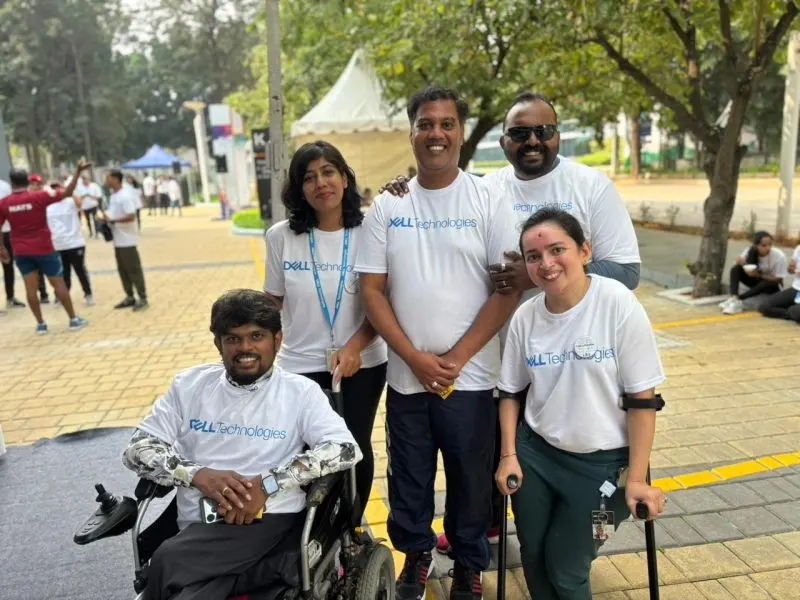
Dell Technologies is known for its 13 ERG groups, advocating for multiple shared identities and experiences. To name a few:
- Asians in Action
- Black Networking Alliance
- Family Balance
- Latino Connection
- Pride
- Veterans and Supporters
- Women in Action
2. Microsoft
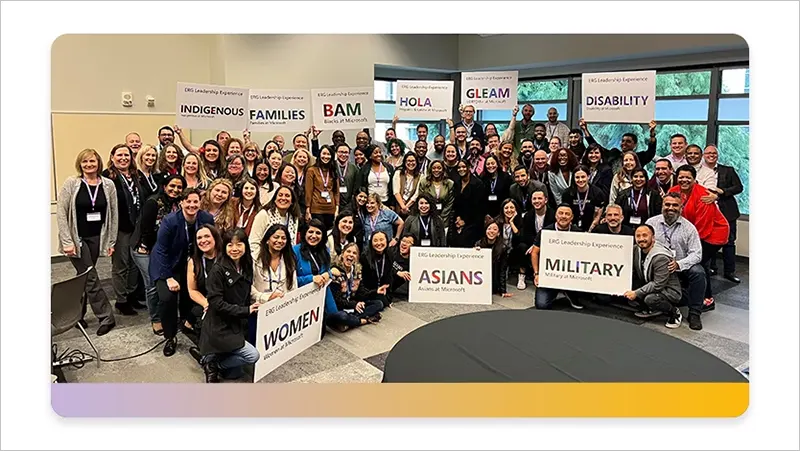
Beginning in 1989 with Blacks at Microsoft (BAM), it now has over 9 employee resource groups, each based on promoting various races, cultures, ethnicities, genders, and professions. It includes:
- Black and African Communities
- People with Disabilities
- LGBTQIA+
- Military and Veterans
- Women
- Asian and Pacific Islander
- Indigenous
- Families
- Hispanic and Latinx
It also offers the Microsoft Disability Scholarship, helping students with disabilities to get an education and pursue a career in tech.
Did You Know?
According to Microsoft’s Global Diversity and Inclusion Report, 81.2% of employees agreed that the company fosters a diverse and inclusive culture, making it a big success for an organization.
3. Google
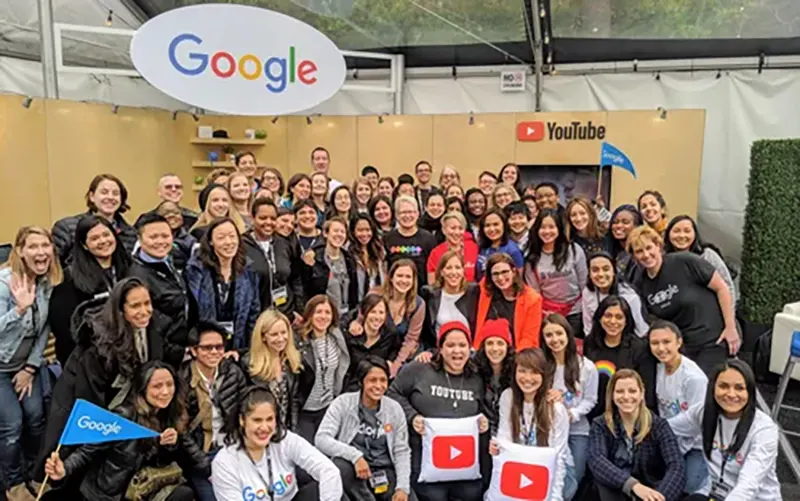
Google is known for its Women Techmakers resource group, with over 412 events held and 83k attendees, making it one of the most popular and successful examples of employee resource groups. It empowers women and creates a shared space for women in tech. However, Google has officially handed over its Women Techmakers career resource program to a non-profit organization, Technovation.
Apart from Women Techmakers, Google’s Belonging features multiple employee resource groups, such as:
- Disability Alliance
- Interbelief Network
- Black Googler Network
- Pride and Trans
- VetNet (Veterans)
- Asian Google Network
- Hispanic Googlers
4. Amazon
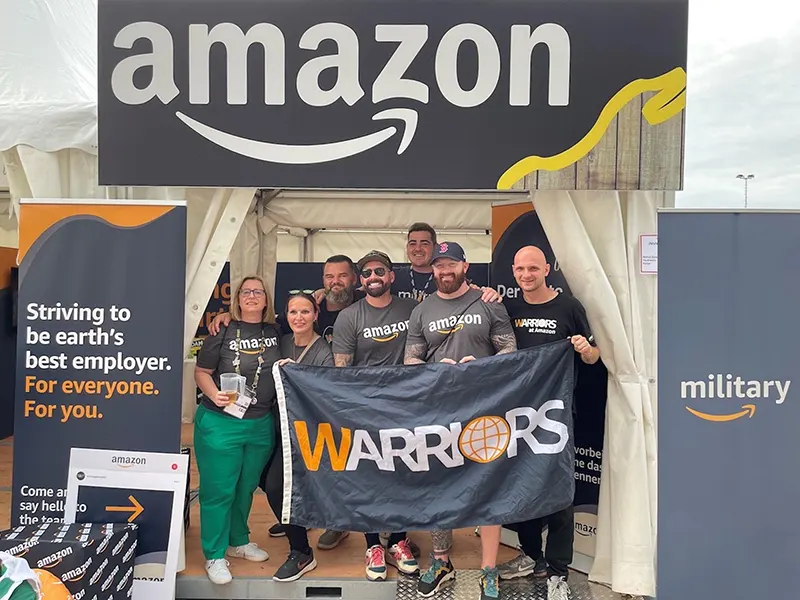
One of the best examples of employee resource groups at Amazon is Families at Amazon, which aims to unite Amazon caregivers and allies and supports anyone with an interest in caregiving and enthusiastically welcomes diverse perspectives, locations, and life situations.
Featuring over 10 more ERGs, Amazon includes:
- Women at Amazon
- Warriors at Amazon
- Mental Health and Well-Being
- Glamazon
- Black Employee Network
Why Do Most ERGs Fail? What Are the Solutions?
Lack of SMART goals and leadership support, low employee participation, poor communication, overburdened leaders, and no performance metrics are why most ERGs fail.
Here’s why most ERGs fail and how you can save yours:
| Why Do Most ERGs Fail? | Solutions |
| Unclear Goals |
|
| Lack of Leadership Support |
|
| Low Employee Participation |
|
| Poor Communication |
|
| No Performance Metrics |
|
| Overburdened ERG Leaders |
|
Also Read: Individual Development Plan Examples & Template for 8 Scenarios
Final Thought
To sum up, employee resource groups are the most crucial factor for an organization to foster inclusivity and create a sense of belonging for underrepresented groups sharing the same life experiences and identities. However, to really sustain your ERG, it is essential to identify the gaps and the need to build one. Getting it backed by the organization makes it ironclad and improves visibility and functioning.
Frequently Asked Questions (FAQs)
1. What are employee resource groups?
Ans: Employee resource groups are self-made, employee-led groups that unite staff based on shared activities, backgrounds, and life experiences that foster a sense of belonging and support professional growth.
2. What do employee resource groups do?
Ans: Employee resource groups bring together employees with shared identities, life experiences, or interests to build a healthy community and support inclusion in an organization. They organise mentorship, workshops, and networking events while providing employees with a platform to share ideas and concerns.
3. Do ERGs really make a difference?
Ans: Yes, ERGs are proven to be beneficial when they have clear goals, active participation, and strong organizational backing. They are known to improve employee retention, engagement, strengthen workplace unity, support career development, and help employees feel included and heard.
4. How to start building an employee resource group?
Ans: Begin by identifying the need for the employee resource group you’re planning to build. Then, find suitable leaders and founding members and create an action plan outlining the short- and long-term objectives. Secure resources, communicate about your ERG, and finally launch with proper debriefing.
5. Are companies getting rid of ERGs?
Ans: No, companies are not getting rid of ERGs; rather, they are restructuring their functioning for improved inclusivity and alignment with broader organizational objectives. Their continued presence at some of the world’s largest companies, such as Google, Microsoft, and Amazon, highlights their relevance.