


Effective self evaluation examples are not the one that states vague facts; rather it helps you highlight your achievements, reflect on your strengths, and identify areas for improvement while drawing an action plan for improvement and future career growth. According to McKinsey, two in five organisations use both upward and downward evaluation in individual performance reviews.
This shows how a comprehensive feedback system is not universally adopted, and in such a case, self-evaluation becomes crucial. Whether you’re looking for a promotion discussion or a performance review, evidence-backed evaluation goes a long way. This article covers self evaluation examples, templates, and tips to help you create a credible self-assessment report.
What is Self-Evaluation? Why Is It Important?

According to the US Office of Personnel Management, self-assessment or self-evaluation refers to a reflection on an employee’s performance, successes, and areas of improvement, helping create a two-way conversation between an employee and the manager to identify gaps in the supervisor’s perspective and discuss performance and future goals.
In simple words, self-evaluation is a structured process in which employees identify and reflect on their strengths, weaknesses, and areas of improvement over a specific period to outline their performance in a company.
Why is Self-Evaluation Important?
Self-evaluation is crucial to:
- Highlight your accomplishments which otherwise might go unnoticed.
- Reflect on your strengths and weaknesses to improve your skills.
- Open two-way communication between the employee and the manager, allowing the supervisor to understand the employee’s perspective.
- Showcase your accountability and ownership.
- Discuss career development, promotion opportunities, and future growth.
Self Evaluation Examples for Performance Review
While self evaluating, the only key is to present a balanced review of your strengths, areas of improvement, and the action plan for improvement. Backing your strengths with evidence and weaknesses with an action plan often lends credibility to your self-evaluation.
Here are some self evaluation examples you must consider:
1. Self Evaluation Examples for Technical Skills
Being specific about what technical skills you master and what you’re willing to learn is the best way to present a self-evaluation. Rather than simply stating, “I have excellent technical skills”, show how your technical skills helped you solve problems and achieve favourable outcomes.
Here are self assessment examples for technical skills:
Strength Examples:
- One of my strongest suits is Google Analytics and Google Search Console, which helped me analyze website traffic and user behaviour, optimize SEO strategies, and increase organic traffic by 35%.
- I used Microsoft Excel (Pivot Tables, VLOOKUP, XLOOKUP) and automated a monthly sales report, reducing the time spent on report generation by 40%, while significantly improving data accuracy.
Weakness Examples:
- Strengthening my SQL skills by completing an advanced SQL certification course and practicing complex queries is the next step that I want to take for future growth.
- I plan to learn Python for data analysis and the relevant libraries, such as Pandas, NumPy, and Matplotlib, through an online course and work on real data to gain hands-on experience in generating business insights.
2. Self-Evaluation Sample Answers for Communication Skills
While writing about communication skills, give a brief idea of how your communication skills have helped you collaborate and manage clients efficiently. You can mention your ability to share information or be a good listener that eventually contributes to successful outcomes.
Here are some self-evaluation sample answers for communication skills:
Strength Examples:
- My strong communication skills helped me collaborate with a cross-functional team, and delegate tasks efficiently, reducing the workload by 20%.
- I actively listen to colleagues and clients, helping resolve conflicts and concerns while maintaining positive relationships.
Weakness Examples:
- Sometimes I struggle with concise reporting, providing more details than necessary. Over the next review period, I will focus on concise business writing to improve readability.
- While I communicate confidently in small teams and brainstorming sessions, I aspire to be more confident when presenting to senior leadership. Hence, I plan to take a communication workshop to build more confidence, get more opportunities, and present effectively.
3. Self Performance Review Examples for Leadership
Leadership does not only include managing or overseeing a team. Active leadership involves taking accountability, decision-making, and conflict resolution. Therefore, while writing leadership in self-evaluation, mention how it improved team performance, solved concerns, and inspired peers.
Here are some self-evaluation sample answers for leadership:
Strength Examples:
- I successfully managed cross-functional teams, delegated tasks, resolved conflicts, and completed the project ahead of time while maintaining high-quality deliverables.
- I led two mentorship sessions for new employees during this review period and successfully conducted onboarding, weekly training, and mentorship, enabling them to become fully productive within 6 weeks.
Weakness Examples:
- I aspire to strengthen my mentoring skills by gaining more consistent practical experience mentoring new employees.
- Sometimes, I feel overwhelmed with the high-stakes decisions that involve multiple clients and stakeholders. To improve this, I plan to participate in leadership development courses and workshops, while seeking regular feedback from senior managers.
4. Self Performance Review Examples for Adaptability
Rather than simply stating that you’re highly adaptable in your self-evaluation sample answers, focus on saying how your adaptability is an asset to the organisation. Write your self-evaluation in a manner that shows your willingness to adapt to the changing technologies and business environment.
Here are some self performance review examples for adaptability:
Strength Examples:
- During changing client requirements, I quickly adapted to their needs and restructured the project, collaborated with the stakeholders, and ensured high-quality deliverables despite multiple revisions.
- I quickly understood the changing technology in the business environment and independently learned Artificial Intelligence (AI) to incorporate it in my workflow, reducing the research time by 25%.
Weakness Examples:
- Although I’m adaptable to the growing business environment, keeping up with the emerging technologies is overwhelming personally. Therefore, I intend to improve this by dedicating 2 hours a day to professional certification courses and training programs.
- While planned changes feel comfortable and easily adaptable to me, I aspire to be more confident and comfortable in making quick decisions during unexpected business changes.
5. Self-Assessment Examples for Productivity
While employee productivity is often linked to sitting longer hours and being busy, the actual productivity is about delivering the results efficiently and promptly. Therefore, write your self-evaluation in a manner that shows how your productivity increased the output and reduced the time taken.
Strength Examples:
- I consistently complete the assigned tasks ahead of time without compromising the quality standards, enabling the team to take on additional client work.
- To boost my productivity, I structured my task management using Outlook and Microsoft Planner, which enhanced workload visibility and helped me plan workflow and manage multiple projects without missing a deadline.
Weakness Examples:
- I plan to improve my productivity further by planning my day, analyzing how I spend my workday, and eliminating the low-value activities that do not directly contribute to the key business goals.
- An important step that I want to take to boost my productivity is reducing the time spent on routine tasks by automating them through various automation tools.
6. Self-Assessment Examples for Critical Thinking and Problem-Solving
Critical thinking and problem-solving require you to demonstrate your abilities to evaluate the situations, identify the root cause, and take appropriate actions. To present this, you must mention how you analysed the problem, what approach you took, and how you achieved a favourable outcome.
Strength Examples:
- When an unexpected risk disrupted the project delivery timelines, I identified the root cause, considered multiple solutions, and chose the most practical approach, which helped me complete the project on schedule.
- By carefully analysing the clients, stakeholders, and upper management’s feedback, I identified the process gaps and reduced the expected project time by 20% by implementing a standardized workflow.
Weakness Examples:
- Although I carefully evaluate multiple opinions and solutions before making a decision, I want to speed up my decision-making process in critical situations.
- I plan to improve my analytical skills by taking a certification course or training programs on advanced data analysis, which will help me draw business insights, analyse trends and bottlenecks, and build data-driven career.
7. Self-Assessment Examples for Key Performance Indicators (KPI)
Highlighting your KPIs is crucial while presenting self-evaluation and ensuring that it is backed with numbers and quantifiable outcomes rather than listing daily roles and responsibilities. Mention numbers, percentages, targets achieved, revenue generation, etc to showcase your impact in the organisation.
Here are self assessment examples for KPIs:
Strength Examples:
- I consistently worked to meet my key performance indicators, including reducing reporting errors by 30% and maintaining the on-time project delivery rate by 92%.
- I structured and monitored my KPIs through performance dashboards, which ensured visibility and helped me identify improvement areas ahead of time, increasing productivity by 35%.
Weakness Examples:
- I plan to improve my task management skills by learning how to prioritize tasks better and use resources efficiently. For this, I’m willing to take a training program or workshop that helps me learn workflow management and how to meet deadlines effectively.
- While I manage most of my KPIs, I struggle with customer-centric KPI. Therefore, I’m planning to strengthen my communication and follow-up process, which enhances customer satisfaction and reduces the issue resolution time in the next review period.
Employee Self-Evaluation Template
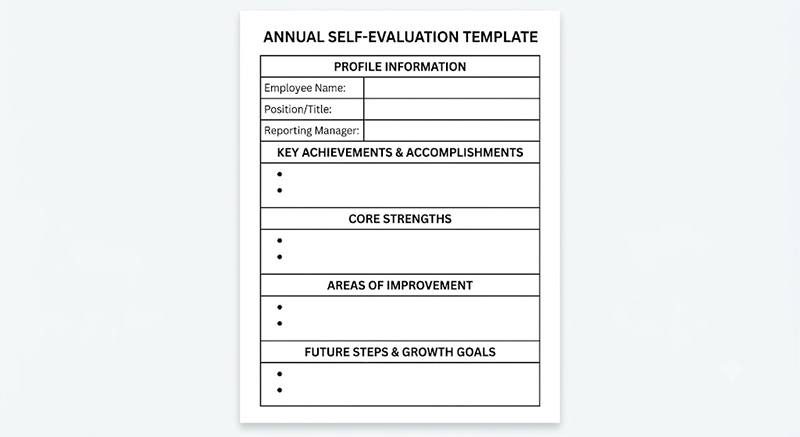
Following the right evaluation template is as important as writing the correct self-evaluation. Here’s a template you can follow:
Employee Name:
Date:
Position:
Manager:
Review:
1. Key Achievements and Accomplishments
- Include your significant accomplishments during the review period.
- How you completed the project and its outcome or impact
- Quantifiable results using numbers and figures, such as increased website traffic, higher engagement, etc.
Tip For Writing Accomplishments:
When writing outcomes, back them up with numbers or percentages. For example: “Managed social media and significantly increased engagement by 30%.
2. Strengths
- Highlight your skills and qualities that are your strengths and help you perform well.
- Mention how these skills and strengths helped you achieve success and how they contributed to the organisation’s growth.
- Showcase how your strengths can help in your career growth and how you will plan to upskill for the next review period.
Tip for Writing Strengths:
Back the strengths and skills with examples for more credibility and impact. For example: “My strong communication skills helped me collaborate effectively with cross-functional teams and complete the project ahead of time.”
3. Areas for Improvement
- Identify and mention the areas of improvement that are essential to grow professionally.
- Explain the challenges you faced during your review period.
- What steps you will take to improve, such as training, mentoring, or certification courses.
Tip for Writing Areas for Improvement:
Focus on presenting areas for improvement positively and constructively. Give a clear action plan of the steps you will take to improve.
4. Next Steps
- Highlight the goals for your next review period.
- Mention the new skills you plan to learn and the new responsibilities you’re willing to take on in the next period.
- How will you measure your growth over the next review period?
Tip for Writing Next Steps:
Give a clear action plan. Follow the SMART method (Specific, Measurable, Achievable, Relevant, and Time-Bound).
Common Mistakes to Avoid While Writing Self Evaluation Examples
Here are some common mistakes you must avoid while writing self assessment examples:
- What makes your self-evaluation credible and strong is how self-aware you are. Consider seeking constructive feedback from your manager, peers, or clients, and explain how you acted on it, while also highlighting the improvements or results.
- Do NOT add vague statements, like “I’m a good team player” or “I have excellent communication skills”.
Instead, back these statements with how these skills helped you achieve better outcomes, for example, “I adapted quickly to changing processes and technologies, helping improve efficiency and team management.”
- Avoid boasting or downplaying your contributions and achievements. The key is to maintain a professional tone and present your achievements confidently and support them with evidence, rather than personal opinions.
- Never compare yourself to others. It may reflect a sense of under-confidence or envy. Focus on evaluating yourself.
For example, instead of writing, “I didn’t contribute much this year”, write, “I successfully handled three client projects, delivered them on time, and received positive feedback.”
- Only highlighting your strengths can make your self-evaluation sound arrogant. Instead, present a balanced review by showcasing both strengths and weaknesses, and how you are planning to improve them.
Also Read: Work Ethics: Definition, Components, and Benefits
Wrapping Up!
To sum up, self-evaluation is a crucial step that helps highlight your achievements and accomplishments in an organisation, which might otherwise go unnoticed.
However, a strong self-evaluation balances your strengths and weaknesses, allowing you to present your accomplishments with constructive feedback, use examples to back them, and lay out a clear outline of future improvement. By following these self evaluation examples, you can create an impactful self evaluation. Begin by writing a self-evaluation sample essay to practice and master the self-evaluation process in your company.
Frequently Asked Questions (FAQs)
1. What not to say in a self-evaluation?
Ans: Exaggerated claims, downplaying or boasting your achievements, comparing yourself, blaming others, and negative statements about yourself should be avoided in a self-evaluation. Rather, it must focus on a balanced review of accomplishments and setbacks.
2. What is an example of a self-evaluation of teamwork?
Ans: For strength, you can write, “I collaborated with cross-functional teams and supported colleagues to ensure projects were completed ahead of time.” For weakness, you can mention, “I would like to contribute more effectively in teams by presenting my ideas more confidently.”
3. How do I write my self-performance evaluation?
Ans: Begin by creating a blueprint or writing a rough self-evaluation sample essay. Once finalised, ensure that you highlight your accomplishments, give a balanced review of weaknesses, and outline the future steps in a professional tone.
4. How long should a self-evaluation be?
Ans: Ideally, a self-evaluation should have approximately 400-800 words. However, it entirely depends on your company’s review format.
