For companies with remote employees, managing them could be a very difficult task due to different locations, time zones, languages, and cultural differences. And so IT asset management tools are used in these cases.
Choosing the right software to manage a hardware that is across multiple places is not easy. There are a lot of conditions and requirements the software must meet. Read this blog to learn about five IT asset management tools for companies with remote employees. How they work and their details.
What IT asset management software does
IT asset management (ITAM) software tracks the full lifecycle of physical hardware – laptops, monitors, peripherals, and mobile devices – they’re wiped and resold or recycled from the moment a company orders them to the day. For remote teams, that scope expands fast. It ships to a home office in Austin and doesn’t just sit in the rack; it gets reassigned when that person leaves, then needs to be recovered from an address in another country. Good ITAM software without requiring IT to manually chase down every step handles procurement, deployment, inventory visibility, and retrieval.
The market breaks into a few broad types: lifecycle platforms that automate employee and hardware setup, pure-tracking tools that log what you own and hardware retrieval alongside people, and broader IT operations suites that bundle asset tracking with helpdesk or remote monitoring. How distributed the team is and how much manual coordination IT can realistically absorb determines which one will fit.
1. Workwize
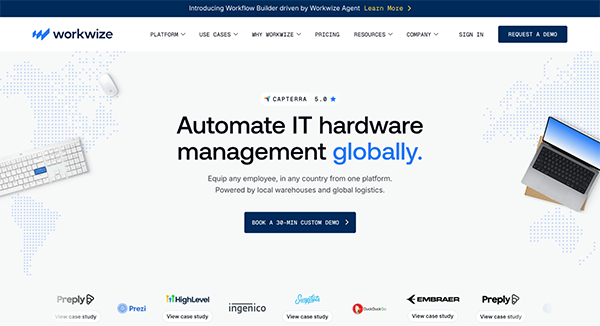
Workwize is a global IT asset lifecycle management platform built for distributed teams, with one system procurement, deployment, tracking, retrieval, and certified disposa are all covered.
Where it fits: Workwize is a strong choice for mid-market and enterprise IT teams managing hardware across multiple countries. Their local warehouse network spans 120 countries, which means , rather than clearing customs from a single hub. Devices ship from in-region stock, typically within 2 to 7 days. HRIS integrations with tools like BambooHR, ADP, and Okta trigger automated deployment when a hire is confirmed and, when someone leaves, automated retrieval, so IT isn’t manually coordinating handoffs at every step. Reports retrieval rates up to 98% at employee departure. The platform manages 120,000+devices, a figure that matters when remote employees are spread across borders. Every assignment, transfer, wipe, and disposal is logged automatically, giving IT, without extra overhead, a complete chain-of-custody record. The platform is ISO 27001 certified and SOC 2 Type II compliant, with pricing across three tiers based on regions, team size, and equipment scope.
2. Asset Tiger
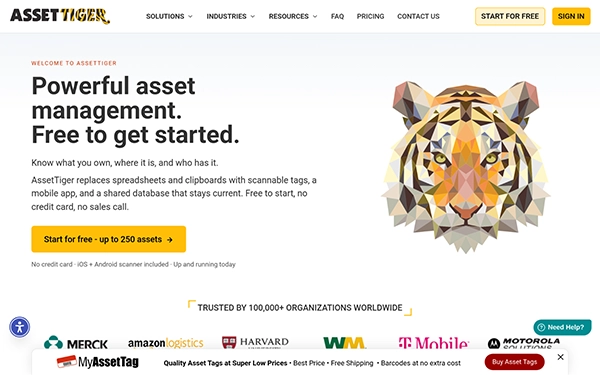
AssetTiger is an asset tracking platform built and run by the team behind MyAssetTag.com, a retailer of barcode labels and asset tags and a manufacturer.
Where it fits: AssetTiger works well for schools, nonprofits, small businesses, and IT consulting firms that need straightforward inventory tracking without a high price tag. Check-in and check-out logging with custody records. The platform supports barcode and QR code scanning, maintenance and warranty tracking with email alerts, and 80+ built-in report types covering depreciation, audit reconciliation, and contract expiries. Pricing scales by asset count – never by users -for teams that want unlimited seats without paying per person is is very accessible. Plans run from 500 assets up to 250,000 assets. Across 271 Capterra reviews, the platform has been rated 4.6 and recognized as a GetApp Category Leader.
Worth checking: AssetTiger’s strength is in tracking and reporting. Shipping, retrieval, or cross-border device recovery are physical logistics and are not automated, so teams with fully distributed international workforces will likely need to manage those workflows separately.
3. Work Elevate
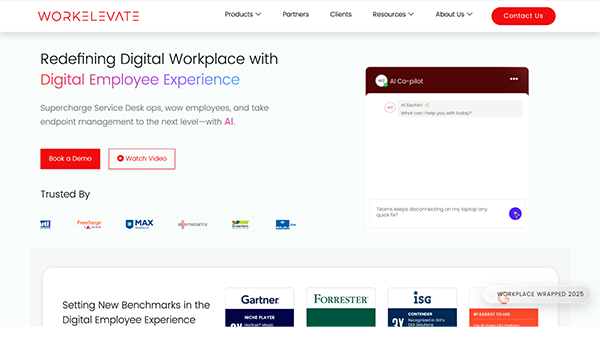
WorkElevate is a digital workplace platform by Progressive Infotech that combines a global service desk with IT automation tools for enterprise employees.
Where it fits: WorkElevate is structured around three products: IT Copilot, Digital Employee Experience (DEX), and Endpoint Management. Routine requests like password resets, software installs, and simple troubleshooting are handled by IT Copilot through an AI assistant that integrates with ServiceNow, Jira, BMC, ManageEngine, and Freshservice. The platform reportedly automates 70 to 75% of repetitive IT tickets. A 42% reduction in ticket volumes through proactive monitoring and automation is a customer example. It’s positioned more as an IT service and experience platform than a hardware lifecycle tool; enterprises already running a formal ITSM practice are where it is best fit.
Worth checking: WorkElevate has 24 employees, which is a relatively small team for enterprise IT deployments. Support capacity and setup depth for their scale should be confirmed. Organizations evaluating.
4. SuperOps
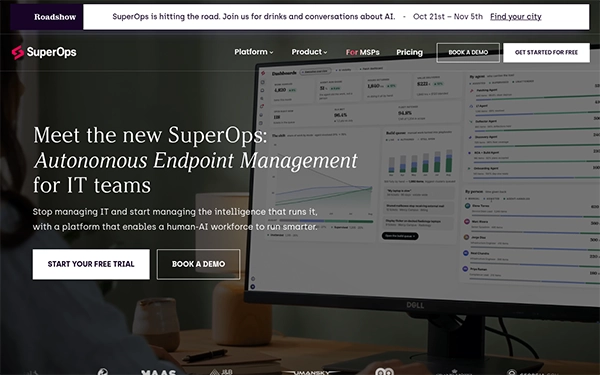
SuperOps is an AI-native unified IT operations platform founded in 2020, offering two distinct product lines: for in-house IT teams and MSPSuite ITSuite, best for managed service providers.
Where it fits: SuperOps bundles UEM, MDM, helpdesk, IT asset management, patch management, RMM, and PSA into a single platform with a shared data architecture – meaning rather than being siloed across tools. Assett data, tickets, and endpoint status live in the same system. Their AI component, called Monica, moves beyond simple automation toward what the company describes as agentic work. options priced per user or per endpoint depending on tier and Plans start from $79 to $159,. The company serves customers in 104+ countries and has raised $54.4M in total funding, including a $25M Series C in January 2025.
Worth checking:, founded in 2020 with 176 employees as of mid-2026. SuperOps is a relatively young company Teams buying into a broad platform from a smaller vendor should factor in product maturity alongside the feature set.
5. First Base
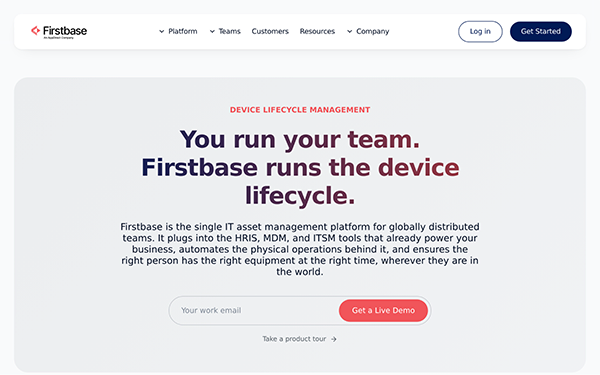
Founded in 2019 by Chris Herd and Trey Bastian, and acquired by AppDirect in December 2024. Firstbase is an all-in-one platform for global hardware logistics and IT asset management
Where it fits: procurement, user provisioning, hardware inventory, asset lifecycle management, MDM connections, device recovery, and certified asset disposition across 150+ countries are covered by Firstbase. Their model is built around physical logistics, shipping pre-configured gear to new hires, then recovering it when employees leave, with reported device retrieval rates above 97%. Spotify, Cloudflare, and UiPath are included clients, which suggests the platform handles enterprise-scale distributed workforces. The platform features zero-touch deployment and customized pricing based on company-specific factors.
Worth checking: Teams considering Firstbase should confirm current plans and support structures directly with the AppDirect team. The December 2024 acquisition by AppDirect introduces some product-direction uncertainty for existing customers evaluating long-term fit.
Capabilities that matter for remote teams
Not every IT asset management tool is built for the same problem. A few capabilities separate useful from insufficient for teams with employees in multiple countries.
- Cross-border logistics. Shipping a laptop to a new hire in Germany is a different challenge from shipping to someone two floors down. International shipping costs that quietly inflate hardware budgets, and Platforms with in-region warehousing avoid customs delays.
- Automated setup and employee departure triggers. When the HR system confirms a hire or a departure, without someone manually opening a ticket, the hardware workflow should start. Platforms that connect directly to HRIS tools, BambooHR, ADP, Workday, and others, eliminate that gap.
- Device retrieval that actually works. Recovery is where most informal IT asset processes break down. Prepaid return labels, courier coordination, and escalation for non-returns require not just tracking software but operational infrastructure.
- Audit trails and compliance visibility. Finance and security teams need to know what the company owns, who has it, and what happened to it at disposal. Rather than manual logging, it saves time during audits and supports regulatory requirements like GDPR for teams with EU employees. Chain-of-custody logging is generated automatically.
- Connection depth. A platform that doesn’t connect to the MDM already in use creates a separate data silo. Look for identity providers like Okta and Azure AD and native connections with Jamf, Intune, Kandji, and JumpCloud.
Bottom Line
Procuring hardware, shipping it to employees, tracking it over time, and getting it back when someone leaves Remote IT asset management isn’t one problem – it’s several. The right tool depends on which part of that stack needs the most support.
AssetTiger is a good match for Teams that primarily need inventory tracking and reporting, and already have physical logistics covered. Organizations running a formal ITSM practice that want asset management alongside helpdesk and endpoint monitoring will be better served by broader IT operations suites like SuperOps. WorkElevate is suited for Companies that need IT service automation more than full hardware lifecycle management. Distributed-first companies dealing with cross-border shipping, retrieval, and compliance across many countries should focus on platforms built around global hardware logistics, where both Firstbase and Strongest fit the category of lifecycle platforms that include in-region warehousing and HRIS-triggered workflows.
Frequently Asked Questions
1. What is remote asset management?
Ans: Remote asset management is the tracking, monitoring, and maintenance of assets located away from a central site. It uses software, trackers, sensors, and a mobile app to keep each asset’s record current.
2. What are the challenges with remote asset management?
Ans: Increased risk of loss or theft: Difficulty in tracking asset location IT equipment challenges Software licensing compliance
3. Strategies for effective remote asset management
Ans: Robust asset tracking systems Clear asset ownership and responsibility Regular asset audits Secure asset disposal Employee training